
MAN pilot project successfully completed
Platooning has potential in logistics
Journeyswith digitally networked trucks on German freeways are safe, technically reliable and can be used well in the day-to-day operations of a logistics company. These are the key findings of the world's first practical test with so-called truck platoons in real logistics operations, which the project partners presented today in Berlin.
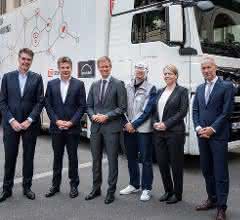
As part of the "EDDI" research project, which was funded by the Federal Ministry of Transport and Digital Infrastructure (BMVI), professional drivers spent seven months driving in two digitally connected vehicles on the Autobahn 9 between branches of the logistics company DB Schenker in Nuremberg and Munich. After around 35,000 test kilometers, the truck drivers, who drove only 15 to 21 meters apart, praised the driving comfort and the general feeling of safety. The practical test also demonstrated savings in fuel consumption.
The BMVI has funded the research project with around 1.86 million euros. The project partners DB Schenker, MAN Truck & Bus and Fresenius University of Applied Sciences have now presented the results on the premises of the BMVI. According to the partners, the use of truck platoons could ensure more efficient use of space on freeways, less congestion and greater road safety.
Andreas Scheuer, Federal Minister of Transport and Digital Infrastructure: "The mobility of the future is automated and connected. This also applies to logistics. That is why I am fully supporting the industry in bringing technologies such as platooning to market maturity. We want to make processes even safer, more efficient and more environmentally friendly - from the ramp to the customer. The driver has a key role to play here. In the digital truck, he becomes a modern logistics specialist. This gives the profession new prospects for the future!"
Doll: Platooning possible on 40 percent of kilometers in land transport
DB Schenker has determined that platooning can be used on a large scale in the logistics network. Alexander Doll, Member of the Management Board for Finance, Freight Transport and Logistics at Deutsche Bahn AG: "We have analyzed our European transport network and can specifically say that around 40 percent of the kilometers driven could be carried out in platoons." However, further tests and a corresponding regulatory framework are necessary for this. Customers would also benefit: "With platooning, we can offer even more reliable and efficient transportation."
The platooning system installed in the MAN trucks worked smoothly 98 percent of the time. The driver only had to actively intervene once every 2,000 kilometers - much less frequently than expected. The pilot operation also achieved a reduction in fuel consumption of around 3 to 4 percent, "We were able to show that platooning has the potential to make a contribution to reducing consumption and CO2 emissions. First and foremost, we are pleased that the system works reliably and can increase safety on the highway. Platooning is therefore an important step for us on the road to automation," says Joachim Drees, Chairman of the Executive Board of MAN Truck & Bus SE.
University: Drivers feel safe
Fresenius University of Applied Sciences investigated the psychosocial and neurophysiological effects on the drivers. The live experience brought about a significant change in the previously critical attitude of the drivers. "A general sense of safety and trust in the technology are reflected in the drivers' assessment of specific driving situations. None are described as uncontrollable," explains Prof. Dr. Sabine Hammer from the Institute for Complex Systems Research at Fresenius University of Applied Sciences. Vehicles from other road users cutting in or through were perceived as "unpleasant" but not critical. "Due to the system's fast reaction times, drivers today would therefore prefer a distance of just 10-15 meters," says Hammer.
"The EEG measurements show no systematic differences in the neurophysiological stress of the drivers between platooning and normal truck journeys, i.e. in terms of concentration or fatigue," says Prof. Dr. Christian Haas, Director of the Institute for Complex Systems Research. For international use, the scientists recommend further studies with longer platooning phases.
The cooperation partners are convinced that the potential of truck platooning can be increased even further through further developments. New digital business models in logistics are also conceivable as a result.


You might also be interested in
Emission-free heavy goods transport: Gruber Logistics, Iveco and AIT start practical test
As part of the Empower research project, a six-month test phase with a battery-electric, zero-emission truck prototype from Iveco for heavy commercial vehicles will start in mid-June 2026. In collaboration with Gruber Logistics, the prototype based...
 read more...
Automated trucks: live tests in Hamburg city traffic
As part of the EU MODI project, two successful practical tests on the automation of heavy goods traffic were carried out this spring - both in the inner city area of Hamburg and on the highway. The project partners tested two important use cases in...
read more...TST initiates depot charging network for e-trucks
The TST Group wants to usher in a new era of truck electrification with a cooperative-oriented depot charging network. TST is building an ecosystem for charging heavy commercial vehicles and delivery fleets that covers all relevant aspects: from...
read more...Daimler Truck celebrates the start of series production of the Mercedes-Benz eActros 600 for long-distance transport in Wörth
Karin Rådström, CEO of Daimler Truck, and Daniela Schmitt, Minister for Economic Affairs, Transport, Agriculture and Viticulture of Rhineland-Palatinate, give the go-ahead for series production of the new model.
read more...Emission-free e-truck for Siemens plant in Leipzig
Since the beginning of June, an e-truck has been transporting goods within a radius of 100 kilometers for Siemens Smart Infrastructure's Leipzig plant for low-voltage switchgear.
read more...400 autonomous heavy goods vehicles delivered to ZTO Express
Inceptio Technology, developer of autonomous driving technologies for heavy-duty trucks, has recently completed the delivery of 400 autonomous heavy-duty trucks equipped with Inceptio drives to the Chinese express service provider ZTO Express.
read more...Route planning for electric, hydrogen and...
"DRivE" project partners complete successful test phase
The "Production Engineering of E-Mobility Components" (PEM) chair at RWTH Aachen University has successfully completed the pilot phase of the "DRivE" research project together with partners. In a two-month field trial, software was tested that is...
read more...Twelve new electric trucks for the regular service business
Craiss Generation Logistik is investing in alternative drive systems: the logistics service provider is expanding its fleet with a total of twelve electric Mercedes trucks. In future, two eActros 300s will be on the road for the company in Austria...
read more...Noerpel Group tests hydrogen trucks
On July 25, Noerpel started the test phase with a hydrogen truck at the Heidenheim site. After two weeks, the Noerpel Group draws a positive interim conclusion about the 18-ton truck in terms of performance and driving characteristics, but remains...
read more...