
News from the CES electronics trade fair
Autonomous battery cells
Driverless, autonomous and electrically powered - this is how commercial vehicles should roll into the mobile future. The CES electronics trade fair in Las Vegas is serving these visions, says LT-manager author Oliver Willms.
Las Vegas, the city of dreams, illusions and disappointments - no American metropolis is better suited to the annual Consumer Electronics Show than the desert city in Nevada. As the world's largest consumer show for all things electronic, the CES offers an impressive range of products: The spectrum of visitor attractions ranges from microprocessor-controlled orange juice squeezers to hi-fi, TV, computer technology and autonomous trucks.
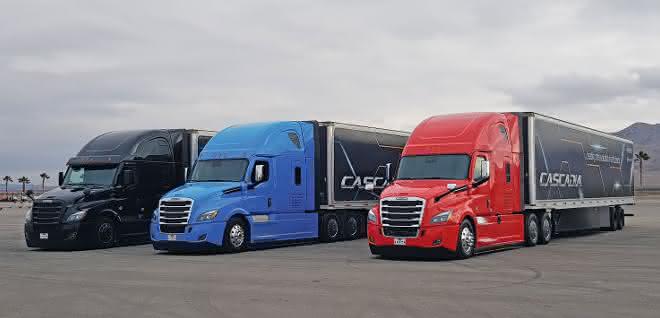
Numerous vehicle manufacturers have discovered CES for themselves in recent years in order to present the latest technologies such as autonomous driving, electromobility and almost limitless driving assistance worlds to the public. The 2019 edition of the electronics showcase is no exception - even if the number of new products and vehicle exhibitors seems to be on the decline. Daimler is the only major commercial vehicle manufacturer present. Not so much in the CES halls - where the Stuttgart-based company's passenger car colleagues play first fiddle - but at the gates of "Sin-City". There, the Group's US subsidiary Freightliner showed the direction the North American transport market is likely to take with the 2019 model year of its trucks. Electrification seems to be the top priority here. The spectrum of zero-emission vehicles with which market leader Freightliner intends to electrify the US transport industry in the near future ranges from 12-tonne trucks to full-blown Class 8 articulated lorries.
eCascadia comes with 1,000 hp
With the electrified eCascadia long-distance semitrailer tractor, the driver can rely on the drive power of a brilliant 750 kW, or over 1,000 hp. A 550 kWh battery pack with enough power for a range of up to 400 kilometers is used to store the electricity. According to the Freightliner project managers, this should be more than enough for special tasks such as picking up containers at the port and transferring them to the next major freight hub. Especially as the total weight of 36 tons is relatively manageable in most US states and does not demand full power from the energy storage system at all times.
At the wheel of the fully electrified eCascadia, you can always enjoy the full pulling power available right from the starting speed, even when fully loaded. With a quiet electric whirr, the articulated lorry arrows out of the starting position at sports car-like speeds and then purrs smoothly along the freeway at full speed. In some states in the USA, speeds of up to 85 miles or 137 km/h are legal - for cars as well as trucks. The high system performance of the electric Freightliner therefore makes perfect sense. To date, two eCascadia vehicles are undergoing customer trials, and the start of series production should not be too long in coming. It remains to be seen whether the zero-emission Freightliner has any real market opportunities, but it is a strong response to the unfulfilled announcements by Tesla and Nikola, who want to roll up the US market with a heavy-duty e-truck. The Freightliner eM2, on the other hand, has good to very good market prospects. The 12- to 15-ton truck can score bonus points as an emission-free transport solution in the megacities of the USA with its extremely powerful 270 kW. This electric truck is not a closed book for newcomers either. Simply accelerate or gently let go, and the eM2 recuperates the braking energy back into the 325 kWh battery cells. For zero-emission-limited California, this is the perfect solution for any distribution in the sprawling metropolitan areas. The medium-weight Freightliner is set to appear soon in the US manufacturer's series range. It's a shame that the electric vehicle initiatives in Europe seem to take a little while, while the US truck manufacturers get these vehicles up and running relatively quickly and easily.
Distance control: superior and sensitive
The vehicle developers have also lent a hand to the diesel versions of the Freightliner flagship. Now that the entire powertrain has been transformed from a motley crew of components into a purely Daimler - or in this case Detroit Diesel - affair, it was not too complicated to adapt the assistance systems introduced in Europe, such as distance radar, brake assist or lane guidance assistance, to the US hood.
Even at the high top speeds of well over 100 km/h, which apply equally to cars and trucks on US highways, the distance control works confidently and sensitively. The system differentiates with astonishing precision whether a car in front of the vehicle is slowing down considerably to become a safety-relevant obstacle, or whether the lane changer is moving away from the hood nose at the same speed. Autonomous driving is booming in the USA, not only in passenger cars but also in freight transport. Particularly here, where the flow of traffic outside the major conurbations tends to be clear and calm, a semi-autonomous vehicle can prove its worth. Less traffic and often miles of straight roads on the interstates play into the hands of electronic driving aids.
As a Level 2 pre-series vehicle, the semi-autonomous Cascadia can also impress with precise lane guidance on the often quite desolate road surfaces of American freeways. However, just as with the semi-autonomous Actros presented at last year's IAA, a driver's hand must remain "perceptibly" on the steering wheel for the system during autonomous driving, so that the driver is permanently available for emergency operations. In a fully equipped long-distance version of the Cascadia, it would be too tempting to take a quick step into the cabin to operate the microwave, fridge or on-board TV.
Effective fine-tuning of the amazingly aerodynamic shape of a rounded hood vehicle should also help the 2019 Cascadia to use fuel as economically as possible. This is because optimum aerodynamics play an exponentially increasing role in the higher driving speeds in American long-distance transportation. Wind deflectors on the A-pillar, on the side flaps and on the roof spoiler above the mighty cabin are designed to further improve the air flow around the trailer. The body gaps on the hood and fenders were sealed with plastic strips to allow the air flow to glide undisturbed over the attractive Hauber look.
Various aero packages
With the optionally available "Aero Package", playing with the wind goes even further. Elastic rubber lips on the side trim panels seal off the underbody from unwanted airflow even on the last few centimetres to the road. The "Aerox package" pulls out all the stops: an elastic front apron under the bumper, extended roof and side deflectors, wheel covers, wheel arch sealing strips at the front and air deflectors between the two drive axles make the Cascadia a real air number with a fuel-saving guarantee. A special highlight: from 45 miles per hour, the chassis is lowered several centimeters towards the road to work particularly efficiently against the airstream.
Most of the exhibits in the exhibition halls of the CES are probably still a long way from the production maturity that Freightliner showed at the Las Vegas Speedway just outside the gates of the gambling city. However, the closeness to reality has changed from exalted technical fantasies in the early automotive years of CES to a relatively similar technical structure. Autonomous vehicles and e-drives are the driving forces behind these technical outlooks, with lots of computer technology as well as radar, lidar, video and sensor technology.
In recent years, ZF has transformed itself from a supplier to one of the leading system manufacturers. Together with computer experts Nvidia, the Friedrichshafen-based futurologists are working on ever more powerful computers to send the transportation vehicles of the future safely and reliably over the roads. ZF's latest supercomputer is called "ZF ProAI Robothink" and its name already promises who will one day have the automated hand on the wheel. The peripherals such as radar, lidar, acoustic and camera sensors are also supplied by Zahnradfabrik Friedrichshafen. Friedrichshafen is rightly proud of this. ZF gave a preview of this last year at its Technology Days (LTM reported). Electrified minibuses, so-called people movers, and their van derivatives are set to roll through cities without drivers in the foreseeable future. The basic shape is the same in almost all development projects: a cubist passenger or freight housing with wheel hub-driven axles at the outermost end of the compact vehicle. ZF has teamed up with the Aaachen-based electric vehicle newcomer e.Go. Practical tests in Friedrichshafen and Aachen are due to start this year.
System supplier Continental's contribution to the topic of autonomously driving electric vans is called CUBE, which stands for Continental Urban Mobility Experience. It is also intended to take over driverless delivery traffic in cities beyond the last mile. Delivery robots on board will take the small parcels over the last few meters directly to the customer or to the drop-off point. The system can also be easily converted for passenger transportation - a multifunctional solution for the urban traffic of tomorrow. As the third major component manufacturer, Bosch will also be showcasing its contribution to this topic, which goes beyond normal transportation to make the traffic of the future even more intelligent with a variety of networked services. The broad spectrum of innovations that Bosch has packed into its study ranges from integrated services for passengers to a vehicle computer that autonomously searches for a charging station.
Valeo makes the trailer virtually transparent
The Daimler Urbanetic study, which will one day transport both people and parcels through the city, is also designed for dual use. Cab or van is a decision that can be made within a few minutes thanks to the modular design. In keeping with the fictitious setting in the big make-believe world of Las Vegas, the Urbanetic, which made its debut at the IAA 2018, was even allowed to complete a few passenger transport journeys on the Strip at night.
French supplier Valeo also took part in the show and drove around the track with its latest autonomous vehicle. The company's highlight: using relatively simple camera technology, a trailer can be made virtually transparent in the digitized rear-view mirror. The driver then looks in the mirror not at a bulkhead, but at the camera image that is recorded behind the trailer. A practical solution that could certainly also be used in vans. By contrast, the driving demo at components multinational Schaeffler was more modest. A maximum speed of 25 km/h is envisaged for the four-wheel vehicle with combined pedal and electric drive, which has been named Biohybrid. As a passenger transporter or cargo variant, the very compact bicycle-car hybrid is set to be launched on the market as early as 2020. However, which drivers and passengers will want to put up with such an airy vehicle in the bad weather seasons remains one of the big questions of practicality, which was also asked many times at this CES.
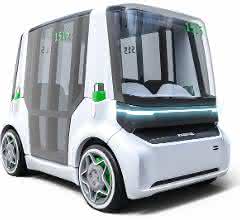
The new Schaeffler Mover is more plausible. The digitally controlled small car with electric drive has TÜV and road approval. However, you can trust the steering wheel-free driving. If one of the controls fails, there are two fuses to guarantee absolute reliability. With GPS, cameras, radar and other sensors, "Space Drive" already provides the basis for level 4 and 5 autonomous driving - fully automated and driverless. Once again, CES is looking to the near future of the transportation industry: perfect and precise - but without personnel.
Platooning - no thanks!
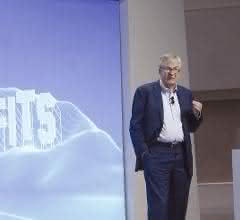
Daimler commercial vehicle boss Martin Daum put a spectacular end to the platooning project at the CES. Extensive tests in the USA, which is particularly suitable for electronically controlled small convoy driving due to the vastness of the routes and the topographical suitability, had shown that platooning could not achieve enough savings potential. "We no longer see this as a sensible option," said Daum, explaining the decision. Even under optimal conditions, the savings would not have turned out as desired. "Sooner or later, our market competitors will come to the same conclusion!" Martin Daum is certain. Consequently, according to the top commercial vehicle manager in Las Vegas, all projects that have been started will be terminated once the commitments made have been fulfilled and the company will concentrate fully on autonomous trucks. The aim is to skip the semi-autonomous Level 3 stage and immediately move on to Level 4 self-driving trucks without driver intervention. The 500 million euro investment should be ready for series production within the next decade.
About the author:
Expert and specialist journalist Oliver Willms has been writing about the commercial vehicle sector for LT-manager since 2010.


You might also be interested in
Winner material flow PRODUCTS OF THE YEAR 2023
Conductix-Wampfler: ChargeLine 0865
Two-pole conductor rail segments for efficient opportunity charging of shuttles, suitable for thousands of cycles per day.
 read more...
Hermann Grewer celebrates his 80th birthday
Hermann Grewer, Honorary Chairman of the North Rhine-Westphalia Transport and Logistics Association (VVWL) and Honorary President of the German Road Haulage, Logistics and Disposal Association (BGL), celebrated his 80th birthday on June 6.
read more...Well chilled for sure
V-Zug Kühltechnik AG, developer and manufacturer of refrigeration appliances and part of the successful V-Zug Group, has set up a new production facility for refrigerators of all heights and dimensions at its Swiss site in Sulgen.
read more...Advantageous automation of small parts warehouses
The RSX1 shuttle system will be at the center of Rocketsolution's presence at this year's Logimat trade fair.
read more...Reduced energy requirements in the high-bay warehouse
One of Germany's leading premium car manufacturers is already focusing on energy efficiency in the production of its new SUV model with electric drive. The storage and retrieval machines in a high-bay warehouse at the production site have been...
read more...Low lift pallet truck for light duty applications
Clark has launched a new low lift pallet truck with the model designation LWio15 for light transport tasks. The truck has a load capacity of 1500 kg and is suitable for short distances in goods distribution, production or warehousing.
read more...Internationalization as an opportunity
E-commerce is in a state of flux. Changes in purchasing behavior and procurement problems are keeping e-commerce retailers busy. Logistics plays a decisive role in the overall online shopping experience.
read more...Fulfillment Center for Frisco.pl
Polish eGrocery specialist and TGW deepen partnership
TGW is building a highly automated fulfillment center for Frisco.pl in the Polish capital Warsaw. This is the second project in a row that the two companies have implemented together.
read more...Which world will it be in 2023?
Michael Schreckenberg teaches at the University of Duisburg-Essen as Professor of Physics of Transport and Traffic. Once a year, he addresses the readers of materialfluss, formerly LT-manager, with a critical and humorous expert article on transport...
read more...