
From LT-manager 5/2019
Metabolic program
Hydrogen drives are the hot topic of the year. Do they offer a real alternative to diesel or purely electric battery drives?
Hydrogen - is this the stuff of dreams for future generations of transportation? You would almost believe it as you walk around the stands at the leading US transportation trade fair in Atlanta in late autumn. Numerous domestic truck manufacturers have a hydrogen drive arrow in their quiver. First and foremost, of course, is Nikola - the start-up company that is causing quite a stir in the US truck market with its futuristic vehicle design, alternative electric drive and, above all, a talent for raising crowdfunding money. For the first time, however, the Nikola truck of the future was no longer the only eye-catcher when it comes to embedding the hydrogen drive as attractively as possible in a truck concept.
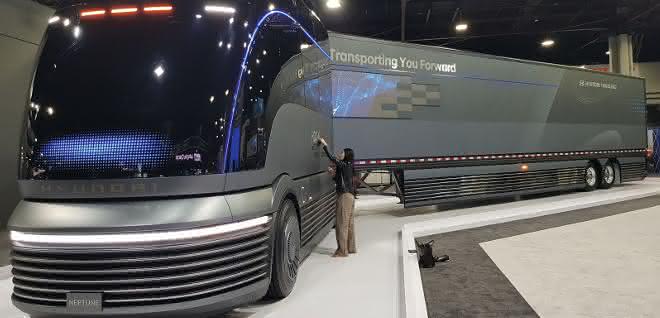
Hyundai made a big splash in Atlanta. The South Korean industrial giant has been offering fuel cell cars for some time now and has now made a big PR move in the USA. The result of Asian research goes by the project name HDC 6 Neptune and easily outshines all alternative drive concepts at the US trade fair.
Hyundai shows high-tech at its best
The articulated lorry, designed entirely in the style of the mighty Streamline steam locomotives from the American pre-war era, boasts the finest in high-tech. The designers from the Far East have opted for new technology under the aerodynamically refined hood and in the "personal studio" of the driver's cab.
Inspired by the start of series production of the first heavy-duty hydrogen-powered Hyundai Xcient Fuel Cell Truck, the Koreans have pulled out all the stops with the trade fair star Neptune. The fuel cell-powered Neptune transports its hydrogen supply on the rear wall of the cab in twelve high-pressure tanks filled to 350 bar. According to commercial vehicle design manager Hak Soo Ha, tanks with a working pressure of 700 bar are also available as an option to extend the non-stop range. However, this requires cooled refueling, which is more complex than the current rapid refueling. Additional tanks in the refrigerated trailer, which is closely coupled to the tractor unit, make even longer trips without refueling stops possible.
Trade fair star Neptune to go into series production in 2030
The futuristic exterior design in art deco style was created by Belgian Hyundai star designer Luc Donckerwolke and, of course, the Neptune also has very pragmatic reasons. The cooling fin grille running underneath the cab floor around the tractor unit is intended to dissipate the large amount of waste heat from the fuel cell drive into the environment. After all, a fuel cell drive requires around two and a half times the cooling capacity of a normal diesel drive. The cabin, which is accessible via sliding doors on the rear side panels, resembles a futuristic single household. The cockpit is projected onto a frame surrounding the windshield, on which the vehicle tour or entertainment data is displayed. In fully autonomous driving mode, the glass front acts as a huge screen, while the driver can cook, shower, do office work or go to the toilet in the rolling apartment.
Afterwards, the super king-size pull-out bunk bed under the glass cab roof invites you to take a well-earned rest - brave new trucker's world. Hyundai commercial vehicle boss Edward Lee is already looking for partners to set up a hydrogen supply network in the USA: "We are ready to work with other partners to pave the way for the expansion of a hydrogen supply system." According to its ingenious fathers, however, the Neptune should not be ready for series production on the highways before 2030. The Koreans in Atlanta did not want to reveal how much horsepower and what range the Neptune will have in a decade's time. However, with sales of half a million hydrogen-powered commercial vehicles, the plans are already quite ambitious.
The trailer also relies on gas: with cryogenic nitrogen technology on board, the Hyundai Translead trailer stays cold, the fresh goods are protected from oxidation and the environment is a little cleaner than with conventional refrigeration units.
Ideas for the future from Kenworth
In a much more civilian package, hydrogen is also inspiring Kenworth's ideas for the future. The traditional North American manufacturer is showing its zero-emission experimental truck, with which the Paccar subsidiary Kenworth and the Japanese car giant Toyota are testing the topic of fuel cells in trucks. The company sees a realistic application for the 560 hp six-by-four with a range of almost 500 kilometers in extended distribution operations in large urban areas or in container handling at port terminals.
The US engine manufacturer Cummins is taking advantage of the hydrogen opportunity and is showing an installable fuel cell unit that is also to be used in heavy-duty distribution transport.
The enthusiasm for the new hydrogen-powered drive concept has also spilled over into Europe - at least in part. Iveco, the company that has found a genuine drive alternative with natural gas drive, preferably in cryogenic LNG form, is getting into bed with Nikola. The first jointly produced hydrogen vehicle is to be launched on the market as early as 2022. The new Iveco S-Way will provide the basic truck structure, while Nikola will contribute the hydrogen drive. The result is a modern truck that can also boast high-tech components on the inside, such as a digital dashboard with touchscreen operation.
First fuel cell trucks on the road in Switzerland
Iveco CEO Gerrit Marx enthuses about the benefits of hydrogen-electric drive systems: "Fuel cell technology will be the future!" Hydrogen complements the natural gas infrastructure network, which still needs to be expanded, and is CO2-neutral as "green hydrogen". And that is one of the key aspects of hydrogen production. The Swiss company Hydrospider, a cooperation between the Swiss hydrogen initiative H2 energy, the energy supplier Alpiq and the German company Linde, is also relying on this calculation. At the turn of 2020, what the German vehicle industry has been talking about for over forty years will become a reality in Switzerland thanks to the dedicated cooperation between a hydrogen initiative and the South Korean industrial group Hyundai. The first of 50 Hyundai heavy-duty trucks planned for this year will roll out onto Swiss roads with whisper-quiet fuel cell engines and "zero emissions".
Rolf Huber tinkers with emission-free drive systems
The driving force behind the promising entry into the commercial use of fuel cell technology in trucks is Rolf Huber. As CEO of the company H2 energy, the former management consultant has been working on various approaches to zero-emission drive systems for a good ten years. As part of his research into the practical introduction of a hydrogen-powered commercial vehicle, Huber, who has a degree in engineering, says he has consulted up to twenty well-known commercial vehicle manufacturers without being able to bring any useful results back to Switzerland. The hydrogen fan was not only interested in the hardware. In his search for the right concept, Huber not only had the vehicle in mind, but also the production of hydrogen. After all, as the committed Swiss reports, 98 percent of all hydrogen is currently produced using fossil fuels: Burning gas, coal or oil produces water vapor, which generates electricity, which in turn is used to electrolyze the water and separate the hydrogen from the oxygen. The resulting large loss of efficiency is therefore a "shot in the arm" for sustainability. Only if hydrogen is produced as a waste product using surplus energy from wind, solar or hydropower does the ecological calculation work out.
Food retailer Coop is part of the H2 party
After the Swiss food retailer Coop signaled its interest in purchasing at least a thousand zero-emission trucks, Huber succeeded in bundling its interests in green hydrogen production and the manufacture of a commercial vehicle suitable for this purpose. Coop is the first major customer on the list of the newly founded joint venture, with a purchase requirement of up to 1,600 heavy trucks by 2025. Coop's group management has been working for years to switch to emission-free operation of its stores and warehouses. According to Rolf Huber, they are only "moderately satisfied" with the battery-powered trucks that have been used on a trial basis so far. Above all, the comparatively long recharging time and the lack of a trailer on the drive side for store deliveries would literally mess up the delivery tour for the food distributor.
In addition, Huber is certain that the battery storage would be permanently damaged by the fast charging processes between the individual delivery tours, thus limiting the total operating time of the vehicle. Compared to an electric truck on offer today, the energy consumption of the H2 truck actually takes no longer than the refueling process for a gas-powered truck: attach the tank nozzle and wait for the automatic filling of the high-pressure tank, done. The system weight of the hydrogen drive is significantly lower than that of a battery-electric drive due to the elimination of heavy electricity storage units, which directly benefits the payload.
Range is decisive for users
Perhaps the most important argument for potential customers is the practical range. The 190 kilowatt (around 260 hp) hydrogen drive from two coupled fuel cells enables the use of a 19-ton two-axle vehicle with the occasional trailer - in other words, the classic application profile in heavy-duty distribution transport. In the short term, fuel cell power and energy from the storage battery can be used to mobilize a boost output of up to 460 hp. With a tank capacity of 35 kilos of hydrogen in seven high-pressure tanks, the 34-tonne train has a range of up to 400 kilometers. The fuel cell also supplies the energy for cooling the transport compartment, operating a tail lift and, of course, air conditioning the driver's cab.
"Green hydrogen" to be available soon
A plus point for the hydrogen drive: if the need for range or consumed energy for auxiliary units should actually be greater, the installation of additional hydrogen storage tanks is not a major act compared to upgrading a battery-electric truck. From Hydrospider's point of view, everything speaks for the use of environmentally friendly technology in heavy-duty distribution transport. The new Hyundai H2-Xcient heavy-duty truck rolls off the production line at the Jeonju truck production plant in South Korea with sophisticated technology and is to be offered to customers by Hydrospider with a "pay per use" rental concept, i.e. full cost coverage for fuel, maintenance, service and insurance. The primary focus is on a full-size 19-tonne truck and later also on three-axle 26-tonne trucks, which can move up to 34 tons of total weight when carrying a trailer - no electrically powered Euro truck can currently shoulder that much over longer distances.
What is decisive for the eco-balance of the new drive: the newly founded Hydrospider Aktiengesellschaft is also responsible for providing the "green hydrogen", which will initially be available at ten filling stations next year. To this end, a newly built electrolysis plant will be running at the Gösgen hydroelectric power plant on the Aare Canal, which is over a hundred years old, from the turn of the year. With a continuous output of two megawatts, around 300 tons of hydrogen will be produced there without the use of fossil fuels. For the time being, this supply will be sufficient to run around fifty trucks. Over the coming years, the production of "green" hydrogen is to be gradually ramped up.
Hydrogen truck still expensive at present
The operating costs alone are not enough to finance the hydrogen truck, which is more expensive than a conventional diesel truck. Hydrogen fuel currently costs around three times as much as a comparable amount of diesel. Furthermore, Switzerland does not subsidize alternative fuels. For a 34-tonne truck with an annual mileage of around 80,000 kilometers, the elimination of the LSVA (performance-related heavy vehicle tax) alone is expected to contribute to amortization with savings of around 65,000 Swiss francs (around 60,000 euros). With the increase in the number of users, the number of vehicles used and the resulting expansion of the filling station network, economies of scale should result in the medium term, which will finally establish the environmentally friendly hydrogen drive as an economically competitive alternative to diesel.
The reward for the South Korean-Swiss initiative was not long in coming. Last November, Hyundai and Hydrospider were able to win the coveted "Truck Innovation Award" from the international "Truck of the Year" jury for their transport concept against a strong phalanx of electric vehicle competitors. Who will ultimately come out on top in the transport market - the dynamos like Hyundai, Nikola and Iveco, the pragmatists with built-in solutions like Kenworth or Cummins, or even the hydrogen refuseniks in the European truck scene - is, of course, not yet clear. Until then, the motto can only be: "Hydrogen march!"
About the author:
Expert and specialist journalist Oliver Willms has been writing about the commercial vehicle sector for LT-manager since 2010.


You might also be interested in
Winner material flow PRODUCTS OF THE YEAR 2023
Conductix-Wampfler: ChargeLine 0865
Two-pole conductor rail segments for efficient opportunity charging of shuttles, suitable for thousands of cycles per day.
 read more...
Hermann Grewer celebrates his 80th birthday
Hermann Grewer, Honorary Chairman of the North Rhine-Westphalia Transport and Logistics Association (VVWL) and Honorary President of the German Road Haulage, Logistics and Disposal Association (BGL), celebrated his 80th birthday on June 6.
read more...Well chilled for sure
V-Zug Kühltechnik AG, developer and manufacturer of refrigeration appliances and part of the successful V-Zug Group, has set up a new production facility for refrigerators of all heights and dimensions at its Swiss site in Sulgen.
read more...Advantageous automation of small parts warehouses
The RSX1 shuttle system will be at the center of Rocketsolution's presence at this year's Logimat trade fair.
read more...Reduced energy requirements in the high-bay warehouse
One of Germany's leading premium car manufacturers is already focusing on energy efficiency in the production of its new SUV model with electric drive. The storage and retrieval machines in a high-bay warehouse at the production site have been...
read more...Low lift pallet truck for light duty applications
Clark has launched a new low lift pallet truck with the model designation LWio15 for light transport tasks. The truck has a load capacity of 1500 kg and is suitable for short distances in goods distribution, production or warehousing.
read more...Internationalization as an opportunity
E-commerce is in a state of flux. Changes in purchasing behavior and procurement problems are keeping e-commerce retailers busy. Logistics plays a decisive role in the overall online shopping experience.
read more...Fulfillment Center for Frisco.pl
Polish eGrocery specialist and TGW deepen partnership
TGW is building a highly automated fulfillment center for Frisco.pl in the Polish capital Warsaw. This is the second project in a row that the two companies have implemented together.
read more...Which world will it be in 2023?
Michael Schreckenberg teaches at the University of Duisburg-Essen as Professor of Physics of Transport and Traffic. Once a year, he addresses the readers of materialfluss, formerly LT-manager, with a critical and humorous expert article on transport...
read more...