Up to 120 trucks can be refueled daily
New LNG filling station in Rostock
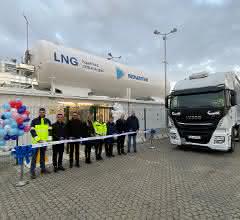
The natural gas producer Novatek has opened an LNG filling station in Rostock. It will be operated by liquefied natural gas distributor BarMalGas in future. The space-saving compact facility can refuel up to 120 trucks a day with LNG and will be operated by the liquefied gas distributor BarMalGas. The project was successfully completed under the supervision and management of the Zukunft Erdgas industry initiative after a ten-month planning, approval and construction phase.
Liquefied natural gas (LNG) is becoming increasingly popular as a low-emission fuel alternative among hauliers and truck fleet operators, as figures from the Federal Ministry of Transport show. According to the ministry, LNG has so far been the drive type most in demand as part of the incentive program for energy-efficient trucks. Trucks powered by LNG emit virtually no particulate matter, hardly any nitrogen oxides and up to 25 percent less carbon dioxide than diesel trucks. With bio-LNG in the tank, they are even virtually climate-neutral. LNG trucks are also half as loud as their diesel counterparts, which is particularly advantageous for night-time city driving.
The LNG filling station network is already well developed with over 200 filling stations along the main European transport routes. There are currently just under a dozen LNG filling stations in Germany. The new filling station in Rostock is a compact facility from Noordtec. The facility is characterized by an innovative design that saves space and costs, as the storage tank is placed directly on the technical container, unlike in conventional facilities. From now on, up to 120 trucks per day can be refueled with LNG in Rostock. Further filling stations at transport hubs in Germany are already being planned.
Dr. Timm Kehler, CEO of Zukunft Erdgas, says: "The new filling station in Rostock is another milestone on the way to a nationwide LNG filling station network in Germany and Europe. Liquefied natural gas is currently the only available alternative for heavy goods transport. The current trend towards LNG propulsion is therefore likely to increase further in the coming years. We expect new registrations in Germany to be in the five-digit range by 2030."


You might also be interested in
Winner material flow PRODUCTS OF THE YEAR 2023
Conductix-Wampfler: ChargeLine 0865
Two-pole conductor rail segments for efficient opportunity charging of shuttles, suitable for thousands of cycles per day.
 read more...
Hermann Grewer celebrates his 80th birthday
Hermann Grewer, Honorary Chairman of the North Rhine-Westphalia Transport and Logistics Association (VVWL) and Honorary President of the German Road Haulage, Logistics and Disposal Association (BGL), celebrated his 80th birthday on June 6.
read more...Well chilled for sure
V-Zug Kühltechnik AG, developer and manufacturer of refrigeration appliances and part of the successful V-Zug Group, has set up a new production facility for refrigerators of all heights and dimensions at its Swiss site in Sulgen.
read more...Advantageous automation of small parts warehouses
The RSX1 shuttle system will be at the center of Rocketsolution's presence at this year's Logimat trade fair.
read more...Reduced energy requirements in the high-bay warehouse
One of Germany's leading premium car manufacturers is already focusing on energy efficiency in the production of its new SUV model with electric drive. The storage and retrieval machines in a high-bay warehouse at the production site have been...
read more...Low lift pallet truck for light duty applications
Clark has launched a new low lift pallet truck with the model designation LWio15 for light transport tasks. The truck has a load capacity of 1500 kg and is suitable for short distances in goods distribution, production or warehousing.
read more...Internationalization as an opportunity
E-commerce is in a state of flux. Changes in purchasing behavior and procurement problems are keeping e-commerce retailers busy. Logistics plays a decisive role in the overall online shopping experience.
read more...Fulfillment Center for Frisco.pl
Polish eGrocery specialist and TGW deepen partnership
TGW is building a highly automated fulfillment center for Frisco.pl in the Polish capital Warsaw. This is the second project in a row that the two companies have implemented together.
read more...Which world will it be in 2023?
Michael Schreckenberg teaches at the University of Duisburg-Essen as Professor of Physics of Transport and Traffic. Once a year, he addresses the readers of materialfluss, formerly LT-manager, with a critical and humorous expert article on transport...
read more...