
A clear statement
Iveco also relies on rail loading
Aware of the load limits of the road, Iveco therefore also relies on rail loading. Trucks account for just over 70 percent of freight transportation in Germany - and the trend is still rising. This means that the load limit of the road has at least been reached, and in many cases exceeded. Expensive and environmentally damaging traffic jams are the result. In order to reduce CO2 pollution in plant traffic by at least 20 percent by 2024, the Daily series, for example, is now being transported by rail from the Suzzara plant to a new distribution center in Rheine. Two trains, each with 1 Iveco Daily on board, travel through Europe within 24 hours. If additional capacity is required, a third weekly train will be added to the timetable. Iveco is thus making a significant contribution to environmental protection and CO2 reduction. This is because the CO2 avoidance potential of rail transport on the main route is 2,100 tons per year.
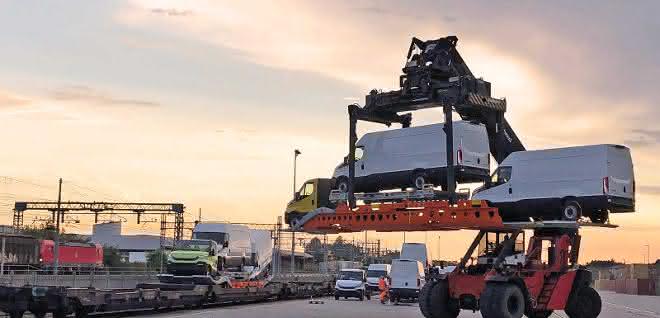
Combined transport: joint climate and environmental protection
Rail-affiliated associations complain that the recent decision to continue the toll exemption for electric and CNG/LNG cars would weaken environmentally friendly rail transport. This overlooks the fact that the railroads are not designed for just-in-time transport and small-scale logistics. Just as trucks would be left behind in mass transportation on fixed routes. Saying yes to CNG/LNG will not take anything away from the railroads, but will only make the truck's share of the transport volume cleaner. The advantages of rail and road must go hand in hand in future. Rail has the advantage on the main routes and the flexibility of trucks in the pre- and onward carriage. On routes that cannot be served by rail and where freight transport is defined by long distances, challenging topography and high weights, only the gas drive currently comes into its own. Iveco has not only launched the LNG drive on the market to realize accepted ranges of up to 1,600 kilometers, but has also decisively pushed the development of the necessary infrastructure. The next step will be the electrification of heavy-duty trucks and, building on this, the fuel cell.
Less emissions and noise with the right vehicles
Iveco has been working for years to reduce the environmental impact of logistics - which includes not only exhaust fumes but also noise. The need for clean air and quiet in densely populated cities is particularly great. For local public transport, Iveco therefore has electric buses from the HEULIEZ line or buses with hybrid drives such as the Iveco Urbanway in its portfolio. A gas engine is not only much quieter in operation, but also more environmentally friendly than a comparable diesel engine. The Iveco S-Way NP, for example, scores highly in the heavy-duty sector and the Iveco Daily Blue Power in distribution transport.


You might also be interested in
Winner material flow PRODUCTS OF THE YEAR 2023
Conductix-Wampfler: ChargeLine 0865
Two-pole conductor rail segments for efficient opportunity charging of shuttles, suitable for thousands of cycles per day.
 read more...
Hermann Grewer celebrates his 80th birthday
Hermann Grewer, Honorary Chairman of the North Rhine-Westphalia Transport and Logistics Association (VVWL) and Honorary President of the German Road Haulage, Logistics and Disposal Association (BGL), celebrated his 80th birthday on June 6.
read more...Well chilled for sure
V-Zug Kühltechnik AG, developer and manufacturer of refrigeration appliances and part of the successful V-Zug Group, has set up a new production facility for refrigerators of all heights and dimensions at its Swiss site in Sulgen.
read more...Advantageous automation of small parts warehouses
The RSX1 shuttle system will be at the center of Rocketsolution's presence at this year's Logimat trade fair.
read more...Reduced energy requirements in the high-bay warehouse
One of Germany's leading premium car manufacturers is already focusing on energy efficiency in the production of its new SUV model with electric drive. The storage and retrieval machines in a high-bay warehouse at the production site have been...
read more...Low lift pallet truck for light duty applications
Clark has launched a new low lift pallet truck with the model designation LWio15 for light transport tasks. The truck has a load capacity of 1500 kg and is suitable for short distances in goods distribution, production or warehousing.
read more...Internationalization as an opportunity
E-commerce is in a state of flux. Changes in purchasing behavior and procurement problems are keeping e-commerce retailers busy. Logistics plays a decisive role in the overall online shopping experience.
read more...Fulfillment Center for Frisco.pl
Polish eGrocery specialist and TGW deepen partnership
TGW is building a highly automated fulfillment center for Frisco.pl in the Polish capital Warsaw. This is the second project in a row that the two companies have implemented together.
read more...Which world will it be in 2023?
Michael Schreckenberg teaches at the University of Duisburg-Essen as Professor of Physics of Transport and Traffic. Once a year, he addresses the readers of materialfluss, formerly LT-manager, with a critical and humorous expert article on transport...
read more...