
Production processes at Eisen Schmitt
Stopa WMS 4.0 as a central communication point
By investing in a Stopa Compact II sheet metal storage system for aluminum sheets, steel wholesaler Eisen Schmitt has significantly accelerated the production processes at its St. Ingbert plant. The automated storage system is equipped with the Stopa WMS 4.0, which communicates with the higher-level ERP system and the sawing systems to be supplied.
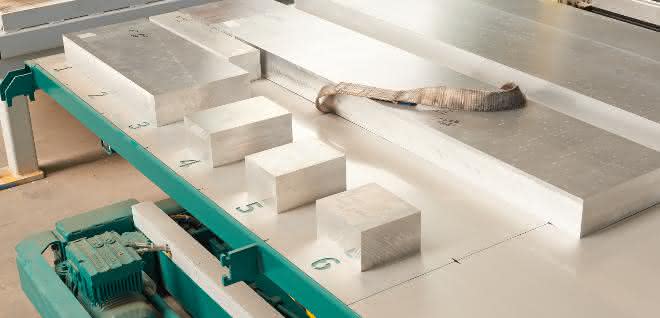
Alois Schmitt GmbH & Co KG (Eisen Schmitt) stores and processes aluminum sheets in St. Ingbert. The automatic Stopa Compact II sheet metal storage system forms the basis for storage. Stopa Anlagenbau GmbH, Achern-Gamshurst, has developed interfaces to ensure efficient communication between the Stopa WMS 4.0 warehouse management software, the operator's ERP system and the cutting optimization software (VOS) of the sawing systems. As the data from the transport orders generated by the WMS is automatically transferred to the saws via the interfaces, there is no need for manual input and the error rate is reduced.
Eisen Schmitt books incoming goods in its ERP system, which forwards the information to the Stopa WMS 4.0. The WMS generates the putaway orders and initiates the provision of empty pallets. The warehouse operator loads the raw material at the goods-in station onto the load carrier selected by the WMS, exactly according to the coordinates specified by the software, into which the pallet is divided.
Customer orders are assigned to one of the saws, which cut parts ranging in size from 40 x 20 to 3,000 x 1,500 mm. The WMS transfers the information received from the ERP system into the data format of the VOS. Smooth communication between the systems results in shorter production cycles and significant process optimization.
The VOS distributes the orders to the stock in the sheet metal warehouse, which is around 22 m long, 11 m high and 5.7 m wide and has an annual handling capacity of around 450 tons. The software takes care to nest orders tightly and thus save material. Depending on the quantity of blanks ordered, the WMS specifies the number of pallets required for retrieval. Load carriers with residual sheets have a higher priority in order to reduce their stocks. While the WMS initiates the retrieval orders, the VOS sends the cutting data to the selected saw. As there are usually several material remnants on a pallet, the operator identifies the sheet to be removed using a barcode label that is affixed after each saw cut.
Eisen Schmitt stores the offcuts from the sawing systems. The VOS generates files from their number and sizes, which the WMS reports to the ERP system and uses to generate putaway orders. The decision to divide the pallets into fields means that the WMS knows where individual blanks are located on the load carriers.
As the automated warehouse at Eisen Schmitt consists of ten blocks arranged in two rows, the full-range supplier benefits from a considerable storage capacity. In addition, the two-mast storage and retrieval machine (SRM) ensures a high level of safety because it automatically checks the storage locations above and below the selected storage locations with regard to their loading and thus prevents collisions.


You might also be interested in
Circular load carriers for more sustainable supply chains
With the planned Industrial Accelerator Act, the European Union wants to accelerate the transformation of industry towards low-carbon production processes and resource-efficient supply chains. Logistics and transportation are also increasingly...
 read more...
Integration of a robotics solution
Lyreco modernizes logistics center in France
Lyreco is pressing ahead with the automation of its central site in Villaines-la-Juhel with an investment volume of over 25 million euros.
read more...Dragsbæk halves pallet area
By using automated pallet solutions from Palomat, Dragsbæk has halved the space required for pallets, optimized processes and sustainably improved working conditions.
read more...Pixels instead of paper
With the solutions from Logistikbude, Bekuplast, manufacturer of plastic containers, keeps an eye on its load carriers, saves costs and can work more efficiently with forwarding partners.
read more...Flexibility in saving space
Purus Plastics has developed a new retail range. The company operates a processing plant for plastics; recycling creates new products from secondary raw materials, including pallets.
read more...Solutions for the food industry
At Werit, the focus is on customer-specific solutions, sustainable recycling and pooling systems and products made from recyclate. The stand concept is divided into four areas: Products and innovations in the food sector, customer solutions,...
read more...Pallets with QR code
At the Epal Germany stand, visitors can gain an insight into the reusable system propagated by Epal, the life cycle of an Epal pallet and the newly developed QR pallet.
read more...The path of the Euro pallet into the IoT
With the introduction of the EPAL Euro Pallet QR in 2024, the European Pallet Association (EPAL) aims to set a new standard for the classic Euro pallet, which has been used successfully for over 60 years, and pave the way for ecologically...
read more...Retail range: flexibility to save space
Purus Plastics has developed a new retail range that is designed to attract the interest of retailers in particular. The company operates a modern plastics processing plant in Arzberg, Bavaria; new products are created from secondary raw materials...
read more...