
Stacker cranes, shuttle and robotics
Dynamic storage with shuttle or RBG - a comparison
"Omni-channel", "batch size 1" and "same-day delivery" - new requirements for internal logistics just a short time ago, but now the standard for many shippers. Linked to this is the question of more performance, capacity and, above all, automation. In recent years, automated warehouses such as automated small parts warehouses (AKL) and shuttle systems have proven their worth.
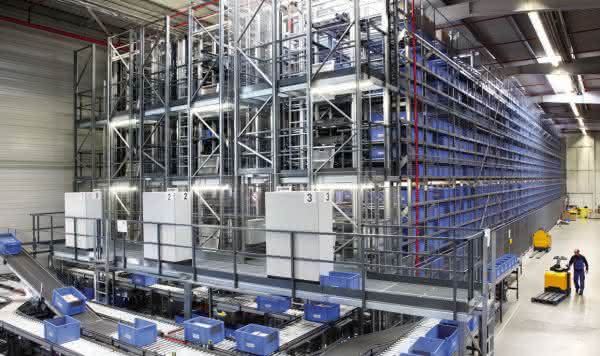
Discussions about the extent to which the more recent development of shuttle warehouses will replace automated small parts warehouses operated by storage and retrieval machines (SRMs) have largely given way to the realization that both systems have a right to exist.
If the ideal system is to be planned purely in terms of storage capacity with freely dimensionable floor space and height, the decision will be to use miniload. Although the number of storage locations is limited by the upper and lower access dimensions of the SRM in the miniload system, the shuttle warehouse requires maintenance levels over the entire height of the racking. As a guideline, it can be assumed that with a stored goods height of approx. 400 mm, any AS/RS AS/RS with a rack height of over 14 meters is superior to the shuttle warehouse in terms of pure storage capacity. The AS/RS AS/RS is also ahead in a pure investment comparison: lower requirements for the steel structure, the vertical transport provided by the AS/RS and various other factors make the AS/RS AS/RS more cost-effective.
The limits of the AKL
For a mini-load warehouse (four aisles, each with one SRM / two LAMs (load handling attachments) and double-deep storage) with an aisle length of approx. 80 meters, a rack height of approx. 15 meters and a high storage fill level, a guideline value of approx. four times 100 storage and retrieval operations per hour can be assumed. A 40-foot container in the incoming goods area with approx. 700 cartons would fill this small parts warehouse to capacity for two hours. Of course, the goods could be temporarily stored in the incoming goods area - this is an individual cost issue and a question of the speed of item availability. The capacity of the miniload can be scaled by increasing the number of aisles. This makes sense if the storage capacity is to be increased at the same time. If the existing storage capacity is sufficient or there is no more space available, the number of LAMs per AS/RS could be increased or two AS/RS per aisle could be used. However, if an even higher storage capacity is required in the short or long term, the step towards shuttle storage systems must be taken.
The types of shuttle warehouse
Shuttles are independently mobile rack conveyors that move along a rail system attached to the rack. The stored goods are usually fed into and removed from the racking levels via lifts.
With the captive variant, the shuttles do not leave "their" aisle or level. Captive shuttle storage systems have so far been unbeatable in terms of storage performance, but also require the highest investment. They have to be fully equipped from the outset, which limits the subsequent increase in performance. If the storage geometry remains the same, only the vertical transport capacity can be increased with additional lift systems or the pre-zone can be multiplied accordingly as the overall system capacity.
In roaming shuttle warehouses, not every storage location can be reached without moving the shuttle vehicles to other aisles or levels. Vertical roaming means that the shuttles change racking levels via a lift system. With horizontal roaming, a rail system is usually installed in the pre-zone for transverse movement. 3D roaming combines both movement options. With roaming systems, the performance of the storage system can be increased by retrofitting the performance-limiting elements or by adding more shuttles (for vertical and 3D roaming) and lift systems (for horizontal and 3D roaming).
A breath of fresh air in old buildings
An AKL requires a uniform height over the entire length of the aisle; the lowest point determines the shelf height. Neighboring aisles can differ in height and length, but must be "on the same line". Shuttle warehouses, on the other hand, can make more flexible use of the dimensions of an existing building. In principle, the storage levels of an aisle can be of different lengths due to deviations in height. Even very jagged building geometries can be used with roaming systems.
Speed as required
The unique selling point of the shuttle warehouse is its storage capacity. A captive system with a double pre-zone and two lift systems per aisle can achieve a capacity of over 600 storage and retrieval operations with single transportation per lift platform (depending on the number of levels, aisle length and storage depth). The limiting element here is not the shuttles, but the vertical transport. To ensure that the lifts can develop their full capacity, the individual shuttles should only operate at a utilization rate of 55 to 65 %, even in warehouses with a high capacity.
If the storage and retrieval machine fails in a miniload, the entire aisle or the assigned aisle area is affected. This can only be countered by spreading the articles across several aisles in a way that is as fail-safe as possible. In the shuttle warehouse, on the other hand, the availability of goods is guaranteed with two lifts. Although the failure of one lift would mean a 50% loss of performance, all storage locations in the aisle would still be fully accessible.
Modern warehouse planning also takes energy efficiency into account. Why move equipment weighing several tons to transport a payload of just a few kilos? This discrepancy is obvious with stacker cranes and is only partially compensated for by modern energy recovery. Shuttle warehouses are more energy efficient. The energy requirement for vertical transportation of stored goods using a lift is roughly equivalent to the energy requirement of the lift drive on a SRM. However, significantly less energy is required for horizontal transportation in a shuttle warehouse. Although the energy consumption depends on the use and design of the shuttles, their energy balance is significantly more favorable.
The other side of the coin
Performance, energy efficiency and item availability come at a price in the case of shuttle warehouses. Both the initial investment and the running costs (with the exception of energy costs) are higher than for a comparable mini-load warehouse. Maintenance does not affect the availability of goods in shuttle warehouses unless it can be carried out at short notice - qualified personnel and replacement equipment must be available on site. In addition, shuttle warehouses are more time-consuming and labor-intensive during the ramp-up phase.
Conclusion
AKL and shuttle storage systems are not competitors; their use depends on the task at hand. The decision is always made in favor of the shuttle warehouse if the miniload capacity would not be sufficient or if significant development prospects are required in terms of performance. High stock turnover and reliability also suggest the use of a shuttle warehouse. However, the selection of the ideal system alone does not guarantee efficient processing. Fully automated storage must be effectively linked with the other logistics components.
www.pierau-planung.de
Author: Christian Berndt, Senior Consultant at Pierau Unternehmensberatung GmbH


You might also be interested in
Winner material flow PRODUCTS OF THE YEAR 2023
Conductix-Wampfler: ChargeLine 0865
Two-pole conductor rail segments for efficient opportunity charging of shuttles, suitable for thousands of cycles per day.
 read more...
Hermann Grewer celebrates his 80th birthday
Hermann Grewer, Honorary Chairman of the North Rhine-Westphalia Transport and Logistics Association (VVWL) and Honorary President of the German Road Haulage, Logistics and Disposal Association (BGL), celebrated his 80th birthday on June 6.
read more...Well chilled for sure
V-Zug Kühltechnik AG, developer and manufacturer of refrigeration appliances and part of the successful V-Zug Group, has set up a new production facility for refrigerators of all heights and dimensions at its Swiss site in Sulgen.
read more...Advantageous automation of small parts warehouses
The RSX1 shuttle system will be at the center of Rocketsolution's presence at this year's Logimat trade fair.
read more...Reduced energy requirements in the high-bay warehouse
One of Germany's leading premium car manufacturers is already focusing on energy efficiency in the production of its new SUV model with electric drive. The storage and retrieval machines in a high-bay warehouse at the production site have been...
read more...Low lift pallet truck for light duty applications
Clark has launched a new low lift pallet truck with the model designation LWio15 for light transport tasks. The truck has a load capacity of 1500 kg and is suitable for short distances in goods distribution, production or warehousing.
read more...Internationalization as an opportunity
E-commerce is in a state of flux. Changes in purchasing behavior and procurement problems are keeping e-commerce retailers busy. Logistics plays a decisive role in the overall online shopping experience.
read more...Fulfillment Center for Frisco.pl
Polish eGrocery specialist and TGW deepen partnership
TGW is building a highly automated fulfillment center for Frisco.pl in the Polish capital Warsaw. This is the second project in a row that the two companies have implemented together.
read more...Which world will it be in 2023?
Michael Schreckenberg teaches at the University of Duisburg-Essen as Professor of Physics of Transport and Traffic. Once a year, he addresses the readers of materialfluss, formerly LT-manager, with a critical and humorous expert article on transport...
read more...