
Software
Networking beyond the warehouse
Market requirements and consumer behaviour have changed significantly in the course of digitalization. The economy's answer to these challenges is Industry 4.0, the networking of all elements of the value chain. What does this mean in concrete terms for logistics?

As the interface between consumers and producers, it plays a key role in shaping the processes of the digital economy. With the help of modern IT and automation concepts, companies are now optimally preparing their logistics centers for the requirements of digitalization, networking and autonomous systems.
In the logistics center of the future, autonomous units have taken over. Self-driving systems move freely in space, have to avoid other systems and independently determine the best route to a destination. This requires greater autonomy on the part of all units involved. They require electronic aids such as camera or navigation systems, must be networked with each other and be able to be controlled from outside at any time via the internet. Logistics 4.0 is therefore primarily about electronics and information processing. In concrete terms, this means that providers of software and automation solutions are the first point of contact for companies that want to make their logistics 4.0-compatible. System integrators, who work independently of manufacturers, have a good overview of the market and can put together and integrate a complete solution to meet requirements from the wide range of products on offer. This is an enormous advantage, especially in the future area of the digital factory, because new, innovative providers of navigation, digitalization or mobile solutions are also taken into account.
The logistics of the future is autonomous and networked
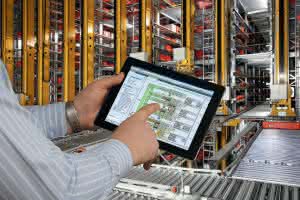
The influences of Logistics 4.0 will take effect at all levels of the automation pyramid. The lower control levels are given more intelligence and therefore greater autonomy. In addition, information and data flows are being networked across all areas of the company and beyond: Logistics 4.0 is about looking beyond the edge of the logistics center towards the entire supply chain - from planning and order processing to production, intralogistics and shipping through to use by the customer. New value chains are emerging in which every production unit, every supplier and every end consumer is part of the comprehensive logistics system. In order to implement this paradigm shift in their own logistics infrastructure, companies need to set the right course. In the warehouse, this applies to the following areas
- Intralogistics software
- System visualization
- data transmission
- Control technology
- Actuators and sensors
Software: interdisciplinary, interactive and mobile
To ensure that all systems used can communicate with each other and exchange data, the software solutions used must have open standards and easy-to-use interfaces. This makes them easy to develop further and allows new system participants to be connected flexibly. In addition, the location from which software is provided must be variable. The classic system with a computer cabinet and server is no longer the norm. Cloud or Software-as-a-Service (SaaS) solutions and the use of virtual servers offer greater flexibility. For example, a warehouse management system (WMS) can be operated as a virtual machine and thus support several company locations. Users access the WMS via the Internet and receive all information in real time. At the same time, hierarchical and inflexible IT structures are overcome in this way. Logistics 4.0 also requires a new way of handling data. All software solutions used provide information, such as the duration of a picking process or the delivery frequency. This data needs to be intelligently evaluated and correlated. A data warehouse takes on this task as a central database. The insights gained on the basis of algorithms help users to make decisions and enable process improvements.
Visualization: the entire system as the first zoom level
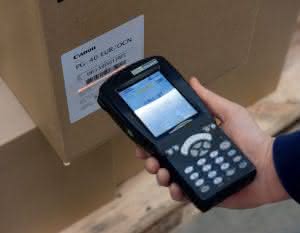
The greater the autonomy of the individual systems in a logistics network, the more important detailed system visualization and seamless shipment tracking become. With cross-company tracking and tracing, the user can keep an eye on where a driverless transport system is currently on the road or where a consignment of goods is located. Based on the idea of a cross-company logistics network, a modern system visualization must be able to clearly depict very complex and large structures. Ideally, it should be possible to zoom continuously into all areas of the logistics system with a floor plan of the entire company as the first zoom level. From there, the user dives deeper and deeper into the details. Mobile devices are advantageous for display. Every maintenance technician must be able to visualize a system on a tablet, for example, in order to be able to analyze potential problems remotely, but also in the middle of the system.
Data transmission: the balancing act between networking and security
In a networked company, all elements are connected to the Internet. Data is exchanged via IP-based connections. The major challenge will be to implement the highest security standards for these networks in order to protect them from external attacks. The most secure way, a strict separation from the public network, cannot be implemented due to the requirements in terms of mobile maintenance and servicing as well as networking. Component suppliers, general contractors and network operators are required to create resilient security solutions for the networked production and distribution environment.
Control technology merges with IT
Control technology coordinates all movements in the logistics system. It is most affected by the transformation of stationary conveyor technology into autonomous systems. It will therefore have to fulfill additional tasks in addition to the classic control functions in the future. These include navigation of the autonomous units, dynamic routing and networking with a large number of other players. In addition, modern control systems will have to make decisions autonomously. The boundaries between control and IT systems are becoming blurred, similar to the on-board systems in today's cars. In the next few years, the classic programmable logic controller (PLC) will be replaced by PC-based systems that take over the functionalities of the PLC. Because every element in the warehouse of the future will be connected to the IP network, the control system will have flexible access to the individual components, request information and issue action commands - regardless of where the component is currently located.
Sensors and actuators
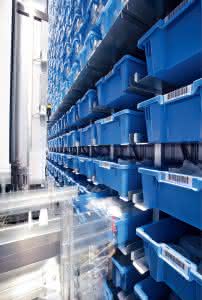
At the lowest level of the automation pyramid, IP networks are replacing traditional fieldbus systems. This digital connection sets new standards in terms of the flexibility of logistics processes. Each sensor and each actuator can be addressed individually via its own IP address. The advantage: changes in the process sequences can be implemented with minimal effort. To address a different sensor, for example, only the IP address needs to be changed. Control commands for actuators, such as the speed or direction of rotation of a motor, will also come from the IP network in future. IP-based maintenance of all elements offers a further advantage: in future, a service provider will dial into each system from outside. Via their connection to the network, autonomous units will report themselves if there is a fault or if regular maintenance is due. This self-monitoring increases the availability of the systems. At the same time, the logistics system becomes more vulnerable. Component manufacturers are obliged to provide flexible solutions that guarantee the greatest possible security.
Conclusion
It will be some time before all the requirements of Logistics 4.0 can be fully met. However, companies can already lay important foundations today. These include the digitalization of all business processes, the networking of the systems used and the selection of software solutions with open standards. At the same time, there are still a number of unanswered questions. For example, how can interfaces be standardized and data formats unified? How can companies create security when using cloud-based systems? And how can the large amount of available data be meaningfully evaluated and put to good use? Here, industry and research are equally called upon to find new solutions. If they succeed, the benefits of digital logistics can be fully exploited: cross-company networking speeds up processes and shortens response times. Information reaches the right recipient faster and contributes to optimized and customer-oriented decision-making at all system levels. Due to the high flexibility of the systems, logistics companies can react more quickly to changes in the market and thus secure their competitiveness. This also makes a high degree of automation interesting for sectors with particularly fast-moving business such as e-commerce.


You might also be interested in
Focus on safety and efficiency
In keeping with the trade fair motto "Energizing a sustainable industry", the Schmersal Group presented new products and systems for the safe, efficient and sustainable design of machines and systems at the Hannover Messe.
 read more...
High robot density in Germany
According to the International Federation of Robotics, Germany is one of the top automated economies in the world: robot density in the manufacturing sector rose to 415 installed industrial robots per 10,000 employees - a record!
read more...A platform transporter for Industry 4.0
With the SFX series, Hubtex develops compact, self-propelled platform transporters for indoor and outdoor use. Load capacities of 25, 40 and 65 tons are possible, and the models have a large loading area for transporting bulky, heavy loads. Thanks...
read more...New generation of Linde counterbalance trucks presented
Linde Material Handling is making the "Swiss army knife" of intralogistics fit for the future with a new generation of its IC engine-powered counterbalance trucks.
read more...The big picture of the Silicon Economy
The digitalization of everything and artificial intelligence in everything will change everything for everyone, says logistics expert Michael ten Hompel. The researcher has always been right with his predictions. A good reason to ask him about his...
read more...Bosch Connected Industry connects the supply chain
According to Matthias Hülsmann, Vice President Connected Logistics at Bosch Connected Industry, connected manufacturing can only be truly successful together with connected intra- and extra-logistics.
read more...viastore: sensibly networking production and logistics
The viastore Group will be presenting Industry 4.0 solutions at the Digital Factory, the leading international trade fair for integrated processes and IT solutions, which takes place as part of the Hannover Messe. The focus will be on the new...
read more...Conveyor and lifting technology
Material flow solutions network production and distribution
Networking, transparency and the simplification of complex processes are the key to higher added value and economical production, even of small batch sizes. This is why people, machines and processes in the manufacturing industry...
read more...Swisslog: More control for automated warehouse solutions
To meet the challenges of Industry 4.0 and actively shape the age of digitalization, Swisslog AG is launching a new generation of software platforms under the name SynQ. SynQ stands for...
read more...