

MDE devices
Mobile data capture of the latest generation
The company Brigitte Küchen has introduced new mobile data collection devices that can also read QR codes. Depending on the area of application, different device types are used and controlled by a single software program. AISCI Ident supported the project as a technical consultant and manufacturer-independent device supplier.
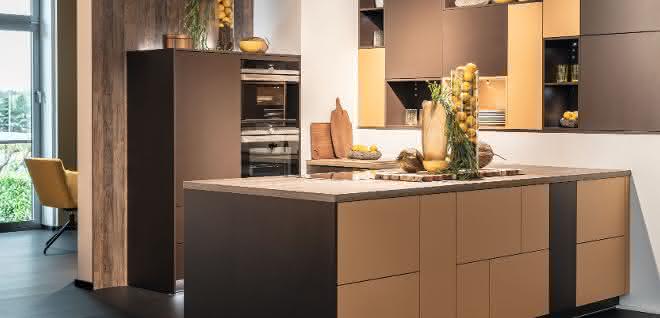
Brigitte Küchen is a medium-sized family business with over 90 years of company tradition. There is a lot of know-how behind the kitchens. For example, in the self-developed software that connects the mobile data collection devices (MDC) to an SQL database and the SAP ERP system via web services. "That was our goal. We wanted to become more flexible, make the MDEs interchangeable and control them with the same software. On the way there, we looked for a competent consultant who would make us independent of a single manufacturer," reports Uwe Tebbe, software developer at Brigitte Küchen.
MDE devices: different strengths and weaknesses
Brigitte Küchen had expanded its labeling system to include the two-dimensional QR code in order to accommodate more information in a smaller space. In addition to the material number, further information about the material is transmitted. "We were unsure which devices were best suited for which area. That's why we looked for expertise," says the developer, explaining the requirement. The contact with AISCI Ident came on recommendation. "Depending on the barcode, reading distance, keyboard or touchscreen operation, operating system, merchandise management or whether a telephone function is required, very different devices are recommended. A forklift driver who wants to scan pallets over a distance of several meters needs a different device than his colleague in the incoming goods department," explains Uwe Nolte, sales representative at AISCI Ident.
As the individual devices are optimized for different areas of application, it is important to define the requirements precisely in advance. It was also important to ensure that the employees were comfortable with the handling. "AISCI created a pre-selection of devices for us and organized a 14-day trial of these devices. That was very helpful," says Uwe Tebbe, describing the selection process. The test position showed the different characteristics of the devices, including battery life, WLAN reception and barcode scanning accuracy.
Different devices in use
At Brigitte Küchen, the MDE devices are used in production, incoming goods, the warehouse and also for the delivery of kitchen furniture. However, different device types are required for status bookings or for registering loaded parts. The furniture manufacturer uses the Datalogic Skorpio model with laser scanner for internal logistics, status bookings or incoming goods. With the addition of the QR code, it is gradually being replaced by the MC2100 from Zebra. The mobile computer is a handheld PC with a 2D scanner and a small display, which was chosen by Brigitte Küchen primarily because of its handy size and its battery and WLAN properties.
With the support of AISCI Ident, the kitchen furniture manufacturer has also improved the service for delivery drivers. The drivers can now upload the data for all delivery parts and customers to a mobile device via a web service. This means that all parts are displayed for each customer and the delivery is confirmed by the customer's signature. If there are any complaints, a photo is taken with the handheld device and immediately sent to the central database. Brigitte Küchen opted for the Zebra TC75 handheld and touch computer.
When technical details matter
"Our expectations of manufacturer-independent advice were fully met. We had good support in selecting the devices and clarifying technical details," says the developer, summarizing his experience. "Setting up a central management system is another issue. The effort pays off very quickly if the devices are in use at several locations and can be set up and maintained remotely from one location," says the AISCI Ident sales representative, citing typical consulting services. The Auto-ID specialist also provides a repair service on behalf of the manufacturer. In addition, the factory warranty can be extended to up to five years with a warranty extension. Uwe Tebbe confirms the benefits of expert project support and assistance: "Advice on device selection and the opportunity to test various devices in detail are a basic prerequisite for a smooth project. It is also very important to have a contact person for technical details once the devices have been introduced." Martin Ortgies


You might also be interested in
Industrial scanners for harsh environments
Honeywell presents 'Granit Ultra 2105i', an industrial scanner for demanding environments in production and logistics.
 read more...
Convenient measurements even in harsh environments
Hexagon Manufacturing Intelligence introduces a new handheld 3D scanning technology that adds convenient new functionality for flexible measurement to its wide range of manufacturing inspection devices.
read more...Pick-by-voice solution with wearable scanners
Proglove is cooperating with Topsystem, a division of the Ehrhardt Partner Group (EPG), to meet the industry's high demand for mobile logistics solutions.
read more...Wearable scanners for warehouse and retail
Proglove will be presenting the Mark Basic multi-range wearable scanner and the new advanced scanning software functionalities for the first time in Germany at Logimat.
read more...Automated guided vehicle systems for washing machines
The domestic appliance manufacturer Miele develops and produces a large proportion of its washing machines and washer-dryers at its Gütersloh plant. Pressed and cast components are also produced here for the other Miele plants.
read more...Working platform for safe access to train roof areas
KRAUSE has developed a roof working platform with zero gap for the Hohenzollerische Landesbahn transport company of SWEG in Gammertingen. It was adapted exclusively for "Lint 54" trains of the 622 series.
read more...On-board sensors replace GPS
In the "Autodrone in Production" project, researchers at the Institute of Integrated Production Hanover (IPH) have developed a drone that can fly autonomously in unknown indoor spaces.
read more...Working independently in the warehouse
With the Linde C-Matic HP autonomous transport robot and the Anyfleet cloud platform, goods handling specialist Linde Material Handling (MH) is expanding its portfolio to include two core products from Munich-based company Idealworks.
read more...Ultra-fresh thanks to dynamic calculation
Flow-Picking-Machinery (FPM) raises the dynamics in fresh food logistics to a new level - the Witron system dynamically calculates the store pallets during operation.
read more...