
Software
Making the right adjustments
The buzzword "software optimization" often causes negative associations, and not without good reason: The first things that come to mind are business interruptions, logistics stoppages or cost traps. The tried-and-tested optimization method of the software manufacturer Dr. Thomas + Partner (TUP) shows that there is another way, namely problem-based, with little time expenditure and at moderate costs.

An implemented warehouse management system requires constant optimization, no matter how sophisticated and detailed. This is because the requirements for its use are constantly changing, whether due to expanded product ranges, new customer requirements, fluctuations in market demand or new market conditions. It is essential not to optimize the entire program across the board, which is time-consuming and costly, but only those areas and processes where there is a need for action. This is important because in the daily life of a logistics provider, it is crucial that a proposed solution, and therefore also an optimization, is verified in a reasonable amount of time.
Even complex planning tasks can be solved, automated and improved in terms of results through the professional use of mathematical optimization methods. "However, for many problems in intralogistics, the solution space is so large that it is difficult to efficiently find optimal solutions," says Eduard Wagner, Senior Project Manager and member of the management team at Dr. Thomas + Partner. He adds: "This is why so-called meta-heuristics are used from the lessons of mathematical optimization methods known as operations research. These are iterative and intelligent algorithms that specify solution steps depending on the problem and lead to good solutions in a reasonable amount of time."
In-house research and development for optimization planning
TUP serves two worlds simultaneously during such an optimization. On the one hand, there is the company's own ongoing research and development, and on the other, the logistical reality of implementing new requirements in a customer-oriented and, above all, timely manner. To put it bluntly, without slowing down or even stopping logistics operations for longer than absolutely necessary. Optimization is therefore only carried out on those adjustments that are actually needed. "If resource costs or sales prices for products and services fall, productivity must be increased in return. This means either using fewer resources with the same output or increasing output with the same use of resources," says Eduard Wagner, explaining the optimization goal.
However, optimizing the use of resources always requires the solution of complex planning problems through the sound and intelligent use of IT systems.
Framework for the automated solution of planning problems
As Eduard Wagner emphasizes, "we at TUP are not starting to reinvent the world, but are using standard procedures and an optimization framework with which the individual steps can be automated and integrated into our warehouse management system (TUP.WMS) according to individual customer requirements." As an avowed Java manufacturer, TUP uses the "OptaPlanner", a Java-based open source framework for the automated solution of planning problems, among other things.
Not a black box
The software developers at TUP, "use precisely such frameworks to provide modules with which we can solve planning problems. And in a cost-effective and timely manner," emphasizes Wagner. Because "in the past, this was an area in which external companies were often used, who sold you a black box including the associated interfaces for a lot of money and delivered a result, but didn't reveal what exactly they were implementing. We don't need this support because we need process chains for optimization, which we may have to adapt and expand quickly," concludes Eduard Wagner.
In this context, TUP uses abstractly encapsulated modules that are developed from the software and made available internally to colleagues as a service. This allows planning problems to be solved, such as the creation of a commission that has certain target functions and at the same time generates constraints.
Solver solutions for planning problems
A central component of the framework is the so-called solver, which can be used to solve mathematical problems. It uses heuristic and metaheuristic optimization algorithms, while the framework conditions - such as target functions and constraints - are defined individually in order to search as efficiently as possible in the solution space. The development and optimization phases are always dynamic and independent of each other. This means that further planning and optimization steps can be incorporated into a solution at any time without the person developing the application in question having to constantly deal with the topic of optimization. This represents enormous progress compared to costly optimization black boxes with rigid monolith characteristics, which are imposed on the entire TUP.WMS in a blanket and quasi-anonymous manner. Customers are also offered transparency, as it is possible to see how the solver is configured at any time.
Analyze and define goals at an early stage
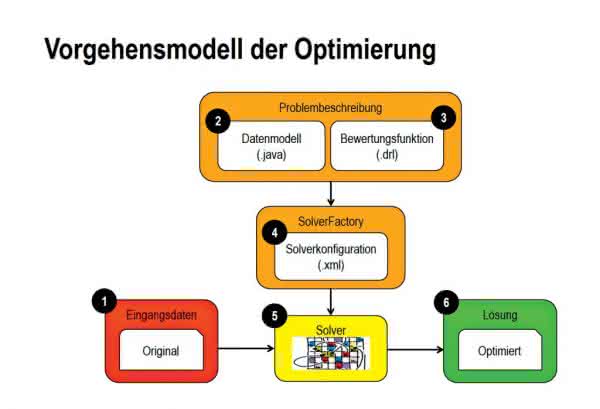
As Senior Project Manager Wagner explains, the following four steps lead to a good optimization result: model the planning problems, implement the score calculation, configure the solver and carry out the optimization.
When modelling planning problems, the technical issue is first analyzed and the goal of the optimization is defined. As Wagner knows from experience, "it is important that the customer understands the challenges before we talk about the solution. Time and again, however, the early analysis work makes it clear to a customer that they are not yet ready for optimization. Also because their processes are currently too fragmented and too detailed."
The technically relevant objects are then mapped in a domain model consisting of simple Java classes. A distinction is made between "problem facts", "planning entities" and "planning solutions".

"On average, only around two to three weeks are required to design a solver solution"Eduard Wagner Senior Project Manager and Member of the TUP Management Board
"Problem facts", for example, are unchangeable and cannot be influenced; they "must therefore be separated early on from the things that can be influenced", says Wagner. The "planning entities", on the other hand, contain boundary conditions for planning that can be changed under certain circumstances. And the "planning solutions" represent the actual target functions. Examples:
- The picking route is minimized in total across all picks.
- The throughput time can be exceeded by a maximum of ten minutes.
Optimization algorithms for each phase of the solution
The score calculation brings all target functions and constraints into a standardized form and thus functions as a "one-norm" evaluation of quality and validity. The score is used to compare and evaluate a vast number of solutions. Rules are used to express how the respective score changes when hard and soft restrictions are violated.
The model, the solver and the optimization algorithms are then configured. The required optimization algorithms are defined for each phase of solving an optimization problem. The solution is iterative and step-by-step, with each step leading to a new solution.
"The configuration of the solver is of course the core element," emphasizes Wagner. The solver programmer decides how the planning problems are to be modelled and which and how optimization methods are best used to solve the problem.
The solver is configured for each application
"The solver is not completely redeveloped. Only the solver project and its classes are newly created. In addition, the solver configuration shows transparently how it will behave," clarifies Eduard Wagner.
This is done on an application-specific basis and tailored to the respective requirements. Wagner: "The solver addresses the defined planning problem, and accordingly each solver must be considered individually. Only the way in which it is developed is similar.
That's why solver configuration is also a special task for colleagues who work in R&D, but who actually use modules with which they can immediately support colleagues who deal with process chains with solutions." An important step in the configuration is the definition of scheduling criteria. For example, the maximum number of steps to be carried out without improving the solution or a specifically defined time period are important termination criteria for optimization.
The courage to do things differently
As efficient and economically useful as software optimization proves to be, it will by no means simplify the professional handling of IT and will not suddenly revolutionize its operational use drastically. After all, a lot of basic virtues and know-how are still required to achieve the desired results. "Even in times of 'Same Day Delivery', 'Big Data' and Industry 4.0, TUP is still conservatively of the opinion that sound basic work in the IT environment is necessary in order to create the conditions for even better solutions in intralogistics," states Eduard Wagner as he looks to the future.
Algorithms successfully applied: at Haba and adidas
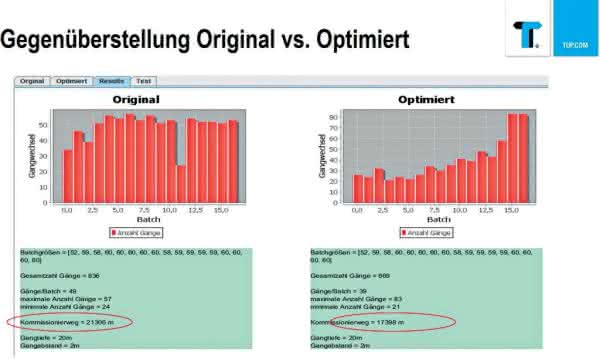
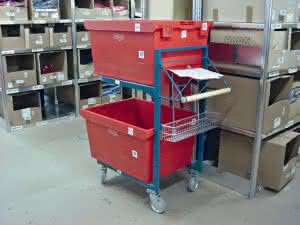
TUP's optimization solution has already been in use for more than a year at the toy and children's article manufacturer Haba and at the adidas brand.At Haba, order picking is being optimized. The initial data are fully reserved orders for which replenishment has already been completed and picking can be started. The target function is to minimize the length of the route or the number of aisle changes across all picks. The algorithm used for this is the "Simulated Annealing" optimization method. The size of the sorting modules and the processing groups are also taken into account.
At adidas, the batches are formed according to different criteria. The optimization also includes an upstream formation of so-called collective shipping units (CEs); these are fictitious CEs that combine shipping units with one item (quantity 1). A sorter chute should be filled as far as possible, taking volume, weight and priority into account.
In a second step, the actual batch formation takes place. The aim is for the batches to fulfill the following different requirements as well as possible:
The initial data are parameters, order data and available quantities for Golden and Silver cartons. The solver creates a predefined number of batches with a fixed maximum number of orders. The parameters are set by the user via a dialog. If required, batches can also be created without optimization.
- High but even proportion of so-called Golden and Silver cartons;
- the specified composition with regard to shoe and textile delivery bills should be distributed over as few batches as possible;
- Consideration of order priority and a due date.
"This starts with basic training, continues with a consistent and highly available infrastructure and culminates in the courage to do things differently than before - in the end, we end up with a disruptive solution or technology."
As Wagner emphasizes, "sophisticated analytical models and Monte Carlo simulation will profoundly change our lives in general in the future, and ultimately IT and robots will support us more and more in our daily work, be it in thinking, decision-making or even acting".
Reinhard Irrgang


You might also be interested in
Dematic and Hai Robotics launch partnership for flexible AMR solutions
Dematic and Hai Robotics have recently agreed a Europe-wide partnership to work together as integration partners in the field of warehouse automation. Through this cooperation, the provider of automation solutions for supply chains and the...
 read more...
The market for service robots
A recent report from IDTechEx analyzes the global market for service robots and examines key applications for delivery and logistics robots, cleaning and disinfection robots, social robots and more.
read more...Application phase for Innovation Award 2026 begins
How can robotics help to make packaging more sustainable? Kuka is looking for creative and innovative ideas in the new round of the Innovation Award.
read more...Exoskeleton with AI power
Robotics company German Bionic presents its most advanced exoskeleton model to date, called 'Exia', which is fully controlled by augmented AI.
read more...Strategic partnership for the promotion of AI
Jungheinrich and Merantix have announced a strategic partnership. The aim of the cooperation is to promote applications based on artificial intelligence (AI) in the industry.
read more...New robotics organization founded
Omron has announced the establishment of a global robotics organization effective April 1, 2025. It will operate in parallel with Omron's automation business so that both areas can complement and support each other.
read more...No-code tool for programming robot user interfaces
ABB provides 'AppStudio', a software tool that allows users of all skill levels to quickly and easily create customized, graphical user interfaces for robots.
read more...SLAM navigation in real time
'Freestyle Localize', 'Trailer Find' and 'Scanner Switch' are three new features of Sigmatek's real-time location software forcontour-based navigation 'SlamLoc'.
read more...Robotic solution: Aiming high under your own steam
The Skypod system is now used in more than 100 order picking warehouses worldwide by companies in all kinds of industries. The autonomous Skypod robots are able to overcome height differences of up to 12 meters.
read more...