
Software
Load moment limitation for mobile cranes
When mobile telescopic cranes lift and move loads, protecting people, materials and machines is a priority. Certified control solutions help to reduce safety risks. With qScale RCL trueSafety, WIKA Mobile Control now presents the first DIN EN ISO 13849-certified software library for the load moment limitation of telescopic cranes - and at the same time offers flexibility in the modular cSCALE control system.
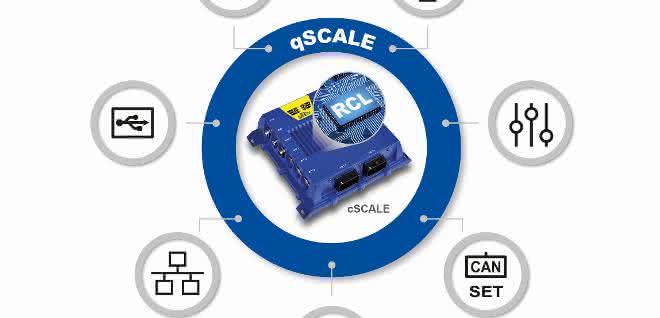
qScale RCL trueSafety is a software library for mobile cranes certified in accordance with DIN EN ISO 13849. The qScaleRCL C library has been implemented with regard to functional safety and complies with current EU standards. All specifications for safety-related embedded software SRESW are taken into account and fulfill the requirements of the Machinery Directive 2006/42/EC. The development process and the implementation of the programming meet the requirements up to SIL 2 according to DIN EN 61508-3 and DIN EN 62021 as well as PL d according to DIN EN ISO 13849. In addition to the pure implementation of the software library, the entire development documentation is also certified.
Flexible load moment limitation
At the heart of the safety system is the modular cScale control system with integrated qScale load moment limitation. It can be combined with any manufacturer-independent hardware components such as sensors for measuring angles, lengths, pressure and force as well as actuators, controllers, consoles or devices such as cameras. The design of a comprehensive qScale system for load moment limitation is individually tailored to the specifications of the mobile machine. As a system integrator, WIKA Mobile Control accompanies the customer through all project phases: from analysis and concept evaluation, through system design and project planning, to prototype testing and field implementation.
Simple system configuration
The qScale Sx Configurator is a Windows-based, menu-driven tool for easy parameterization of the load moment limitation of a mobile crane. In addition to general machine data such as manufacturer and machine type, the crane model can be parameterized customer-specifically across the entire machine kinematics with the qScale Sx Configurator. The model consists of freely configurable elements such as telescopes, jibs and other attachments. This flexibility makes it possible to map all crane models on the telescopic crane market. This data is supplemented by the customer-specific load capacity tables. Load tables - including multi-dimensional tables - can be easily inserted and the behavior inside and outside the load tables is configurable. For easy validation, users are provided with three-dimensional visualizations of the load tables to maintain an overview at all times. Integrated reporting functions support the user with functionally reliable project documentation.
The qScale Sx Configurator can also be used to define the operating modes and the reference of the payload tables to the operating modes. The load tables can be switched via variables and conditions (angle of rotation, digital inputs, telescoping sequences, working ranges or counterweights). Actions and limitations such as total shutdowns, individual movement shutdowns as well as error outputs and warnings can be selected.
Finally, the qScale Sx Configurator enables a customer-specific definition of the calibration process and thus offers the service department a menu-guided calibration process. The entire calibration process is recorded and documented in order to automate the approval process and to analyze and optimize the entire calibration process offline, even without a machine connection. A customizable traffic light colour system enables the user to easily visualize compliance with the tolerance ranges of load and radius.
Reliable safety functions
At the heart of the safety system is the modular cScale control system with integrated qScale load moment limitation. The safety mechanisms for fault detection play an important role in the system. All safety-relevant program and parameter data in the RCL-C library is protected by checksums. This ensures data consistency. The entire calculation processes run redundantly, are checked via cross-comparisons and are monitored cyclically via the safety mechanisms integrated in cScale. Compatibility monitoring of the safety-relevant program versions guarantees the correct interaction of the software modules.
Modular block library
The CoDeSys block library is the interface between the cScale control program and the RCL-C library. The library also contains qualified blocks for functional implementation outside the RCL-C library, including blocks for analog and digital I/O, signal processing, event and file handling, parameter and data handling, data loggers as well as CANopen and CANopen safety communication. The modular system allows individual applications to be programmed quickly and easily in order to develop certifiable customer-specific applications. A customer-specific parameterizable data and event logger records measurement data during operation and saves the recorded data. This data can then be converted into a standard Excel format and edited.


You might also be interested in
Crane retrofit in Emmerich
In the inland port of Emmerich, Tsubaki Kabelschlepp has overhauled the cable routing of a container gantry crane belonging to Contargo Rhein-Waal-Lippe. A pre-assembled Totaltrax solution was used, which the experts for energy chain systems...
 read more...
For drumming and towing - cables that pull along
With the Reeltec and Festoontec product series, TKD Kabel offers a portfolio of robust cable solutions for cranes and hoists. The specialist for application-oriented cable solutions thus also supports the increasing digitalization and automation of...
read more...Crane retrofit in Emmerich
In the inland port of Emmerich, Tsubaki Kabelschlepp has overhauled the cable routing of a container gantry crane belonging to Contargo Rhein-Waal-Lippe. A pre-assembled Totaltrax solution was used, which the experts for energy chain systems...
read more..."Customer awareness of environmental issues is increasing"
What trends and developments are there in the industry when it comes to green logistics? Experts provide insights: Christian Heid is Managing Director, SWF Krantechnik.
read more...New standards in lifting technology and material handling
Crane technology manufacturer SWF is now embracing digitalization and networking with a vengeance. Intelligent control aids make work safer and easier.
read more...Next generation electric wire rope hoist
SWF Krantechnik, supplier of components for industrial cranes and hoists, presented its new product innovationsto a broad specialist audience for the first timeat LogiMAT.
read more...Premieres for wire rope hoist and chain hoist
Rope hoist, chain hoist, Demag KBK light crane system: Demag will be presenting new products in each of the three product areas at Logimat.
read more...Crane technology: Konecranes presents solutions for material handling
Konecranes will present its latest Industrial Service and Equipment products at Logimat. Konecranes has pioneered safer, more productive and more sustainable material handling equipment.
read more...Starting signal for the intralogistics trade fair
The annual event opened its doors to trade visitors at 9 a.m. today. By midday, it was clear that there was a high level of interest from visitors, which corresponds to the fully booked halls.
read more...