
Artificial intelligence
Efficient material flow design with AI in three steps
The material flow of raw materials, parts and semi-finished products in production and warehouses is often complex and can often be expanded in terms of efficiency. Machine learning, generative AI and the like can help with optimization.
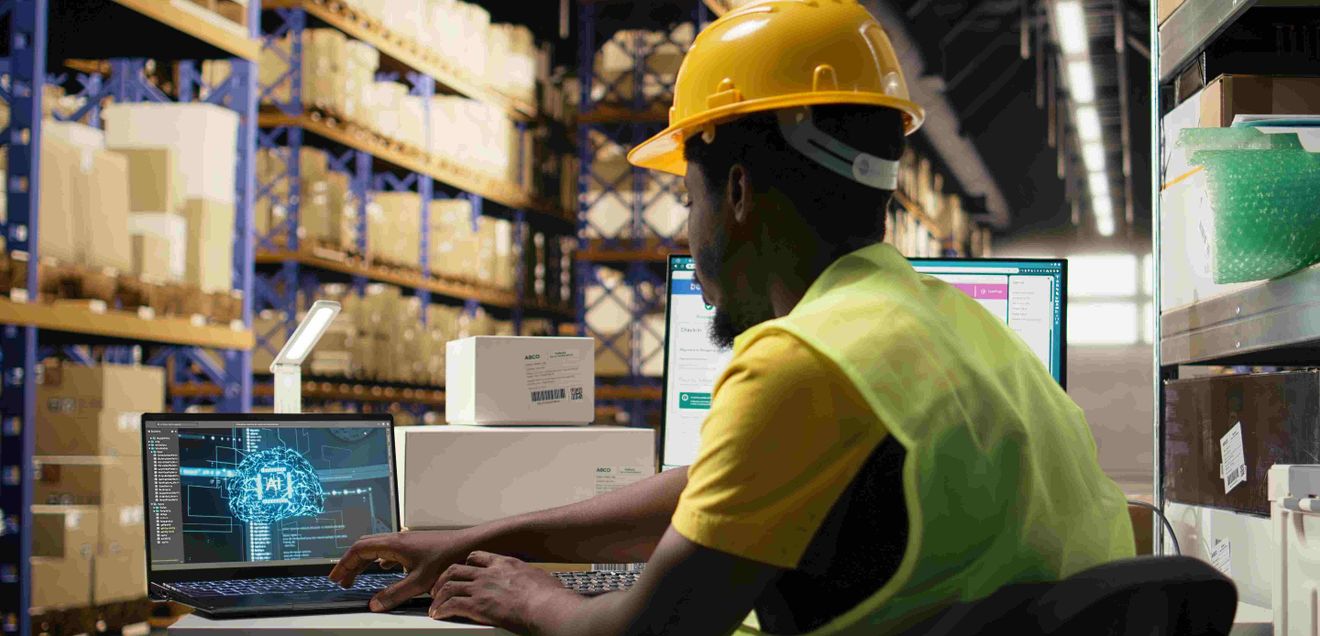
Components and raw materials are a significant cost item for manufacturing companies. The faster they are processed and delivered to customers, the faster they turn from costs into revenue. This makes it all the more important to keep their dwell time in the warehouse and production as short as possible. Elisa Industriq has identified three steps that artificial intelligence can take to make material flows more transparent and efficient.
Exploding material costs, a shortage of skilled workers and increasing price pressure from customers are forcing companies to permanently optimize their processes. A decisive lever for efficiency and competitiveness lies in material flows. Artificial intelligence (AI) opens up new possibilities: It analyzes data from different sources, makes recommendations for improvements and implements them independently if desired. Elisa Industriq, a provider of software for operational intelligence, outlines three practical steps for optimizing material movements with AI - from transparency in the material flow to warehouse logistics and inventory planning.
Creating clarity about material flows
Until now, companies have found it difficult to track exactly where a workpiece or assembly is in production and when. This was often only possible with a great deal of manual effort. A precise answer to the question "How much of a certain raw material is still in stock at the moment?" was also virtually impossible. The relevant data was either not available for all process steps or was distributed across different systems, for example in manufacturing execution systems (MES), ERP or warehouse management systems (WMS). Today, AI solutions provide the necessary overview. This is because they access the warehouse management system and other applications, analyze the relevant data and identify which object is currently at which point in the process. Such a real-time monitor for the material flow forms the basis for identifying optimization potential in the processes.
Optimizing intralogistics

If companies know where raw materials, components and end products are located and when, they can work on shortening transport routes and reducing transport times. For example, driverless transport systems and robots are already moving materials from one production step to the next in many companies today. However, the control systems in the background are often not connected to each other. If a transfer is necessary, for example from an automated guided vehicle to a robot, the synchronization between their control systems is usually done manually. This takes time and is prone to errors. With artificial intelligence, these material flow systems can be synchronized automatically. The result: the transport systems and robots independently organize the exchange of components with each other and the process is accelerated.
AI systems also analyze the movement and access patterns in the warehouse: materials with a high turnover rate are then automatically stored close to the picking or production areas. This also saves distances, reduces picking times and increases efficiency.
Plan material quantities with foresight
The entire stock of a particular material is not always in one place in the warehouse. Often a small part of the stock is located close to production, while the larger part is stored in an external warehouse, for example. If the stock near production drops, replenishment is taken from the external warehouse. This is usually done on the basis of observations and empirical values. Industry-specific AI solutions help to plan ahead more precisely. They analyze company-wide material movements in real time and determine typical consumption patterns. They also take orders and production plans into account. In addition to historical data, they also incorporate current data, such as geopolitical events or climate change, into the resulting demand forecasts - which significantly increases the accuracy of the forecasts. As a result, the artificial intelligence recognizes potential bottlenecks at an early stage and can suggest or even trigger automatic stock transfers or repeat orders - even before there is a risk of production downtime.
"AI speeds up processes and helps to reduce costs. In a study by the German Economic Institute, more than 80 percent of companies reported savings through AI, averaging 13 percent. And that's just the beginning," says Michael Fatum, Managing Director of Elisa Industriq in Germany. "Those who optimize their material flows with AI now still have the chance to secure their own competitiveness."


You might also be interested in
AI robotics program: Sereact and Rohlik Group cooperate
Sereact and the Rohlik Group want to work together to drive forward the industrial scaling of AI-controlled robotics in the e-grocery sector. With the launch of an AI robotics program at several locations in Germany and Austria, the two companies...
 read more...
Logistics AI with spatial intelligence
The Bavarian deep-tech company The Green Bridge is developing a technology that embeds spatial data in time horizons and automatically recognizes dynamics. This enables logistics companies to improve delivery times, increase transport efficiency,...
read more...Automatic scheduling in office supplies wholesale
Around 250,000 articles in five countries for wholesale, B2B and B2C in the office supplies sector are represented in the system and make up PBS Holding AG's broad product range. The replenishment effort is therefore enormous. The Austrian company...
read more...CO₂ management: Europa Worldwide Group relies on Blue Yonder
To achieve its environmental goals and to meet the growing sustainability awareness of its customers, the Europa Worldwide Group, an international logistics service provider, relies on Blue Yonder's Logistics Emissions Calculator, a component of the...
read more...Starting signal for open source: SKALA provides first components
The Fraunhofer Institute for Material Flow and Logistics IML has published open source components for logistics for the first time as part of the SKALA innovation project.
read more...AI-based scanning system ensures speed in the net warehouse
The start-up Invisium has developed a solution for the fully automated recording of reusable load carriers, which aims to eliminate the need for costly and time-consuming stocktaking. The application at the food retailer Netto Marken-Discount is its...
read more...MIT and Mecalux launch research project
The Center for Transportation & Logistics at the Massachusetts Institute of Technology (MIT) and Mecalux have launched a five-year cooperation project. The aim of the project is to accelerate the integration of self-learning artificial...
read more...RoX research project: Fiege involved as a partner
The aim of the RoX research program is to promote the use of AI-based robotics solutions in practical applications and industries. The logistics service provider Fiege is one of the consortium partners of the joint project funded by the Federal...
read more...A Centralized View of Complex Processes
Today, medium-sized logistics companies must manage an increasingly diverse range of operations efficiently and reliably. Different modes of transport, customized customer solutions, and established workflows can hardly be accommodated by...
read more...