
Sensors
High data transparency for production and logistics
Leuze SmartID-Edge controls a network of identification systems and sensors for track-and-trace requirements in production and in the supply chain. Secure communication between 1D scanners or 2D camera systems takes place at edge level using OPC UA and full integration of the AutoID Companion Specification.
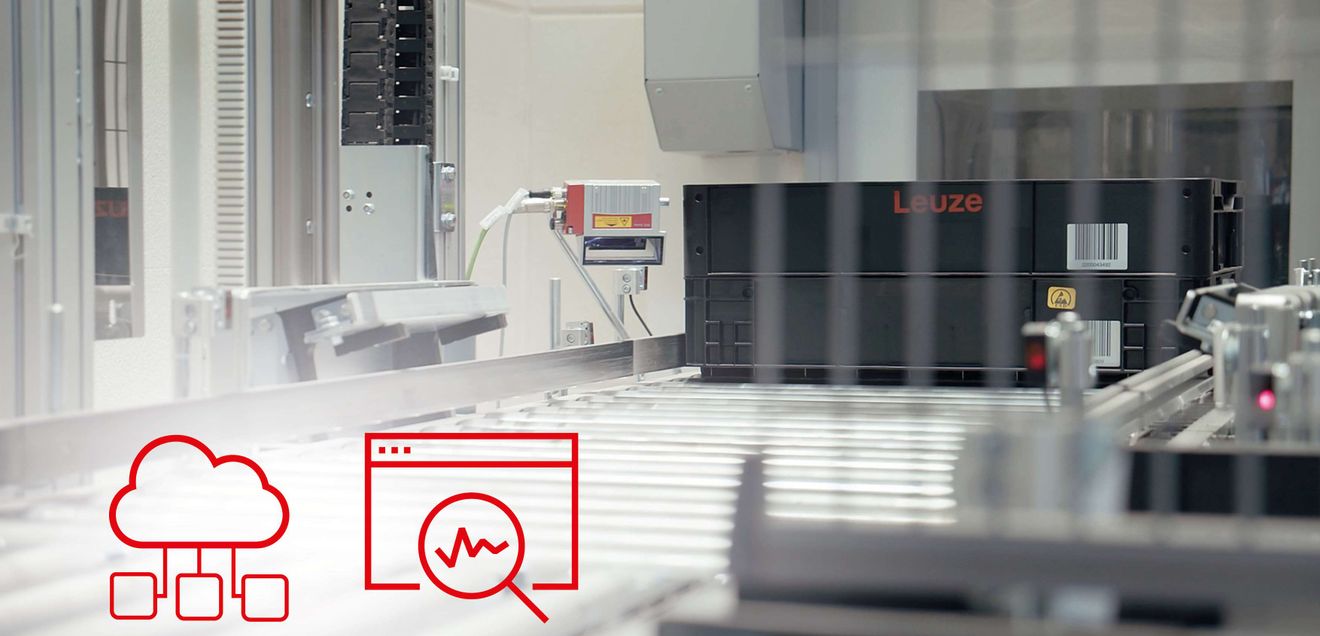
The advantage: each object to be identified is not only represented by its code, but is also mapped on a virtual tag in the edge system. Additional process, status and sensor information can then be assigned to the virtual tag. This data is available across all processes in real time.
Networking plays a decisive role, particularly in today's automation systems in production and logistics. The aim is to be able to call up the exact status of production processes at any time and to obtain a complete overview of production-relevant data at field level. This involves key questions such as: How can users achieve this maximum transparency of their production processes efficiently? And how secure is the communication between the network participants?
Several requirements for efficient identification
Nowadays, modern automation systems in production or intralogistics have a number of control systems, sensors and actuators. These are networked with each other via Ethernet-based communication or fieldbus systems and can exchange data. Sensors generate event-based signals to activate production processes or provide measured values to monitor correct production processes and quality requirements. AutoID systems such as 2D camera systems and RFID readers identify objects, load carriers and containers in production and in the material flow.
RFID and 1D/2D codes
Typical requirements for modern identification systems are to be able to handle variable data volumes and different code systems, depending on the object to be identified. With classic 1D/2D codes, however, these possibilities are limited because standardized barcodes such as a Global Trade Item Number (GTIN) only provide a defined, unchangeable and rather small amount of data. Furthermore, a barcode always requires access to a higher-level IT system such as MES or ERP, where the complete data set represented by the barcode is stored. In addition to other advantages provided by the physical principle, RFID benefits from the flexibility of the data carriers ("tags") used. These usually have a freely programmable electronic memory, which means that product and process data required for specific situations can be stored directly on the object. For economic or technical reasons, however, it is not always practical or possible to use RFID. Frequent media discontinuities when switching from barcode to RFID in continuous production processes are also undesirable because they result in increased effort in the automation processes and in data handling.
Using data more intelligently
This is where the SmartID-Edge concept from Leuze comes in. It uses standardized RFID mechanisms to process and store identification data while retaining the classic optical barcode technology. This is achieved by linking RFID data structures and command sets with standard barcode scanners and camera-based scanners using OPC UA as the data exchange standard and a fully integrated AutoID Companion specification. Each physical barcode is assigned a virtual RFID tag, which is stored in a database on an edge server. Data is exchanged at field level exclusively between the barcode devices and the edge server. The plant's control system, for example a PLC, has no access to the edge server - only the barcode identification systems exist for the PLC, although these behave like RFID systems.
This opens up unimagined possibilities for enriching data when identifying objects in the production process: In addition to the unique object ID, status information about the identification system as well as read quality and other process and status data can be stored in a data record. This data record is available in real time thanks to direct access at field level. Queries to MES and ERP systems are no longer necessary, which relieves data traffic in the networks and frees up system resources at IT level. Multiple local sensor and AutoID networks can be synchronized via distributed edge servers. This means that all identification events are available throughout the network at all times. Linking these local events with the associated information stored in the edge database over the entire production lifecycle provides the basis for the digital twin. This is even possible within a supply chain with different suppliers and plants by extending the edge server with an API and cloud connection. This allows logistics to work more efficiently, eliminates manual data collection and avoids complex system transitions in business software (ERP).
Integrated security mechanisms
Measures for secure communication are an essential prerequisite for the trouble-free, smooth use of networked systems. Here, the SmartID Edge solution offers several integrated security mechanisms. Modern automation components and identification systems with communication via Ethernet-based interfaces or fieldbuses such as ProfiNet, Ethernet/IP or EtherCAT have integrated web servers. The web servers allow convenient access to the devices in the local network. In order to meet the high requirements for adaptability, precision and performance, necessary updates to the device firmware must be carried out quickly, reliably and securely. Recognized functional improvements can thus be implemented without having to replace the device and new functions can be implemented automatically. At the same time, it must be ensured that only permitted firmware is loaded into the device and that the data transfer cannot be manipulated. These requirements for secure data transmission are becoming fundamental cornerstones of modern automation systems that communicate locally in networks and via cloud systems, not least due to the EU's Cyber Resilience Act.
Communication platform with end-to-end encryption
OPC UA provides an interoperable, Ethernet-based communication platform that is characterized by integrated end-to-end encryption. In addition, the OPC UA Device Interface Specification Part 100 defines a manufacturer-independent procedure for performing and managing software updates. The direct loading method is recommended for devices with limited hardware resources. The new software is transferred as a file archive, whereby after checking the specific header, each file is installed immediately after unpacking. After a final check, the device is restarted. All communication via OPC UA, including the software download, is secured by exchanging certificates between the client and server. An automated certificate exchange via an external Global Discovery Server (GDS) ensures the central administration of applications and certificates in the entire OPC UA network. Communication between the network participants therefore meets high security requirements: Data cannot be manipulated. It is ensured that each device is always operated with the latest and, above all, only the original firmware.


You might also be interested in
Knowing where to go: various AGV navigation technologies
Automated Guided Vehicles, or AGVs for short, navigate using different technologies. The technical requirements and local conditions are decisive for choosing the optimum solution. Sensor technology also plays a role in reliable navigation. Matthias...
 read more...
Ultrasonic sensors for many applications
Leuze presents the 420B and 412B ultrasonic sensor series. The ultrasonic sensors are available with adjustable sound beam and as switching (HTU) or measuring (DMU) sensors for flexible applications.
read more...LTW Intralogistics at the Logimat 2026
Efficiency and quality in the material flow
LTW Intralogistics is presenting its holistic approach to future-oriented material flow solutions at Logimat. Under the motto "Flow. In every detail", the company will be demonstrating how integrated systems, intelligent software, design and service...
read more...Lenze and Sonepar launch sales partnership
The Lenze Group and Sonepar Germany have entered into a long-term cooperation agreement. The aim is to make Lenze drive technology more widely available via the Sonepar sales network.
read more...Guiding industrial trucks safely through high-bay warehouses
The 'Wrong-Way-Sensor (wws)' from Microsonic guides industrial trucks safely through high-bay warehouses. The ultrasonic sensor has a scanning range limit of 3.5 m and detects industrial trucks entering rack aisles in the logistics hall within this...
read more...Sick wins logistics innovation prize
Sick received the VDI Logistics Innovation Award 2025 for its robot guidance system 'Pallet content Localization' (Palloc), which was presented at the 32nd German Material Flow Congress on 20 and 21 March 2025.
read more...Register reusable containers quickly and...
Successful LogiMAT premiere of the RCD S+ for Eckelmann
At the intralogistics trade fair in Stuttgart, Eckelmann presented the FactoryWare RCD S+ (Reusable Crate Detection) camera-supported counting gate for digital mass recording of reusable containers in logistics depots.
read more...AI-based image processing for AMR
Sick takes over tech startup Accerion
Sick, a provider of sensor-based automation solutions, has announced the acquisition of the Dutch technology company Accerion. Accerion specializes in AI-based image processing with a focus on positioning technologies for mobile robots.
read more...Powerful with a long range
With the Q2X series from Banner Engineering, Turck presents compact miniature opto sensors with maximum ranges and five different detection modes for a wide range of applications.
read more...