
Sensors
Knowing where to go: various AGV navigation technologies
Automated Guided Vehicles, or AGVs for short, navigate using different technologies. The technical requirements and local conditions are decisive for choosing the optimum solution. Sensor technology also plays a role in reliable navigation. Matthias Göhner, Global Industry Manager Intralogistics at Leuze electronic, knows their strengths and weaknesses.
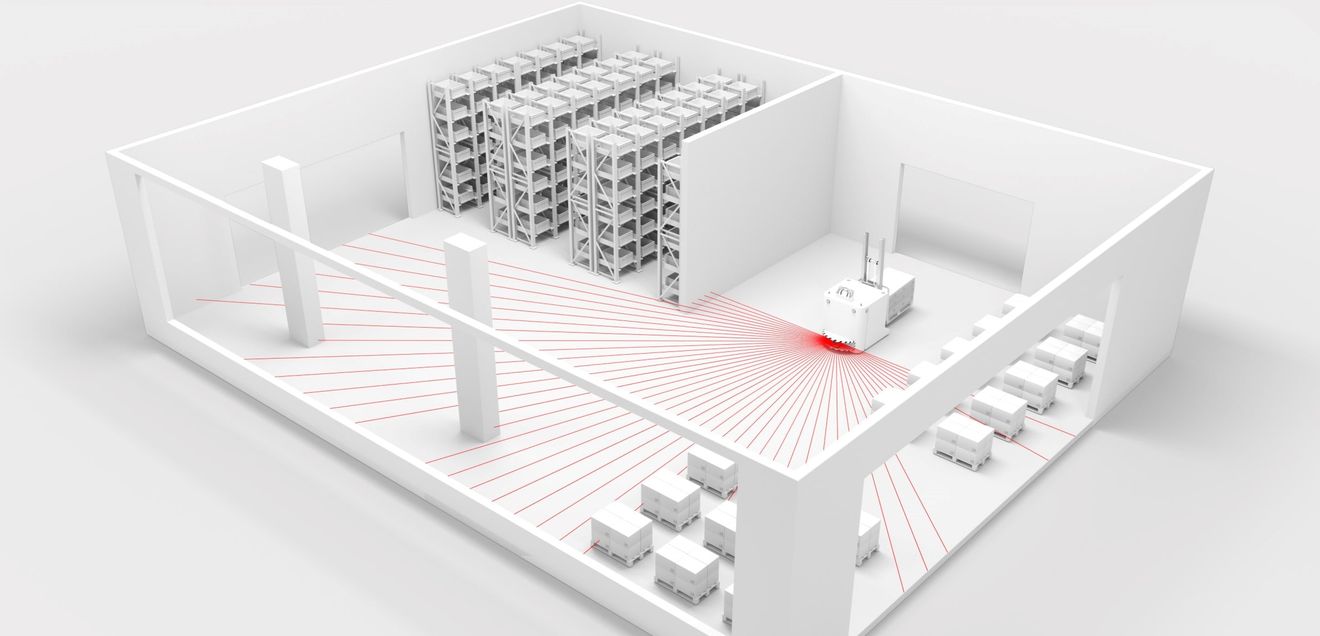
Laser navigation, also known as contour navigation or natural navigation, is recommended for particularly precise and flexible navigation of the AGV. This is based on laser scanners or lidar (light detection and ranging). The AGV first drives through its surroundings in "learning mode", detects fixed points using a rotating laser beam and creates a map from this. The AGV uses this map to orient itself autonomously in space. Obstacles can be reliably detected and, if necessary, avoided. Compared to camera-based systems, laser navigation works even in dark environments and in poor lighting conditions. Please note: Dust or dirt can impair the precision of the system. Regular maintenance and cleaning are therefore necessary. In addition, the range of the laser beams is limited. Laser navigation is therefore more suitable for work areas with clearly defined contours than for wide, contourless environments. The main advantage of laser navigation is precise and flexible navigation. The sensors that can be used for this are safety laser scanners, such as the RSL 400 safety laser scanner from Leuze. It combines safety technology and measured value output in one device.
For dynamic environments
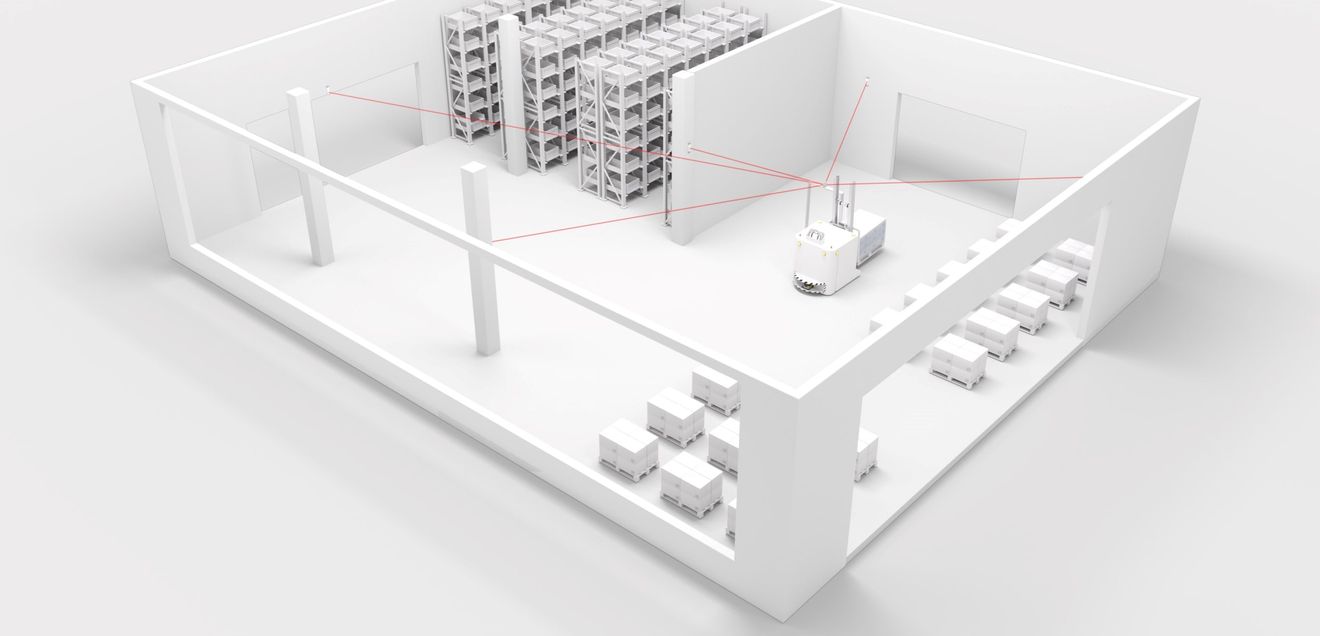
Laser triangulation uses reflectors in the room to determine the AGV position with a laser scanner. The scanner requires visual contact with at least three reflectors, which are installed at a height of several meters. This enables very precise positioning and navigation of the AGV. This technology is useful in dynamic, frequently changing environments. On the cost side, it must be taken into account that the sensor must be attached to the AGV at reflector height. In addition, the reflectors must be installed in the room. These must be visible at all times in order to reliably determine the position of the AGV. Please note: Additional sensors are required for route protection. Lidar sensors are used here.
Always follow the path
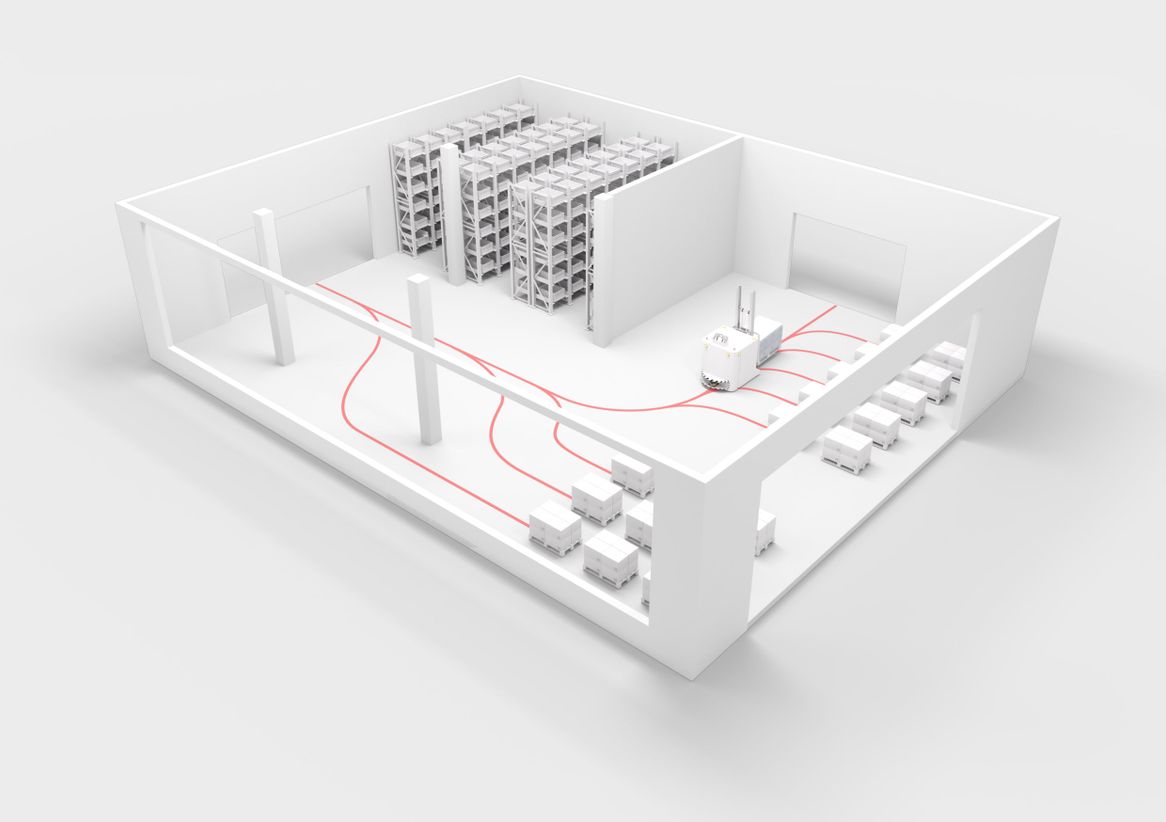
Another type of AGV navigation is optical or inductive guidance. With inductive guidance, the AGV follows a magnetic tape or induction cable laid in the ground; with optical guidance, it follows a track laid on the ground. Sensors installed on the AGV detect the path, enabling the vehicle to be precisely aligned. The advantage is that the acquisition and installation costs for the sensors are manageable. This technology is particularly suitable for environments with clear and predictable paths. It is independent of the vehicle type: the sensor is simply attached to the AGV at a short distance from the ground. The disadvantages include the effort required on site if magnetic tape or induction cables are laid. In this case, vehicles are also fixed to the previously defined lane. This limits flexibility for new layouts or routes. In addition, navigation can be less precise compared to lidar or camera technologies when there are many bends or narrow passages. The sensor technology that can be used for this: optical guidance sensors, such as the OGS 600 from Leuze. The sensor uses edge detection to recognize the lane and sends corresponding signals to the control system.
AGV navigation by structure
Grid navigation is based on a coordinate system. It consists of 2D codes on the ground or transponders embedded in the ground. These are attached in a grid pattern and serve as reference points that the AGV uses to determine its position. The AGV moves along predefined grid paths. This technology is easy to implement. The coordinate system enables precise positioning and high navigation accuracy. Grid navigation is particularly useful in environments with predictable and structured routes, such as warehouses or production facilities with clear lanes. The disadvantage is the lack of flexibility for new routes or frequently changing environments. The installation of transponders also requires physical intervention in the floor. This is where 2D code readers come in, such as the DCR 200i from Leuze. Installed on the AGV, the sensor reads the codes as it drives over them. The advantages are the extremely compact design and the large working range of 40 to 360 mm.
High flexibility thanks to camera-based navigation
With camera-based navigation or vision guidance, cameras capture markings or patterns in the environment. The navigation software uses this data to determine the position and navigation of the AGV. The main advantage is the high degree of flexibility when routes change frequently. However, camera-based systems often only work to a limited extent in poor light or weak contrasts. In addition, their range is limited and objects at greater distances cannot always be recognized precisely. Compared to other navigation methods, the implementation of camera-based systems in the overall system can be more complex. The acquisition costs are also often higher, and investments have to be made in high-quality cameras and image processing technology. So-called ToF cameras are used for this type of navigation.
The important thing is that the navigation technology for AGVs, including sensors, must match the company's intralogistics. Only then can material transportation be designed for maximum efficiency.


You might also be interested in
The finalists for the IFOY Award 2026 have been announced
The IFOY Award 2026 is entering the decisive phase: 17 devices and solutions from eight nations and four start-ups have made it to the final. The finalists will face the IFOY audit at the Test Camp Intralogistics in Dortmund in April.
 read more...
TwinFleet shows what industrial trucks really do
What are industrial trucks doing on the factory floor all day? Leadec TwinFleet answers this question: the solution creates transparency and shows starting points for optimizing the fleet and warehouse.
read more...Powerful with a long range
With the Q2X series from Banner Engineering, Turck presents compact miniature opto sensors with maximum ranges and five different detection modes for a wide range of applications.
read more...New generation of dolly radio sensors
In many manufacturing companies, dollies or floor rollers provide mobility in the material flow. With the Nexy communication network, these dollies can be integrated into the automatic material or replenishment supply.
read more...Ultrasonic sensors for many applications
Leuze presents the 420B and 412B ultrasonic sensor series. The ultrasonic sensors are available with adjustable sound beam and as switching (HTU) or measuring (DMU) sensors for flexible applications.
read more...AI-supported sensor solutions
At Fachpack in Nuremberg, Sick will be presenting sensor solutions for process and quality control as well as machine safety.
read more...Five-megapixel autofocus camera in starter set
The U-Eye XS from IDS Imaging Development Systems weighs just 12 grams and, thanks to its size of just 26.4 x 23 x 21.7 millimeters, fits into a wide range of embedded applications in the logistics sector.
read more...Reliable object detection for warehouse automation
With the new W10 photoelectric proximity switch, Sick presents a sensor with which a wide range of detection tasks in automation technology can be solved more universally than ever before.
read more...Handy and smart: New ident sensor with USB interface
With the BVS Ident-Sensor USB, Balluff is expanding its portfolio with a small and cost-effective variant. The code reader transfers content to the IT system quickly and easily, tracks goods in the logistics system - and is an intelligent...
read more...