
Port of Hamburg
Seaborne cargo handling at the Port of Hamburg recovers in 2021
Following last year's slump due to the coronavirus pandemic, seaborne cargo throughput at the Port of Hamburg developed more positively than expected in 2021. With a result of 128.7 million tons and thus an increase of around two percent, seaborne cargo throughput was better than in the first year of the coronavirus pandemic. Container throughput reached 8.7 million TEU (20-foot standard containers), an increase of 2.2%.
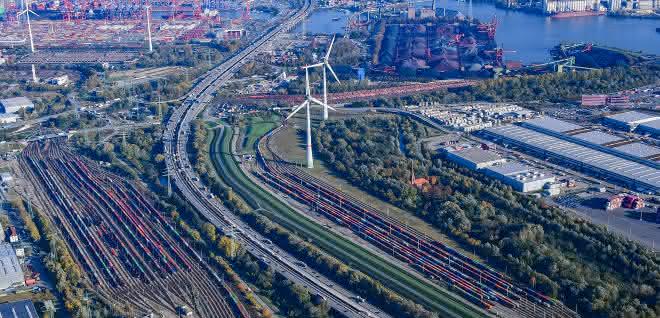
Rail freight transport achieved a record result in 2021. The Hamburg port railroad handled a transport volume of 48.5 million tons (+4.0 percent) last year. At 2.79 million TEU, container transport even achieved an increase of eight percent. "Hamburg is impressively expanding its leading position as the world's largest rail port. Despite the ongoing challenges posed by the pandemic and disrupted transport chains, a new record result was achieved for environmentally friendly rail freight transport," says Ingo Egloff, CEO of Port of Hamburg Marketing e.V. (HHM).
Additional container train connections and increasing transports in the medium distance range up to 300 kilometers promoted growth by rail. The modal split share of rail in container transport in Hamburg is now 51.5 percent. The shift of freight transportation to rail is exemplary in Hamburg, relieving the burden on the roads and protecting the environment. The proportion of trucks in Hamburg is declining and now stands at 46.1 percent. Inland waterway vessels account for 2.4 percent of container transport to and from the Port of Hamburg.
Strong growth in container transportation on the New Silk Road
In addition to sea transportation, more and more containers are also being transported by rail between China and Hamburg. Hamburg is the leading start and end point in Germany for container shipments by sea and for container train connections on the New Silk Road. "Even though it currently takes around 20 days to transport the more than 12,000-kilometer route between China and Hamburg by rail, the overland route via the New Silk Road is faster than by ocean-going vessel. The container train connections between Hamburg and China therefore offer an attractive transport alternative for time-critical goods. Last year, around 160,000 TEU were transported by rail between Hamburg and more than 25 destinations in China. That is a strong increase of 51 percent. A total of more than 290 China train connections to and from Hamburg are marketed by various providers," explains Axel Mattern, CEO of HHM.
Seaborne cargo handling in the Port of Hamburg in 2021
The global impact of the coronavirus pandemic also influenced the handling and traffic development in Germany's largest universal port in 2021. In 2021 as a whole, 128.7 million tons of seaborne cargo were loaded or unloaded at the terminals in the Port of Hamburg. This is an increase of 1.9 percent compared to the previous year. Both general cargo handling, which increased by 1.3 percent to 88.9 million tons, and bulk cargo handling at 39.8 million tons (+3.3 percent) contributed to this growth. In the container handling segment, a total of 8.7 million TEU were handled in Hamburg in 2021. Compared to the previous year, this is an increase of 2.2 percent.
Within the bulk cargo segment, the handling of grab cargo developed positively with a total of 21.6 million tons, an increase of 11.2%. The main contributors to this growth were the import of coal at 5.5 million tons (+15.9%) and ore at 10.5 million tons (+10.6%). In the agribulk sector, a total of 6.4 million tons of suction goods were handled in 2021. The overall decline of 14.7% is due to less handling of grain. In the liquid cargo segment, throughput in 2021 totalled 11.8 million tons (+1.7%). More exports of mineral oil products are primarily responsible for the slight increase in this segment, which is developing very stably overall. "In addition to looking at the volume of goods handled in the port, one should also consider that goods worth around 116 billion euros are exported around the world every year from German production alone via the Port of Hamburg. The Port of Hamburg secures around 607,000 jobs in Germany," says Egloff.
China, the USA and Singapore lead the ranking of Hamburg's top 10 partner countries in container throughput
In terms of container throughput in the Port of Hamburg's ten most important partner countries, the countries in positions one to six remained unchanged. The decline in seaborne container throughput volumes with China, which was recorded in the previous year, was halted. In 2021, an increase of 5.5 percent was achieved with 2.6 million TEU. This consolidates China's position as Hamburg's most important trading partner by far. "We are very pleased that Hapag-Lloyd will be connecting the Port of Hamburg with the southern Chinese terminal Dachan Bay, which belongs to the Port of Shenzhen, on a weekly basis from April with the new China Germany Express (CGX). This new container liner service will further expand the total of 18 liner services connecting Hamburg with Chinese ports and consolidate Hamburg's position as a leading port in China," says Mattern.
Among the other trading partners in container traffic, the USA (+4.5 percent), Singapore (+0.9 percent), Russia (-3.0 percent), Sweden (+7.5 percent) and the United Kingdom (-9.9 percent) follow China in the ranking. Poland (+20.7 percent) followed in seventh place in the Port of Hamburg's top 10 overview, South Korea (-0.4 percent) in eighth place, Denmark (+4.6 percent) in ninth place and Brazil (+3.2 percent) in tenth place.
The completed fairway adjustment of the Lower and Outer Elbe brings advantages
Incoming and outgoing shipping now benefits from an increase in draught of between 1.00 and 1.90 meters compared to the situation before the deepening of the fairway - depending on the dimensions of the ship. For example, Megamax ships with a width of up to 62.50 meters or a length of 400 meters can enter the port with a draught of up to 13.10 meters, regardless of the tide. Before the adjustment, it was only 11.40 meters. Depending on the tide, it is now 14.10 meters. A draught of 15.40 meters is even possible on incomings. Previously it was only 13.60 meters.
"We would like to thank our customers and partners for their trust in us and the Port of Hamburg during the long-standing fairway adjustment project. Since the end of January this year, we have now been able to enable improvements in maximum draughts of between 1.00 and 1.90 m for both tide-independent and tide-dependent traffic, depending on the size of the ship. This helps to strengthen the Port of Hamburg's competitiveness," says Jens Meier, CEO of the Hamburg Port Authority.
Another advantage is the possibility that has now been created for better encounters between large ships. A meeting box was built at Wedel over a length of eight kilometers. This makes it possible for ships with a combined width of less than 104 meters to pass each other. In addition, the fairway between Wedel and the mouth of the Stör River was widened from 300 meters to 320 meters. Ships with a combined width of less than 92 meters can now safely pass each other here.
The two board members of Port of Hamburg Marketing, Axel Mattern and Ingo Egloff, welcome the now successfully completed adjustment of the Elbe fairway. "For shipping and our port customers from the business sector, the improved accessibility of Germany's largest universal port also brings the advantage of routing more cargo via Hamburg. Last year alone, 221 large container ships in the 18,000 to 24,000 TEU slot capacity class called at the Port of Hamburg. This is an increase of 16.9 percent and shows that the now completed fairway adjustment is of enormous importance for safe and fast traffic management on the Elbe. With efficient transport routes, smart logistics solutions and the increasing use of low-emission energy sources and technology, we are on the right course towards sustainable growth," says Mattern. On the land side, the environmentally friendly railroad takes over the main part of the transportation of goods and connects the inland market regions quickly and reliably with the port.
Outlook 2022
"The war in Ukraine will also have an impact on the Port of Hamburg's throughput development. However, it is not yet possible to say to what extent the sanctions against Russia will affect throughput development. It is not possible to make a realistic forecast for the current year at this time, as the coronavirus pandemic could also continue to have an impact on seaborne foreign trade," says Mattern. For 2022, the Port of Hamburg's marketing organization is hoping for an overall stable trend in seaborne cargo throughput.


You might also be interested in
Save Food Initiative at the Interpack 2026
Clever approaches against food waste
At Interpack 2026, the Save Food Initiative and its international partners will be showing how packaging systems can become more sustainable and reduce food waste. Expert talks, awards and practical examples will provide concrete inspiration.
 read more...
100+ installations worldwide: Trust through practice
Automation must function reliably, every day, at all times. With more than 100 adapter-based sorting systems from Dürkopp Fördertechnik (DFT) installed worldwide, the technology has proven itself in continuous industrial operation.
read more...Packaging industry in Nuremberg
Fachpack 2025: A breath of fresh air for start-ups and converting
From September 23 to 25, 2025, Fachpack will bring together the packaging industry in Nuremberg. With new formats such as the FuturePack start-up summit and the Converting meets Packaging pavilion, the trade fair will focus on current developments...
read more...Returns logistics: automated, sustainable and future-oriented
Returns have become an integral part of e-commerce - and continue to pose one of the biggest logistical challenges, particularly in the fashion segment. High volumes, short processing times, complex quality requirements and increasing customer...
read more...The Anton Cloud is coming
Anton Software, provider of the EVA shipping and export system for 35 years, will present two innovations at Logimat 2025 - the Anton Cloud, a plus in terms of relieving the burden on in-house IT departments and reducing costs as well as secure...
read more...Generative AI in the automation environment
The mechanical engineering and automation industry is undergoing profound change. This transformation is being driven by more volatile global trade, geopolitical crises and increasing market pressure, which demands greater agility, technological...
read more...Using AI-supported robots to combat the labor shortage in logistics
Logistics companies have already invested heavily in robotics and automation in response to increased demand. However, the shortage of labor threatens to slow down growth. According to the International Federation of Robotics, a new generation of...
read more...New prospects for robotics and AI in 2024
The current boom in artificial intelligence is opening up completely new perspectives for robotics in particular. From the perspective of robot manufacturer ABB, Marc Segura outlines the opportunities for the industry in intralogistics and beyond....
read more...Conveying and lifting technology
Automated high-bay warehouse reduces required floor space
7.5 million items in a warehouse with 15,000 square meters of space: Recommerce provider Rebuy will temporarily store this amount of media products in Berlin in the future to make them ready for resale.
read more...