
"No green chichi"
Logistics uses the levers for more sustainability
"The topic of sustainability is here to stay," said Thomas Fell, Managing Director of GS1 Germany, at the opening of the 26th Retail Logistics Congress, which took place in Cologne on August 18 and 19.
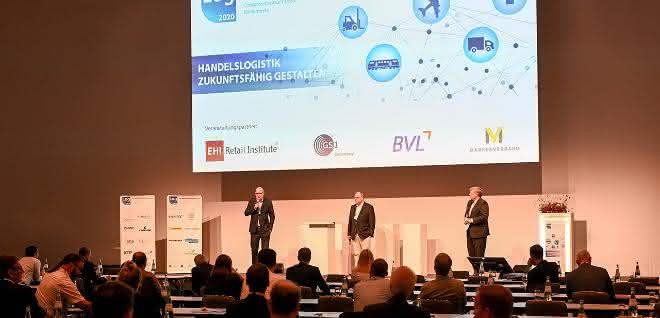
Numerous speakers from companies in the logistics sector underlined the importance of sustainability in logistics. The congress was organized by the BVL, the EHI Retail Institute, GS1 and the Markenverband and was one of the first business congresses to take place as an in-person event after the pandemic-related shutdown.
Logistics does not have a good image, particularly with regard to environmental sustainability. In reality, however, this economic sector, which is particularly focused on efficiency, has access to important levers - and uses them. "We don't want any green chichi," emphasized Timothy Glaz, Head of Corporate Affairs at Werner & Mertz GmbH, for example. In his presentation, he showed how sustainable packaging concepts can be designed.
From recyclate to reusable packaging: industry, retail and logistics are rethinking
What if, for example, product packaging could be made from as much post-consumer waste as possible, such as that found in the yellow bag? Glaz illustrates that this is possible by using the example of recyclate, a granulate made from plastic waste. In purely technical terms, it is possible to produce packaging for shower gel and the like from 100 percent recyclate. There are only shortcomings in terms of appearance, which make further development of the process necessary. Glaz is also calling on politicians to lower the regulatory hurdles for the use of used materials. In contrast, memo AG's reusable shipping system has already been clarified in regulatory terms and is already in circulation. The provider of sustainable products for office and leisure has been optimizing this system since 2009. On request, the end customer receives a reusable box as packaging for their order. After removing the contents, the customer returns it to the cycle. In order to perform better ecologically than a conventional shipping box, such a box must be circulated 55 times.
Olaf Dechow from the Otto Group makes it clear that saving plastic packaging is not only ecologically sustainable, but also makes sense from a business perspective. Among other things, he refers to the EU plastic tax that will apply from January 1, 2021.
From the middle to the last mile: alternative concepts are booming
At the various stages of the supply chain, logisticians are working on many aspects of more sustainable business - for example on the middle mile in the sorting centers. Andreas Marschner, Vice President EU Transportation Services at Amazon, advocates pre-sorting and bundled deliveries in order to optimize the utilization of the transport vehicles that are sent from there on the last mile to the cities and the end customer. This allows multiple shipments to be made to destinations close to each other, thus reducing traffic in the city and CO2 emissions. Another model with the same goal is the delivery of private parcels to the workplace. Parcels can be bundled and delivered to a parcel box or a parcel kiosk at the workplace, where employees can collect them, which also relieves the workforce of an everyday problem. "In this way, we can achieve 6,000 fewer trips per day," says Björn Kleszczewski from the Düsseldorf-based company incharge. As is so often the case, economy and ecology go hand in hand, as more than half of logistics costs are incurred on the last mile, as Dr. Kai D. Kreisköther from Aachen-based start-up DroidDrive explained. "But urban logistics in particular still has a lot of potential. And it would be a shame not to be able to exploit it," emphasized Prof. Dr. Wolfgang Stölzle from the University of St. Gallen.
Working together for more sustainability
"Sustainability is feasible if you are fully committed to the topic," said Marschner from Amazon, taking the wind out of the sails of the skeptics. However, he admits that sustainability is also a process that cannot be optimized overnight and can take some time to become lucrative, especially from a business perspective. In order to successfully become more sustainable, it is important to make use of the opportunities offered by digitalization and, above all, to work together. Collaborations such as those between logistics companies and packaging manufacturers or manufacturers and CEP service providers open up new, additional opportunities.


You might also be interested in
Around 2,300 participants expected
Kick-off for BVL Supply Chain CX
With over 220 experts, 120 exhibitors in the Expo Area and around 2,300 participants, the second edition of BVL Supply Chain CX has opened at the Estrel Berlin. Until Friday, the focus will be on exchange, inspiration and networking.
 read more...
Denkinger awarded the German Logistics Prize 2024
Denkinger Internationale Spedition is delighted to have won the German Logistics Award 2024. With the winning project "Rail.Hub", the medium-sized transport and logistics company impressed the jury with a mix of ideas and innovations and their...
read more...Arvato Takes Over European Logistics for Mister Spex
Starting September 1, 2026, Arvato will take over key logistics and fulfillment processes for Mister Spex in five European countries. The partnership is intended to create a scalable supply chain and support the continued growth of the omnichannel...
read more...New Logistics Hub for Panasonic HVAC in Europe
NOSTA Logistics is expanding Ladbergen into a European logistics hub for Panasonic HVAC. To this end, the full-service logistics provider is making 12,000 square meters of space available, where air conditioning, ventilation, and heat pump...
read more...TGW Automates Intersport Distribution Center
Intersport France has launched a new, highly automated distribution center in Saint-Vulbas, near Lyon. The facility, built by TGW Logistics, is designed to support the sporting goods retailer’s growth, smooth out seasonal peaks, and make store...
read more...Major project in the Korean retail sector
Knapp builds Korea's largest shuttle system
Together with Knapp and Doosan Logistics Solutions, Asung Daiso is building a new highly automated omnichannel logistics center in Yangju, South Korea. The facility is the largest shuttle system ever built by Knapp in South Korea.
read more...Kion gets off to a strong start in 2026
Significant increase in incoming orders
The intralogistics company Kion Group records a significant increase in order intake in the first quarter of 2026 and increases profitability and cash flow despite geopolitical uncertainties.
read more...Jungheinrich implements automation for...
Fully automated large warehouse launched in Páty
Gebrüder Weiss has put an automated warehouse into operation in Hungary, largely replacing manual processes. The new logistics center near Budapest increases efficiency, capacity and sustainability and at the same time responds to increasing demands...
read more...Integration of a robotics solution
Lyreco modernizes logistics center in France
Lyreco is pressing ahead with the automation of its central site in Villaines-la-Juhel with an investment volume of over 25 million euros.
read more...