
Data from databyte proves it
Logistics sector in the fast lane
Never before have there been so many new start-ups in the sector recorded in the commercial register as in 2021, while insolvencies are at their lowest level for ten years. An observation that deserves a closer look.
Logistics in Germany: an overview
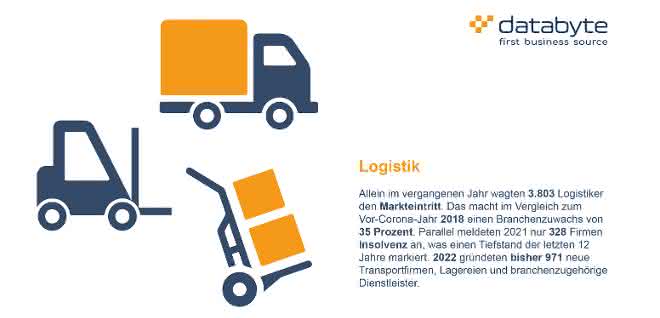
In May of this year, the commercial register recorded 30,788 active companies in the logistics sector. Last year alone, 3,803 logistics companies ventured into the market. Compared to the pre-coronavirus year of 2018, this represents a 35% increase in the sector. At the same time, only 328 companies filed for insolvency in 2021, which marks a 12-year low. So far in 2022, 971 new transport companies, warehouses and related service providers have been founded.
Measured as a percentage of the general industry landscape per federal state, the north is best positioned in terms of logistics: Hamburg has the largest share with 2.6 percent, followed by Bremen, Brandenburg, Lower Saxony and Schleswig-Holstein. In terms of water transportation in particular, Hamburg is ahead with 682 and Lower Saxony with 649 economically active companies - far ahead of the quantitative leader North Rhine-Westphalia. The most populous federal state is the undisputed leader in rail, road and logistics centers and warehouses. Hesse is ahead in air transport with 75 companies.
Not a figurehead: female managers in the logistics industry
One area in which the sector can gain even more momentum is the number of female managers. While the proportion of women in management positions across all sectors in Germany is around 24%, logistics only has just over 10%. Here again, the sectors differ greatly: while road transport still has 16 percent, rail transport literally falls by the wayside with three percent women in management positions.
Successful on the rails
When looking at individual logistics sectors, one thing stands out: Rail transport reported the strongest growth from 2020 to 2021 at 200%. The reasons for this may be announced federal funding to modernize the rail system or the positive climate footprint of transporting goods by rail. Rail transport is followed by air transport with an increase of 68%, water transport with 58%, warehouses with 26% and, bringing up the rear, road transport with 7%.
Warehouses and distribution centers
Intralogistics has also been one of the big winners in recent years, with 2021 breaking all records: 20 years ago, 271 new companies emerged, 10 years later the number grew by 200 warehouses. In 2020, warehouse logistics already recorded 643 new market participants. Due to pandemic measures and supply bottlenecks, the number of new start-ups rose to 810 companies in 2021 within a year. At the same time, insolvencies remained at their lowest level since 2008.
"The current look at the commercial register gives the impression that the logistics industry is responding to its challenges by founding new specialized market players," observes Alexander Hiller, Managing Director of databyte GmbH. "Whether it's the LKSG, supply bottlenecks or the implementation of upcoming ESG guidelines - the industry is on the move."


You might also be interested in
Save Food Initiative at the Interpack 2026
Clever approaches against food waste
At Interpack 2026, the Save Food Initiative and its international partners will be showing how packaging systems can become more sustainable and reduce food waste. Expert talks, awards and practical examples will provide concrete inspiration.
 read more...
100+ installations worldwide: Trust through practice
Automation must function reliably, every day, at all times. With more than 100 adapter-based sorting systems from Dürkopp Fördertechnik (DFT) installed worldwide, the technology has proven itself in continuous industrial operation.
read more...Packaging industry in Nuremberg
Fachpack 2025: A breath of fresh air for start-ups and converting
From September 23 to 25, 2025, Fachpack will bring together the packaging industry in Nuremberg. With new formats such as the FuturePack start-up summit and the Converting meets Packaging pavilion, the trade fair will focus on current developments...
read more...Returns logistics: automated, sustainable and future-oriented
Returns have become an integral part of e-commerce - and continue to pose one of the biggest logistical challenges, particularly in the fashion segment. High volumes, short processing times, complex quality requirements and increasing customer...
read more...The Anton Cloud is coming
Anton Software, provider of the EVA shipping and export system for 35 years, will present two innovations at Logimat 2025 - the Anton Cloud, a plus in terms of relieving the burden on in-house IT departments and reducing costs as well as secure...
read more...Generative AI in the automation environment
The mechanical engineering and automation industry is undergoing profound change. This transformation is being driven by more volatile global trade, geopolitical crises and increasing market pressure, which demands greater agility, technological...
read more...Using AI-supported robots to combat the labor shortage in logistics
Logistics companies have already invested heavily in robotics and automation in response to increased demand. However, the shortage of labor threatens to slow down growth. According to the International Federation of Robotics, a new generation of...
read more...New prospects for robotics and AI in 2024
The current boom in artificial intelligence is opening up completely new perspectives for robotics in particular. From the perspective of robot manufacturer ABB, Marc Segura outlines the opportunities for the industry in intralogistics and beyond....
read more...Conveying and lifting technology
Automated high-bay warehouse reduces required floor space
7.5 million items in a warehouse with 15,000 square meters of space: Recommerce provider Rebuy will temporarily store this amount of media products in Berlin in the future to make them ready for resale.
read more...