
Logistics service providers
Green Logistics - part of the company's DNA
Green logistics is firmly anchored in the DNA of logistics service providers. In addition to the ongoing professionalization of transport services and diversification of complex services along the entire supply chain, sustainable and environmentally friendly business practices play a central role. Saving energy and fuel costs as well as alternative drive concepts for vehicles are at the top of the list.

Twenty-three percent of global energy-related greenhouse gas emissions are generated in the transportation chain, which includes logistics," reports the
"Through our activities as the world's largest logistics service provider, we therefore have a special responsibility to reduce the negative impact of our business on the environment. The Group-wide GoGreen environmental protection program is an expression of this responsibility. The focus is on avoiding, reducing and, if necessary, offsetting greenhouse gas emissions. CO2 emissions, which have the greatest overall negative impact on the environment for logistics, are the top priority. In 2008, DHL was the first logistics provider worldwide to introduce a measurable climate target: "We want to increase the CO2 efficiency of our own transportation services by 30 percent by 2020 compared to 2007 levels."
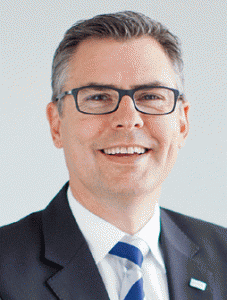
"The importance of green logistics in our industry is growing every day. One of the pioneers of sustainable concepts in logistics is digitalization: it makes many routes shorter, helps to manage supply chains more efficiently, saves resources and, of course, CO2."Matthias Schadler Managing Director pfenning logistics Photo: pfenning logistics
CO2-free parcel delivery in Cologne and Bochum
The most recent measure in this context is the use of StreetScooter electric vehicles for parcel delivery. A total of 66 of these vehicles will be in use in Cologne by the end of the year.
This was announced on September 8 by Jürgen Gerdes, Member of the Board of Management of Deutsche Post DHL Group responsible for the mail and parcel business, together with NRW Transport Minister Michael Groschek and the Mayor of Cologne, Henriette Reker. "In times of booming e-commerce, it is not only the number of parcels we deliver to customers that is growing, but also our responsibility towards our environment," says Jürgen Gerdes. "We take this responsibility very seriously, which is why we are now also launching CO2-free parcel delivery in Cologne, the largest city in North Rhine-Westphalia." By switching parcel delivery to purely electric vehicles by the end of 2016, almost 200 tons of CO2 will be saved in Cologne every year.
In July of this year, Deutsche Post DHL also gave the green light for CO2-free parcel delivery using the environmentally friendly StreetScooter in Bochum. In the medium term, Deutsche Post DHL Group intends to convert its entire delivery fleet to e-vehicles. To this end, production capacity at the StreetScooter plant in Aachen is currently being expanded so that around 10,000 of these electric vehicles can be produced annually from 2017.
Green Logistics at pfenning logistics
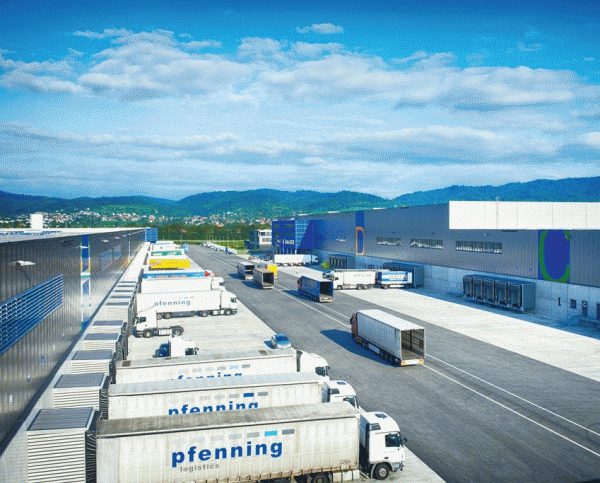
As one of the largest retail logistics providers in Germany
has a special responsibility in dealing with sustainability issues. "Every kilometer that we travel in an environmentally friendly way is a plus for our customers' environmental footprint," says Matthias Schadler, Managing Director of pfenning logistics. "When implemented consistently, green logistics also increases efficiency for us as a logistics company and ultimately for us as people."
For five years now, the company has been following its own sustainability commitment in investment planning, project development and operational practice, which covers all areas of the company and extends to the responsibility of individual employees.
With the planning and construction of logistics centers such as the multicube rhein-neckar, pfenning logistics is setting standards throughout Europe. Since its DGNB certification in 2013, the multi-user facility, which went into operation in 2012, has consistently ranked first among all industrial buildings in Europe, first receiving the gold certificate with a top score of 1.21 and then the platinum certificate from the German Sustainable Building Council (DGNB) in 2015. The top score of 1.21 corresponds to 93 percent of all achievable points. The property achieved a top score of 100 percent in both the ecological quality assessment and process quality categories. In 2013, the multicube rhein-neckar was awarded the 1st German Logistics Real Estate Award "logix".
Achieving environmentally effective bundling effects
"We are delighted to win awards with Green Logistics concepts," says Schadler. "However, we are even more pleased to be able to save energy costs and achieve sustainable bundling effects for our customers through innovative location concepts. Green Logistics is part of our DNA."
The "multicube rhein-neckar" offers 128,000 square meters of storage space for 360-degree logistics with high value-added potential: It is divided into separate hall modules and thus enables the storage of different product and retail ranges from the chemical, food, pharmaceutical and FMCG sectors in parallel under one roof.
The roof of the plant, equipped with Europe's largest crystalline rooftop solar system, is a solar power plant: 33,000 solar modules on 11 hectares of roof surface provide an electricity output of 8.1 megawatts and save 5,171 tons of CO2 per year compared to fossil fuels. This volume can ensure the supply of up to 5,000 households.
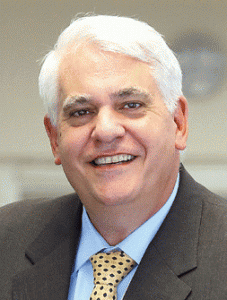
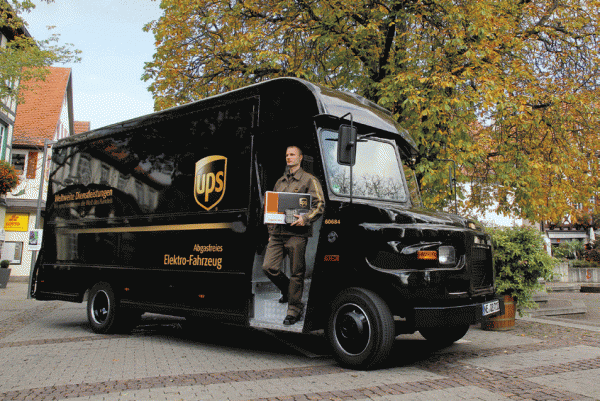
"With the use of electric vehicles throughout Germany, UPS is committed to innovation and sustainability."Frank Sportolari Chief Representative UPS Germany Photo: UPS
pfenning logistics is also investing in technologies that enable environmentally friendly logistics in the area of transportation. Over the past two years, more than 17 million euros have been invested in modernizing the fleet, which currently consists of 600 vehicles. Around 80 percent of the tractor units are equipped with modern Euro VI engines. The new vehicles are equipped with a telematics system that allows the fleet's deployment planning and efficiency to be optimized. All professional drivers employed by pfenning logistics learn how to drive economically at the pfenning Academy.
Preserving the environment is particularly important to this third-generation family business. At pfenning logistics, voluntary environmental management certification in accordance with ISO 14001 is therefore an integral part of the Green Logistics philosophy.
"Ideally, the returns come back CO2-neutral"
"Those who make green logistics part of their corporate philosophy not only earn recognition for it, but also come up with better, often very innovative solutions," explains Schadler with a view to the growing returns rates in online retail. "You have to think about the supply chain from the end in order to achieve economical and environmentally friendly solutions in reverse logistics."
With integrated concepts, pfenning logistics therefore considers every step of the return process for its well-known retail customers: from packaging design requirements and environmentally friendly packaging materials to the consolidation of returns across locations. "Ideally, returns come back CO2-neutral," says Schadler.
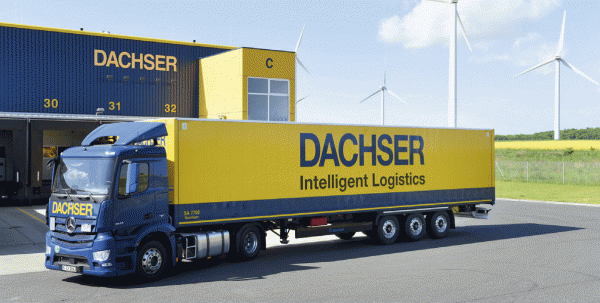
has implemented sustainable, centrally controlled logistics for Blueair with two European warehouse hubs and the intelligent interaction of its business fields. The motto is: "The less transportation, the better the air". After all, environmental protection and a minimal CO2 footprint are integral components of the brand promise for the manufacturer of innovative air purifiers and filters. Logistics are crucial to this, as the products are supplied to retailers in more than 60 countries.
A detailed shipment data analysis by Dachser's central contract logistics team revealed that Hamburg was the most suitable warehouse location for Blueair's European logistics due to the volume of incoming containers.
Environmentally friendly flow of goods for air filter manufacturers
Blueair produces many products in China and sells a considerable proportion of them there. 90 percent of the air purifiers and filters destined for the European market have been routed to the port of Hamburg since autumn 2015 and unpacked and palletized at the Dachser warehouse. "To ensure complete traceability of the individual products, we scan the serial numbers and also observe special packing instructions for individual recipients," says Nils Ziegler, Warehouse Operations Manager at Dachser's Hamburg logistics center.
Via the interface to the parcel service provider
replacement deliveries for service contracts are delivered directly from the warehouse to the end customer. The palletized goods do not remain in the warehouse for long either, as the coveted air filters are already sold to dealers in 12 European countries before they reach Hamburg. The products are therefore quickly fed into the logistics service provider's European general cargo network. Here, high capacity utilization rates and consistently bundled flows of goods minimize the impact on CO2 and particulate matter.
For the Scandinavian market, Dachser has mirrored the set-up in Hamburg exactly and set it up again in Stockholm: Blueair and Dachser route ten percent of the sea containers to the warehouse there, followed by overland distribution in the Nordic countries.
Nils Ziegler: "As we all work with the same WMS Mikado, no new interfaces were necessary. We were already able to prepare a lot of things in Hamburg." Blueair thus saves on transportation and the associated emissions. "Only a shuttle service between the warehouses in Hamburg and Stockholm remains."
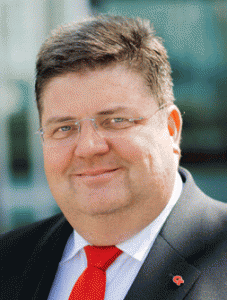
"Together with our partners, we have managed to reduce our carbon footprint by more than seven percent in a short space of time."Jörn Peter Struck Chairman of the Management Board of Cargoline Photo: CargoLine
For the future, warehouse hubs based on the Hamburg and Stockholm models are initially planned in the UK and India, and the B2C business in Europe is also to be further expanded. "With Dachser, we have succeeded in lowering transport costs and reducing our ecological footprint at the same time," emphasizes Carl-Johan Holmdahl, Order & Logistics Manager at Blueair. "That's good for business and good for the environment.
Calculate CO2 emissions per shipment or customer
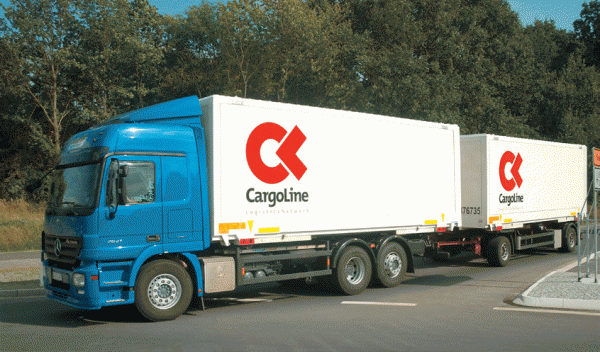
Jörn Peter Struck, Chairman of the Management Board of CargoLine: "At the end of 2011, the shareholders of
sustainability as one of our strategic corporate goals. Since then, we have recorded our emissions as a network in accordance with standards and developed a calculator with which we can determine the CO2 emissions per shipment or per customer based on these real values. We have had this validated by an independent testing body in accordance with DIN ISO 14064 and DIN EN 16258.
We have already been able to significantly reduce emissions through numerous measures such as better utilization of truck capacity, the use of Euro 6 trucks, electric forklift trucks, photovoltaic systems, green electricity, optimized routes, driver training and much more. In addition, we offset the CO2 emissions of the CargoLine system headquarters. We want to continue these efforts in the future". As Struck goes on to emphasize, "together with our partners, we have managed to reduce our CO2 footprint by more than seven percent in a short space of time."
Comprehensive sustainability is made up of many building blocks. For example, the members of CargoLine's "Green Logistics" working group developed practicable measures to reduce shipment-specific CO2 emissions. The results developed are to be understood as recommendations for action for the cooperation and are already being successfully implemented by many partners.
The following main topics were selected as starting points for CO2 reduction: Organizational and technical innovations in the fleet, driver training and incentive systems for fuel-efficient driving, support through telematics and software-supported route planning, alternative drive technologies, as well as stationary and mobile tire pressure systems. For example, regular training on fuel-efficient driving can reduce fuel consumption by up to five percent.
Conversion from diesel to electric for sustainable transport logistics
UPS introduced its 100th electric van to the European vehicle fleet in March 2016. The P34e with a gross vehicle weight of 3.5 tons is based on a Mercedes Sprinter and has the typical UPS vehicle design. It will be used primarily and initially in Paris, where dense road traffic requires smaller and fewer vehicles. The deployment of the 100th electric van is part of UPS's global strategy to convert diesel vans to electric vehicles. In Germany, UPS has already been using converted electric delivery vehicles with a total weight of 7.5 tons, the so-called P80e, since 2010. Half of the 100 environmentally friendly vehicles are currently in use in Germany.
"With its various sustainability projects, Germany is one of the leading markets for UPS in terms of environmental initiatives," says Frank Sportolari, Chief Representative UPS Germany. UPS began to increase its commitment to alternative fuels in 2012 and set itself the goal of traveling one billion miles on alternative fuels by the end of 2017. This target has now been achieved a year early. This means that around 12 percent of the diesel and gasoline fuel previously consumed by the UPS fleet is now being replaced by alternative fuels such as renewable natural gas and renewable diesel.
Reinhard Irrgang
http://www.cargoline.dehttp://www.pfenning-logistics.com http://www.dachser.de http://www.ups.com http://www.dpdhl.com


You might also be interested in
Arvato implements shuttle system for H&M in Poland
H&M will be able to handle its logistics in Central and Eastern Europe faster and more agile in future: Arvato has expanded its e-commerce distribution center in Stryków, Poland, and installed an automated shuttle warehouse with a capacity of up...
 read more...
Automation using shuttle technology and SAP
GC Corporation develops, produces and distributes dental products. In order to make the European subsidiary, GC Europe, fit for the future to meet increasing logistical requirements, the company expanded its storage and picking capacities at the...
read more...Intralogistics for steel wholesalers
Lemvigh-Müller relies on Knapp
Lemvigh-Müller is making its largest investment in logistics to date and centralizing two warehouses in Odense and Kolding, both in Denmark, into one distribution center in Kolding. This will ensure that Lemvigh-Müller can handle larger volumes of...
read more...New shuttle warehouse for BSH Hausgeräte in Dillingen
The ground-breaking ceremony for a shuttle warehouse for household appliance specialist BSH Hausgeräte recently took place in Dillingen, Bavaria. TGW Logistics will build a highly automated small parts warehouse there by spring 2027.
read more...Combined storage solution with transshipment and pallet warehouse
With the newly founded Faurecia Clarion Electronics (Fengcheng), Faurecia aims to become a global leader in electronics technology for vehicle cockpits. When it comes to intralogistics, the company relies on a combined warehouse solution from...
read more...Storage and order picking technology
SSI Schaefer automates for the market leader in ready-to-eat salads
Fresh Servant maximizes its performance through automation at its logistics center in Edsevö, Finland. The company relies on a complete system from SSI Schaefer, consisting of an SSI Cuby shuttle warehouse, pick-by-light picking and the WAMAS...
read more...30 million spare parts shipped annually
The manufacturer and supplier of automotive spare parts DRiV has put a new automated distribution center for Europe into operation. An automation solution from Knapp forms the heart of the system.
read more...Production and assembly flexibly supplied
Automotive supplier Magna manufactures exterior mirrors at its Assamstadt site in Germany. Magna relies on an automation solution from Knapp to cope with the changes in logistics and to be able to operate flexibly with a high level of vertical...
read more...Novaltia builds new distribution center with Knapp
The Spanish pharmaceutical wholesaler Novaltia is once again relying on a complete solution from Knapp: In the new distribution center at its headquarters in Zaragoza, logistics processes are to be streamlined and sequences made more precise by...
read more...