
Digitization
An invitation to open source
Four big names, one big project: Anchoring open source in logistics worldwide. Dachser, DB Schenker, duisport and Rhenus have jointly established the Open Logistics Foundation to open the next chapter of digitalization in logistics.
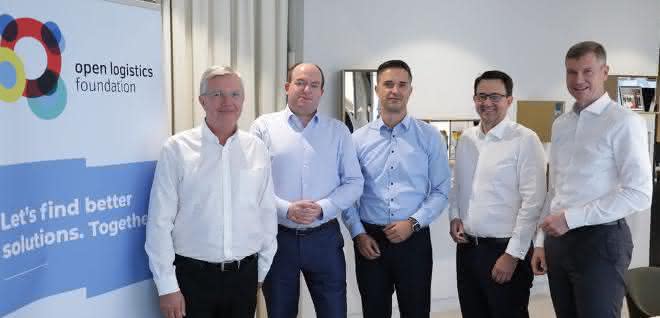
But that's just the beginning. A conversation with the founders and the person who brought them together, about their motivations, the big holes that need to be drilled and what open source could have to do with the Logistics World Cup.
materialfluss: The Open Logistics Foundation joins the ranks of the major non-profit open source foundations. Open source means that the source code of software is openly accessible. This is nothing new; many successful business models are based on this principle. Open source is everywhere, except in logistics, it seems. Why is that?
Markus Bangen: With open source, Michael ten Hompel has placed a topic in logistics that everyone knows is long overdue. We all know that we have to develop commodities together. We just haven't got over the threshold of competitive thinking so far. There have simply always been too many 'buts'. Pooling resources and topics offers us a unique opportunity to set de facto standards instead of creating more monoliths.
Christian Bockelt: To actively drive forward truly disruptive innovations, you need the right companions and a serious push. Fraunhofer IML has recognized that this constellation can make a difference and has brought us together.
Stefan Hohm: The challenges of digitalization are too great for one company to solve alone. It can only be done together. Open source has a very decisive advantage: it makes it easier to get started with digitalization and is therefore an important success factor for the entire logistics sector. At the same time, open source is a driver for a standardized process landscape in digital value chains.
Stephan Peters: It is often the case that momentum is needed. Especially in the weeks leading up to the foundation, we realized that the Foundation brought together exactly those people who have been researching innovations in the innovation environment in Dortmund and in the Fraunhofer Labs for years. We have brought together what fits together and what we have been developing for years. This innovation research has created trust and a natural closeness. When the critical phase of setting up the foundation with the lawyers began, you could clearly feel that.
mfl: The right people, at the right time, with the right mindset in the right place. Sounds sensible. But in-house IT development is something like the holy grail of logistics. Is the industry ready for open source?
Bockelt: A large proportion of our software is already created using open source. Now it's about enriching open source with logistics aspects and creating standards. That is a very exciting aspect ...
Peters:... and bringing logistics knowledge together in a repository, in an open source community, is a decisive argument. The open source approach guarantees an open standard for the digitalization of logistics processes and at the same time offers a high degree of flexibility for individual adaptations.
Hohm: Intelligent logistics is based on high-performance IT systems. This principle has applied at Dachser for many decades and will continue to do so. That is why Dachser is also known for its in-house IT development. However, it makes little sense to program every line of code in a standard application ourselves. This is neither economical nor does it offer a competitive advantage. On the contrary: it often even prevents the pragmatic networking of partners and customers. It is therefore advantageous for everyone involved in the supply chain if selected software components are made available to everyone free of charge as open source elements in future and are further developed by a neutral body.
Michael ten Hompel: The logistics sector must become significantly more software-heavy if it wants to play a role in the coming platform economy and shape its future in a self-determined way on the basis of European legal standards and values. Digitization is the goal, and open source is the key to bringing all companies, regardless of size and industry, along on this journey.
mfl: The start has been made. Now it's time to drill a few thick planks so that open source goes viral in logistics. Participate, preferably everyone - that's the motto. Why should they do this? What is the added value?
Bockelt: This approach will replace individual investments in the digitalization of commodities. Every company involved will benefit from this.
Fear: In a classic port like duisport, talking about a common slot system for all terminals would have been a waste of time and money just a few years ago. Today we are doing it. The pressure of suffering is now there. We have simply realized that we can only do it together, we won't achieve anything with isolated solutions.
Hohm: Acceptance in the logistics sector will very much depend on which use case we place first. Let's take the driver app, we already have one or two of them (everyone laughs). That's the best example of wasting resources. Every company builds its own app and every driver has countless apps on their mobile device. An enormous amount of effort is put into this, but no company generates any added value with it. Based on such simple but widespread use cases, the realization will prevail relatively quickly.
Peters: The use cases we are talking about are obvious: e-pallet bill, e-delivery bill, driver app, ETA and a few others. But the biggest challenge will be to get the logistics and software industries excited about using the open source repository and collaborating on it. We could reduce complexity and be so much more innovative, faster and better if there were no longer 100 completely incompatible individual solutions for such problems, but a common standard.
ten Hompel: That's exactly how it is, and creating this common basis is the core objective of the Foundation. There is always a tendency to tie the Foundation and open source to individual applications. This is not about four competitors doing something together. It's about increasing the leap into digitalization, because many people still significantly underestimate the complexity that we are facing with AI and predictive algorithms as the basis for data-based business models. This change - and this is really important - is also a cultural change. Many companies have long since understood that they can generate added value for themselves if they do not have to take care of every interface themselves, but can create value-adding software.
mfl: Let's talk about time and money. How much development time and costs can be saved through open source?
Peters: For us, it depends heavily on the application, but the expectations are clearly in double figures. Digitization is not an end in itself. It overcomes interfaces and contributes to overarching goals such as transparency, efficiency and sustainability. Above all, however, it must also be economically viable and successful on the market.
Hohm: Dachser's focus is on the business case. Our aim is to make local applications leaner and more standardized. IT is an orchestrator for us. It makes use of various modules. There are applications that are crying out to be downloaded from a repository and made available to a large community. And when more people think about the same topic, something better usually comes out of it.
Bockelt: There are topics that we can only solve together and there are differentiating topics for which you build your own software. And there will be algorithms that we donate to the repository and thus to the general public. It is important to us to give all players in the industry access.
Peters: We can only achieve this through transparency and the basis for this is trust. We have to convey this, in addition to what we put into the repository first.
mfl: Demanding digitalization is easy, implementing it changes everything. The year is 2031: Looking back, what should we say about today and about the Open Logistics Foundation?
Peters: I would like the headline: "Germany logistics world champion thanks to open source" or "From logistics world champion to open source world champion".
Fear: We have finally crossed the threshold of transparency and trust that everyone has been talking about for 20 years, but no one has yet overcome. We've just about got our act together.
Bockelt: The Open Logistics Foundation has triggered a wave of transformation. The bold step towards open source has paid off for both the logistics industry itself and its customers.
Hohm: I would like us to be able to say that October 22, 2021 was the day we managed to take logistics to a new level and enable collaboration - via open source.
ten Hompel: I hope that I will be able to say in three years' time: Who would have thought back then that the open source community would grow exponentially. And I think the best thing would be if, in ten years' time, we no longer remember what it was like before open source.
mfl: Michael ten Hompel, you brought the founders together. What advice do you have for the logistics industry?
ten Hompel: All companies should ask themselves one question: What are we actually doing with open source? Because the logistics community needs to be clear about one thing: In the platform economy, the money will be made with AI. The use of software will increase exponentially in a short space of time and this will only be possible with open source. Dachser, DB Schenker, duisport and Rhenus have laid the foundations for an open source community by establishing the non-profit Open Logistics Foundation. Now it is important that logistics repositions itself as an industry and joins forces. My advice? Never walk alone.
This article appeared in issue 3/2022.


You might also be interested in
Circular load carriers for more sustainable supply chains
With the planned Industrial Accelerator Act, the European Union wants to accelerate the transformation of industry towards low-carbon production processes and resource-efficient supply chains. Logistics and transportation are also increasingly...
 read more...
Integration of a robotics solution
Lyreco modernizes logistics center in France
Lyreco is pressing ahead with the automation of its central site in Villaines-la-Juhel with an investment volume of over 25 million euros.
read more...Dragsbæk halves pallet area
By using automated pallet solutions from Palomat, Dragsbæk has halved the space required for pallets, optimized processes and sustainably improved working conditions.
read more...Pixels instead of paper
With the solutions from Logistikbude, Bekuplast, manufacturer of plastic containers, keeps an eye on its load carriers, saves costs and can work more efficiently with forwarding partners.
read more...Flexibility in saving space
Purus Plastics has developed a new retail range. The company operates a processing plant for plastics; recycling creates new products from secondary raw materials, including pallets.
read more...Solutions for the food industry
At Werit, the focus is on customer-specific solutions, sustainable recycling and pooling systems and products made from recyclate. The stand concept is divided into four areas: Products and innovations in the food sector, customer solutions,...
read more...Pallets with QR code
At the Epal Germany stand, visitors can gain an insight into the reusable system propagated by Epal, the life cycle of an Epal pallet and the newly developed QR pallet.
read more...The path of the Euro pallet into the IoT
With the introduction of the EPAL Euro Pallet QR in 2024, the European Pallet Association (EPAL) aims to set a new standard for the classic Euro pallet, which has been used successfully for over 60 years, and pave the way for ecologically...
read more...Retail range: flexibility to save space
Purus Plastics has developed a new retail range that is designed to attract the interest of retailers in particular. The company operates a modern plastics processing plant in Arzberg, Bavaria; new products are created from secondary raw materials...
read more...