
From materialfluss 11-12/2019
Combine bridge and table
Vehicles can be unloaded in various ways. Two variants that are independent of the vehicle and for which the user does not require a special driver's license are the loading bridge and the loading lift table. Which is more practical? A comparison.
A loading bridge is a ramp in the building, usually hydraulically adjustable, which is used on loading ramps for loading and unloading trucks. To do this, the truck reverses up to the loading ramp. As not all loading areas have the same height, this difference in height between the loading area and the ramp is compensated for with the adjustable loading ramp. The final gap between the dock leveller and the loading area is usually bridged with ramp plates, which also compensate for the minimal deflection and rebound of the truck during the loading process.
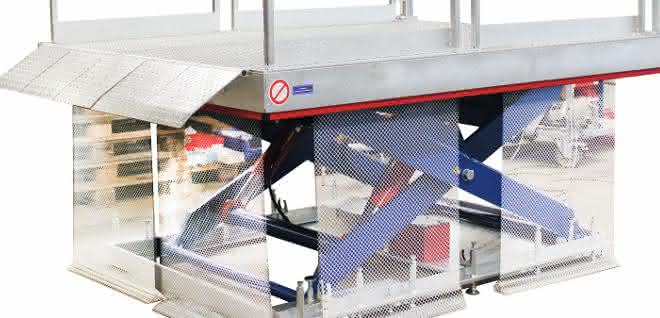
A loading lift table also compensates for the difference in height between the loading area of a vehicle and the ramp or road level. With loading lift tables, the deflection of the truck bed during the loading process is also compensated for with ramp plates. The design basis of a loading lift table is a simple scissor lift table. With extras such as ramp plates, railings and gantries, the lift table is specially adapted to the requirements of logistics applications.
Efficient handling via the loading bridge
The large loading area enables efficient goods handling via loading bridges. In contrast, with a loading lift table, the user can only place as many goods as the size and load capacity of the lift table platform allows. As trucks are usually much larger than scissor lift tables, the lift table must always be moved. A loading bridge can therefore be used to load and unload the vehicle quickly if a large number of Euro pallets or grating trolleys need to be moved.
Loading lift table scores with flexibility
However, when it comes to flexibility, the loading lift table beats the loading bridge. If the user wants to unload both trucks and, for example, Sprinters at the same point and possibly also enable transportation from road level to loading ramp level, the loading bridge is unsuitable. This is because its adjustment range is usually only within a range of plus/minus 30 centimetres and is therefore not sufficient to reach the different vehicle heights or even the road level. This is where the loading lift table is suitable, which can also disappear into the ground when using plug-in railings and a drive-over platform and is no longer in the way as soon as loading and unloading is complete.
All aspects must be weighed up
Together with the loading bridge, drive-in aids, dock shelters and gates are usually required. This overall package can exceed the cost of a loading lift table. However, a loading lift table can also quickly become as expensive as a loading bridge, for example in the case of a large platform with a corresponding load capacity. The user must therefore weigh up which loading and unloading solution best suits their requirements. They opt for a loading lift table if they are supplied by many different vehicle variants and need to transport goods from road level to the vehicle and/or loading ramp. The loading lift table is also the right choice if there is not much space available and the lifting aid should be invisible when not in use. Finally, he also opts for a lift table if the loading aid is to be placed detached from the building.
About Janzen Lifttechnik
Janzen Lifttechnik GmbH's portfolio includes scissor lift tables, column lifts and goods elevators. The products are designed and manufactured to customer specifications - from simple hydraulic scissor lift tables for ergonomic lifting of loads to combinations with trolleys, tilting and rotating devices. In practice, however, it is rarely an either-or decision. Larger companies and logistics centers in particular combine both solutions and make use of their respective advantages. In most dispatch centers, many loading bridges work in combination with individual loading lift tables


You might also be interested in
Loading lifting unit, transport trolley and...
Loner - now with speed
The Xetto is a loading and lifting unit, a transport trolley and a workbench - all in one. The machine manufacturer Willnecker from Germaringen sees this as a worthwhile investment due to the significant time savings in everyday assembly work.
 read more...
New lever solution with E-Drive
The new lift with e-drive from Hovmand is an innovation in lifting technology. With the help of the motorized rear wheels of the lifting device, several hundred kilograms can be moved and lifted effortlessly.
read more...Lifting columns for electric height adjustment
Versatile solutions
Lifting columns from RK Rose+Krieger are typically used for the electrical height adjustment of (assembly) workstations, medical facilities or complex systems in mechanical engineering.
read more...Working platform for safe access to train roof areas
KRAUSE has developed a roof working platform with zero gap for the Hohenzollerische Landesbahn transport company of SWEG in Gammertingen. It was adapted exclusively for "Lint 54" trains of the 622 series.
read more...Flexible transportation for heavyweights
CE partner teamtechnik Industrieausrüstung GmbH developed a heavy-duty turntable in conjunction with standard transfer systems from Bosch Rexroth for the flexible transportation of battery modules weighing up to 1,000 kg through production and...
read more...fetra further expands handcart program
The transport equipment manufacturer fetra has just launched new variants for the outdoor sector, which are intended to extend the performance spectrum and offer even more comfort.
read more...Independent loading and transport system
xetto separates from Hoerbiger Automotive
The xetto loading system is going its own way: As announced by both companies, Xetto GmbH has taken over the xetto transport and loading aid from Hoerbiger Automotive Komfortsysteme as of December 2019.
read more...Aerial work platform broker with new boss
Pedro Torres takes over Riwal
Riwal, one of the leading full-service rental companies for aerial work platforms and telehandlers, has appointed Pedro Torres as CEO of the Netherlands-based Riwal Group with immediate effect.
read more...Forklift meets aerial work platform
Jungheinrich and Riwal agree on cooperation
Jungheinrich and Riwal, a specialist in the rental of aerial work platforms and telescopic handlers, will work together in the future on an international level in the rental of their equipment.
read more...