
Forklifts & Components
The signs are green in Ireland
A big event in tranquil rural Ireland: on April 23, the industrial truck manufacturer Combilift not only celebrated its 20th birthday, but also opened the expansion of its production facility on the same day. Managing Director and Co-Founder Martin McVicar had a lot to do on the day and announced some impressive figures.
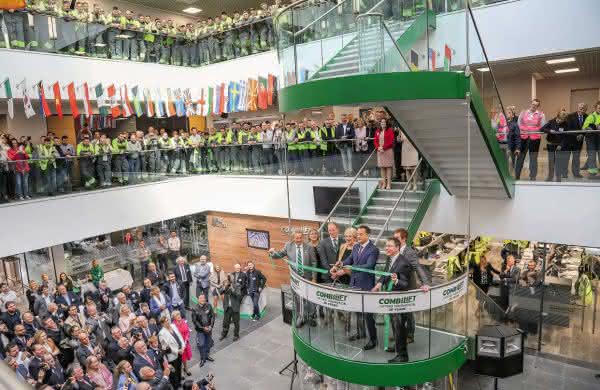
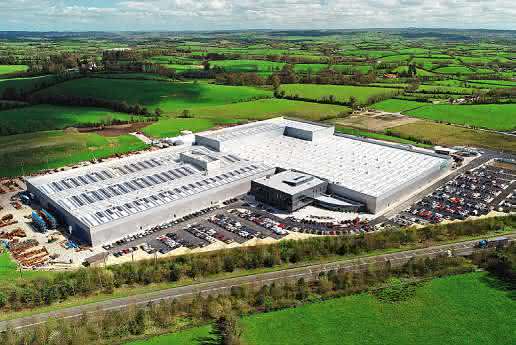
Combilift, the inventor of the four-way forklift powered by a combustion engine, will produce up to 10,000 vehicles per year in single-shift operation in the 46,500 square meter production facility following the 50 million euro expansion that began in 2015 and has now been officially opened. Previously it was 5,000 vehicles. The number of employees is set to rise from 550 to 750 in the coming years, and turnover is also expected to increase accordingly from its current level of 230 million euros.
Figures that would also make an impression in any other European country, so it was no wonder that on April 23, Irish Prime Minister Leo Varadkar left his beloved Dublin to make one of his rather rare visits to the country. In Monaghan, he was met by company employees, customers, dealers, local politicians and journalists from numerous countries. After a short speech, the obligatory ribbon was cut (here in the country's typical green) and Varadkar also immortalized himself on a commemorative plaque at the entrance to the company. Extensive company tours with extremely friendly and motivated employees ("This is your factory today, ask whatever you want") and a festive evening with typical local folklore and a humorous look at the early years of the company, when McVicar sold drawings that later became products, rounded off the inauguration ceremony.
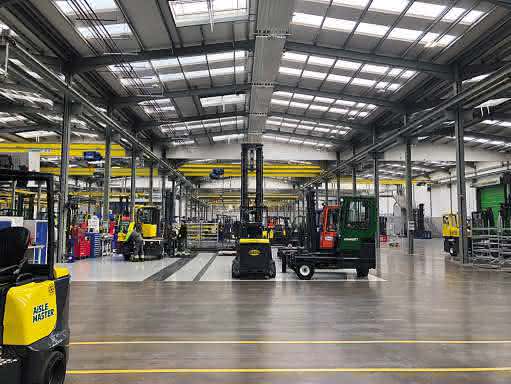
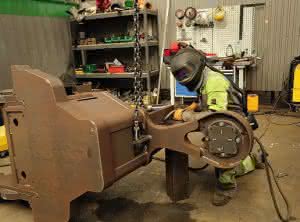
You don't have to be an expert on Irish economic policy to appreciate what a boon a local company like Combilift is for the labor market. And in Monaghan at least, the robot colleague does not yet have much say in the production of industrial trucks: Combilift operates relatively conservatively, welding by hand and the existence of four fixed production lines also points the way to a more traditional production method. In line with the slogan "The best design is simple design", the trucks are kept functional, with high-gloss finishes and high-end features supplied by other manufacturers who are more likely to be involved in mass production.
Individual solutions for the transportation of goods
calls Combilift's concept a "mass production of customized products", because it should not be forgotten that Combilift vehicles rarely form entire fleets in warehouses, but rather enable individual goods transport solutions for very specific applications - from long goods forklifts to straddle carriers for containers the height of a house. With a share of around 10 percent of turnover, manual work is also economically viable, McVicar explains in an interview with journalists. The transportation costs, which amount to around three percent of the sales price of a Combilift, are also not an argument against the location in the middle of the island, far away from airports or ports. In addition to the advantage of "Made in Ireland", Combilift also relies on the innovative strength and creativity of its own engineers. Seven percent of turnover is spent on research and development and a new model is added to the product range every six months on average.
Shares of sales are subject to change
Combilift currently generates the majority of its turnover with vehicles for handling long goods (55 percent), with warehouse trucks contributing 30 percent and the heavy-load product line 15 percent. These figures are set to change dramatically over the next five years: McVickar then expects the share of warehouse trucks to be 50 percent, long goods handling 30 percent and heavy load 20 percent.
So the signs are green in Ireland, both in the literal and actual sense. It will be interesting to see where the journey will take the company, whose founders Robert Moffett and Martin McVicar sold a total of eight devices in the first year of its existence (to date, a further 37,992 have been sold in 85 countries).
Martin Schrüfer


You might also be interested in
Dematic and Hai Robotics launch partnership for flexible AMR solutions
Dematic and Hai Robotics have recently agreed a Europe-wide partnership to work together as integration partners in the field of warehouse automation. Through this cooperation, the provider of automation solutions for supply chains and the...
 read more...
The market for service robots
A recent report from IDTechEx analyzes the global market for service robots and examines key applications for delivery and logistics robots, cleaning and disinfection robots, social robots and more.
read more...Application phase for Innovation Award 2026 begins
How can robotics help to make packaging more sustainable? Kuka is looking for creative and innovative ideas in the new round of the Innovation Award.
read more...Exoskeleton with AI power
Robotics company German Bionic presents its most advanced exoskeleton model to date, called 'Exia', which is fully controlled by augmented AI.
read more...Strategic partnership for the promotion of AI
Jungheinrich and Merantix have announced a strategic partnership. The aim of the cooperation is to promote applications based on artificial intelligence (AI) in the industry.
read more...New robotics organization founded
Omron has announced the establishment of a global robotics organization effective April 1, 2025. It will operate in parallel with Omron's automation business so that both areas can complement and support each other.
read more...No-code tool for programming robot user interfaces
ABB provides 'AppStudio', a software tool that allows users of all skill levels to quickly and easily create customized, graphical user interfaces for robots.
read more...SLAM navigation in real time
'Freestyle Localize', 'Trailer Find' and 'Scanner Switch' are three new features of Sigmatek's real-time location software forcontour-based navigation 'SlamLoc'.
read more...Robotic solution: Aiming high under your own steam
The Skypod system is now used in more than 100 order picking warehouses worldwide by companies in all kinds of industries. The autonomous Skypod robots are able to overcome height differences of up to 12 meters.
read more...