
Charging solution
Charging electric forklifts more sustainably
The timber merchant SCS Scheiffele-Schmiederer relies on the intelligent charging solutions from Fronius Perfect Charging in combination with the inverters from Fronius Solar Energy.
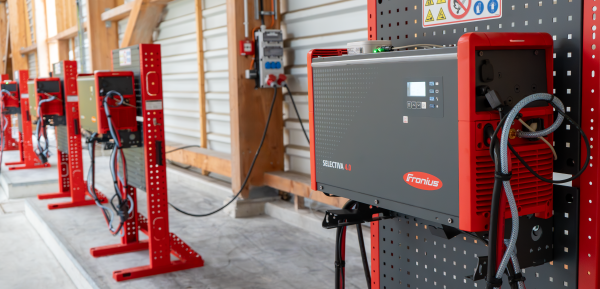
By integrating the PV system into the new charging infrastructure, the company can save costs and energy while protecting batteries and the environment.
SCS Scheiffele-Schmiederer (SCS for short) was founded in 1841 as a timber mill in Dillingen and has since developed into a timber wholesaler with production facilities and six branches in Bavaria and Baden-Württemberg. From here, the family business supplies its customers in southern Germany. According to the company, it attaches particular importance to sustainable and resource-conserving management: Among other things, sustainable building materials were used in the construction of the new company headquarters in Gundremmingen. SCS uses collected rainwater as process water, relies on efficient logistics processes and supplies its electric vehicles and forklifts with solar energy from its own roof.
Charging technology on the test bench
SCS recently took a closer look at the charging technology of its industrial trucks. At its site in Gundremmingen, SCS operates a fleet of eleven electric industrial trucks, which are used to transport wooden beams, boards and profiles in the warehouse and for shipping on the company's own trucks. The logistics managers were looking for efficient charging technology that could safely and sustainably charge the variety of batteries used with and without electrolyte circulation. "The FFZs are essential for smooth operations and must be highly available. We were dissatisfied with the availability of the FFZ and the batteries, and considered whether such a high charging current was really necessary," explains Karl Schmiederer, Managing Partner at SCS. As a result, Fronius was contacted as a technology partner.
The experts from Fronius carried out a comprehensive analysis on site and developed a solution together with the customer. "Thanks to funding support from the Federal Office of Economics and Export Control, we were able to standardize the charging infrastructure and ensure that it complies with the latest standards and is operated economically," adds Matthias Leibold, Technical Manager at Fronius Perfect Charging.
Charging electric forklifts: Converting the technology
The Selectiva 4.0 chargers offer intelligent functions and a gentle, energy-efficient charging process for lead-acid batteries. They are versatile and can charge different types of batteries, which simplifies charging processes and saves costs. "Specifically tailored to SCS's application situation, this meant that 16 Selectiva 4.0 16 kW chargers supply the FFZ with energy generated by the PV system with the 16 Tauro Eco 100 3 D and two Tauro 50 3 D inverters on the hall roof," explains Matthias Leibold.
One of the advantages of Fronius charging technology is the ability to network the chargers with the Charge & Connect software. Thanks to intelligent networking, the chargers can be easily connected to the customer's own inverters. This allows the customer to transparently monitor the kWh consumed per charging station and the kWh generated by the PV system. The installation of 16 Tauro-Eco-100-3-D and 2 Tauro-50-3-D inverters sets new standards in sustainable energy generation at the Gundremmingen site. Together with the more than 5,000 solar modules installed, the Fronius inverters make a major contribution to the energy self-sufficiency of the entire group of companies, which operates a total of two PV systems with a total capacity of 4 MWp. "This installation is a symbol of our commitment to a sustainable future and our efforts to make a real difference through innovation and quality," Karl Schmiederer sums up.
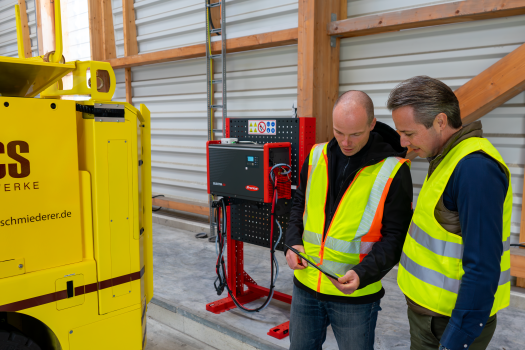
Thanks to the PV Connect function, which can be easily activated in the Charge & Connect portal, it is possible to make targeted use of your own PV energy for charging the forklift fleet. "Thanks to a precise yield forecast, future battery charges can be planned in advance within a 2-day window. This means that the PV energy from the weekend can be carried over into the following working week. The customer benefits from maximizing their own consumption by being able to optimally plan their working week for the required length of battery charging," Matthias Leibold sums up. "This means that battery charges can be shortened or extended in order to use only their own PV electricity."
Improved utilization of the battery pool
The new chargers have also been equipped with LED strips throughout. This allows forklift drivers to quickly and easily recognize when the battery is fully charged: orange means that charging is in progress, while green indicates that the battery is fully charged. Blue indicates that the battery has cooled down and is ready for use. A minute-by-minute indicator in the display also allows the charging time of each battery to be monitored. "This improves the utilization of the battery pool and also has a positive effect on life expectancy," explains Matthias Leibold. The batteries were also equipped with the Fronius TagID battery sensor system. Also connected to the Charge & Connect portal, this allows not only the charging infrastructure but also the traction battery pool to be monitored. "SCS can thus identify critical behavior and batteries with faulty behavior during the charging process at an early stage. This enables the company to take quick countermeasures and minimize unplanned outages. Thanks to the digital inventory list, SCS can now also quickly gain insights for the next budgeting phase," says Matthias Leibold, summarizing the benefits of the Battery Connect function.
At the touch of a button, Charge & Connect transparently displays the charging status of the connected batteries, the energy consumption and the status of the chargers. By displaying the key KPIs of the charging infrastructure, manual visual inspections are a thing of the past. For example, the number of charges per month, the operational readiness and the percentage of operating errors can be called up centrally and operating and application errors can be identified and rectified at an early stage.


You might also be interested in
Efficient and safe charging
With its solutions, Fronius aims to set new standards in the charging of industrial trucks and automated guided vehicles. These enable users and manufacturers to seamlessly integrate vehicles, chargers and lithium-ion batteries in automated...
 read more...
Digital assistants for a safe journey
With modern assistance systems - integrated into the forks - Vetter Industrie wants to set new standards and make the fork fit for the digital future.
read more...Intelligent charging of forklifts with solar energy
Charging industrial trucks with solar power and optimizing self-consumption - this is possible with a new function in the Charge-and-Connect portal from Fronius Perfect Charging.
read more...Safety and productivity for demanding forklift truck applications
Hyster offers a new driver assistance system for forklift trucks. Reaction improves the proper operation of forklift trucks. The solution adapts the forklift's performance in real time to the vehicle's status, location and operating conditions.
read more...New driver assistance technologies from Yale
Yale Lift Truck Technologies has introduced Yale Reliant to the market. The package of driver assistance technologies is designed to help optimize best practices in warehouse and intralogistics operations.
read more...Green giants under power
Mitsubishi Forklift Trucks is expanding its range of counterbalance trucks with new heavy-duty electric forklifts with load capacities from 6 to 12 tons.
read more...Winner material flow PRODUCTS OF THE YEAR 2023
Still: LXT 120/350 with Still Descent Speed Regulation (DSR)
Still Descent Speed Regulation (DSR) is a three-stage assistance system that facilitates safe downhill driving - especially with heavy trailer loads.
read more...Collision protection system extends driver assistance
U. I. Lapp has opened its new distribution center in Hanover in view of steadily rising sales in the cable business. Still planned, installed and commissioned the equipment, including racking systems and industrial trucks.
read more...PohlCon and Wiferion enter into long-term cooperation
Following successful joint projects, PohlCon, a supplier of cable support, underfloor and load protection systems, has agreed an exclusive partnership with the Freiburg-based technology company Wiferion.
read more...