
Innovations from Still
OPX iGo neo: New functions for order picking
With the iGo neo, Still has had a technology on the market since 2016 that turns series production vehicles into autonomous assistants for their operators. The intralogistics provider is now launching a series of further innovations for the OPX iGo neo horizontal order picker.
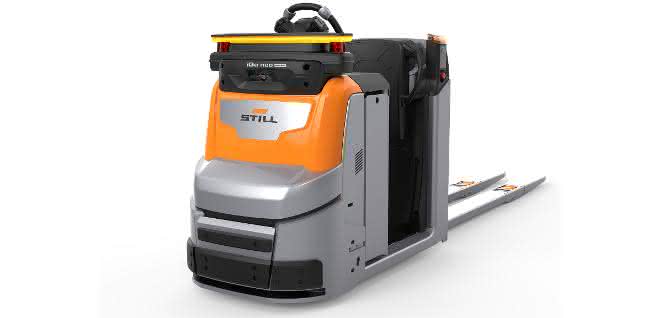
The OPX iGo neo horizontal order picker autonomously follows its operator every step of the way during order picking. It reacts to both its operator and its surroundings, enabling ergonomic order picking that is unique on the market. The innovative technology ensures that the vehicle is always ideally positioned in relation to the operator. This eliminates unnecessary walking distances, which in itself leads to increased efficiency.
Safety is also at the top of Still's agenda, especially when it comes to autonomous vehicles. This is why the OPX iGo neo has a unique safety concept. The horizontal order picker recognizes and reacts to people as well as dynamic and static objects depending on the situation. It independently detects and drives around non-critical obstacles and stops gently in front of critical barriers.
Collision avoidance in manual operation
Since November of this year, the Still Easy Protect collision protection system has been providing additional safety, even in manual mode. The assistance system is available for all OPX iGo neo models: "If the operator is on a collision course during manual operation, the vehicle recognizes this and brakes automatically depending on the distance of the obstacle," explains Thede Baumann, Product Manager for the iGo neo.
When developing this assistance system, an important objective was to keep the restrictions on driving operations as low as possible. "To achieve this," says Volker Viereck, Head of intelligent autonomous software development at KION mobile automation, "the driving maneuver requested by the operator is constantly evaluated and the system only intervenes if the operator is explicitly on a collision course." This means that the closer the vehicle gets to an obstacle, the more the specified speed is reduced in order to avoid a collision. "However, if the operator reacts to the obstacle by adjusting the steering angle, i.e. avoids it," explains the person responsible for robotics development, "the vehicle automatically accelerates back to the speed desired by the operator."
Easy Protect also evaluates the distance at which the operator wants to pass an obstacle. Depending on this distance, the system can also reduce the speed of the vehicle.
"Easy Protect is comparable to the lane departure warning system in a car," says Baumann. The big difference to the automotive industry, however, is that the operator is supported very discreetly by the assistance system. In a nutshell: the corrections made by the vehicle are minimal and very gentle, but still accurate to the centimetre.
The intervention strength of the new assistance system from Still can be selected by the operator and can also be adjusted if necessary. Three modes are available for this: early intervention, standard intervention and late intervention. "The iGo neo was able to show off its strengths in this assistance system in particular," continues Viereck, "as the sensors for this were already present in the vehicle." The new feature does not require any hardware upgrades - all existing customers can therefore retrofit their existing vehicles via a vehicle software update. This underlines Still's strategy of allowing the OPX iGo neo to benefit from optimizations and new features even after delivery. If desired, the robot vehicle can remain permanently up to date.
Still Easy Protect extended to include 3D collision protection
The 3D collision protection system, which will be added to Still's OPX iGo neo from next year, uses a 3D camera to reliably detect obstacles in front of the vehicle - both in manual and autonomous mode. "The camera is positioned above the personal protection system," explains Volker Viereck. "This means that its field of vision covers the entire height of the front of the vehicle, which was also an explicit request from our customers."
In addition to increased safety, 3D collision protection also leads to greater work efficiency, for example when using several scissor lift vehicles. In practice, larger safety distances were previously required, as the raised forks of the vehicle in front could not be detected by sensors. "As this restriction is resolved by Easy Protect 3D, vehicles can close up more closely," says Baumann. This reduces walking distances and increases productivity. This assistance system from Still, which is unique on the market to date, can also be retrofitted to existing order pickers.
New industrial pallet version
A new vehicle version of the OPX iGo neo horizontal order picker from Still is now available. The industrial pallet version enables the transport of load carriers up to a width of 1,000 millimetres in autonomous assistance mode. Previously, this was only possible for a pallet width of 800 millimetres.
This option makes the OPX iGo neo even more versatile. In addition to industrial pallets, special load carriers with a width of up to 1,000 millimetres can also be transported. The integrated personnel protection system safeguards the increased vehicle and load width. In addition, the intelligent vehicle knows its own dimensions and behaves accordingly. The iGo neo does not need to adapt to the required distances, as it does this itself. The new industrial pallet version from Still is available for all models.


You might also be interested in
Dematic and Hai Robotics launch partnership for flexible AMR solutions
Dematic and Hai Robotics have recently agreed a Europe-wide partnership to work together as integration partners in the field of warehouse automation. Through this cooperation, the provider of automation solutions for supply chains and the...
 read more...
The market for service robots
A recent report from IDTechEx analyzes the global market for service robots and examines key applications for delivery and logistics robots, cleaning and disinfection robots, social robots and more.
read more...Application phase for Innovation Award 2026 begins
How can robotics help to make packaging more sustainable? Kuka is looking for creative and innovative ideas in the new round of the Innovation Award.
read more...Exoskeleton with AI power
Robotics company German Bionic presents its most advanced exoskeleton model to date, called 'Exia', which is fully controlled by augmented AI.
read more...Strategic partnership for the promotion of AI
Jungheinrich and Merantix have announced a strategic partnership. The aim of the cooperation is to promote applications based on artificial intelligence (AI) in the industry.
read more...New robotics organization founded
Omron has announced the establishment of a global robotics organization effective April 1, 2025. It will operate in parallel with Omron's automation business so that both areas can complement and support each other.
read more...No-code tool for programming robot user interfaces
ABB provides 'AppStudio', a software tool that allows users of all skill levels to quickly and easily create customized, graphical user interfaces for robots.
read more...SLAM navigation in real time
'Freestyle Localize', 'Trailer Find' and 'Scanner Switch' are three new features of Sigmatek's real-time location software forcontour-based navigation 'SlamLoc'.
read more...Robotic solution: Aiming high under your own steam
The Skypod system is now used in more than 100 order picking warehouses worldwide by companies in all kinds of industries. The autonomous Skypod robots are able to overcome height differences of up to 12 meters.
read more...