
From materialfluss 3/2020
From robots to intralogistics
In an interview with Martin Schrüfer, Cellumation managers Dr. Hendrick Thamer (CEO) and Claudio Uriarte (CTO) reveal what material flow has to do with soccer robots and what the future holds for the start-up and its ground-breaking product.
materialfluss: How and when did the idea on which cellumation is based come about?
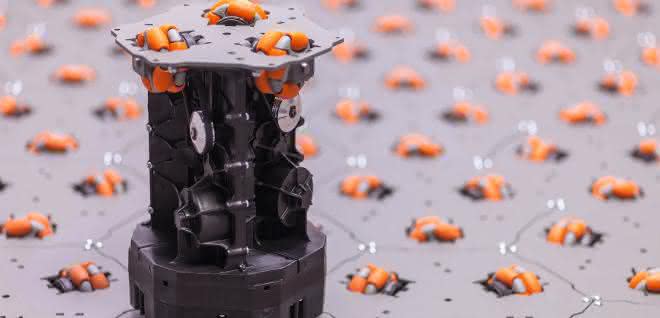
Claudio Uriarte: The idea was born at the Bremen Institute for Production and Logistics at the University of Bremen. We worked there for several years and spun off from it in 2017. As far as the development of the celluveyor is concerned, we needed a highly flexible conveyor surface as part of a research project. It needed to be able to move objects in all directions in a very small space. However, there was no suitable technology on the market - and the project unfortunately didn't come to fruition as a result. A few months later, I saw mobile soccer robots. The robots could move flexibly and quickly in all directions. That was initial. I thought: Why not turn the robot team around, head in together and promote the soccer field! That's how the celluveyor was born. The basic element, the cell, is nothing more than an inverted soccer robot.
Hendrik Thamer: We then developed numerous prototypes in night shifts and weekends to test whether the basic idea of the celluveyor could be implemented technologically. Once this was confirmed, the real work began. Capital and funding had to be raised for further development and, in addition to the development work, the business plans for setting up a company had to be implemented. In total, nine years have passed from the initial idea to the current status.
mfl: Are you planning to keep Cellumation independent or are you flirting with a partner?
Uriarte: Through our previous work at the institute, we are used to working independently with a high degree of freedom. We have also adopted this way of working in our company - and would like to retain it. Nevertheless, we are open to partners. In December 2018, for example, we took on the Spanish company Vector Conveyors as a partner at cellumation. Their know-how in areas such as production and industrial requirements brought expertise to the company that we didn't have before. This has given us a significant boost.
mfl: Cellumation has already realized a few projects, but has not yet made a big appearance in the industry. Is this part of a larger plan or rather modesty on the part of Bremen?
Thamer: Probably a mixture of both. Building a company on the basis of a novel idea is hard enough. If the project is also capital-intensive, the level of difficulty increases even more. "Hard-ware is hard". That's why we initially concentrated on developing our technology so that it would be robust quickly and meet our customers' requirements. At the same time, building up the company required a lot of resources. We therefore made a conscious decision to be a little quieter in the media for the time being. However, we are now well positioned and will put our modesty in Bremen to one side.
mfl: What's next for the Celluveyor?
Thamer: There is plenty of potential for targeted further developments - we will still deliver one or two surprises. The hardware development has been completed and we are now starting series production. Ultimately, the special feature of our solution is that the entire functionality is based on the software. The cells are always the same and can now be mass-produced. However, we are continuously developing the software for additional applications. In this respect, we have now evolved into a software company after completing the hardware development and are now bringing its advantages to conveyor technology.

mfl: Where are the elements produced? How do you plan the vertical range of manufacture?
Uriarte: The elements will initially be produced by our partner Vector Conveyors in Spain. The corresponding capacities are available here and the necessary processes and workstations have already been prepared. We will concentrate fully on our strength, the development and implementation of new technologies. We will realize sales through regional and global system integrators. cellumation will not do any integration. The system integrators have the necessary experience and resources for this - and they can support users via their service networks.
Thamer: We are already working with some integrators, but we are open to further partnerships. So if anyone feels addressed after the interview...
mfl: How important to you is the exchange with the industry, such as that which took place at the TEAM Logistics Forum?
Thamer: The exchange is immensely important for us. In particular, our presentation and the subsequent discussion at the TEAM Logistics Forum was a lot of fun. The feedback was very good and helpful. We also presented at a few specialist events during the development phase of the technology. For example, we won the startup competition at the BVL Congress in 2018 and also won the Innovation Award at the DHL Innovation Day 2016. We were able to use the many helpful suggestions to improve at all levels. We will therefore be happy to maintain and further intensify this exchange.


You might also be interested in
Dematic and Hai Robotics launch partnership for flexible AMR solutions
Dematic and Hai Robotics have recently agreed a Europe-wide partnership to work together as integration partners in the field of warehouse automation. Through this cooperation, the provider of automation solutions for supply chains and the...
 read more...
The market for service robots
A recent report from IDTechEx analyzes the global market for service robots and examines key applications for delivery and logistics robots, cleaning and disinfection robots, social robots and more.
read more...Application phase for Innovation Award 2026 begins
How can robotics help to make packaging more sustainable? Kuka is looking for creative and innovative ideas in the new round of the Innovation Award.
read more...Exoskeleton with AI power
Robotics company German Bionic presents its most advanced exoskeleton model to date, called 'Exia', which is fully controlled by augmented AI.
read more...Strategic partnership for the promotion of AI
Jungheinrich and Merantix have announced a strategic partnership. The aim of the cooperation is to promote applications based on artificial intelligence (AI) in the industry.
read more...New robotics organization founded
Omron has announced the establishment of a global robotics organization effective April 1, 2025. It will operate in parallel with Omron's automation business so that both areas can complement and support each other.
read more...No-code tool for programming robot user interfaces
ABB provides 'AppStudio', a software tool that allows users of all skill levels to quickly and easily create customized, graphical user interfaces for robots.
read more...SLAM navigation in real time
'Freestyle Localize', 'Trailer Find' and 'Scanner Switch' are three new features of Sigmatek's real-time location software forcontour-based navigation 'SlamLoc'.
read more...Robotic solution: Aiming high under your own steam
The Skypod system is now used in more than 100 order picking warehouses worldwide by companies in all kinds of industries. The autonomous Skypod robots are able to overcome height differences of up to 12 meters.
read more...