
From materialfluss 8-9/2019
Conveyor technology in the world's largest shoe cabinet
Gabor Shoes in Rosenheim is a manufacturer of high-quality, fashionable women's shoes and has set up a new logistics center in Mindelheim. Vanderlande supplied the conveyor systems, the Quickstore 3.2 storage and retrieval machines, the racking and steel construction and the material flow control system.
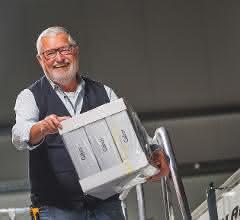
The Gabor logistics center ensures that supplies to retailers run smoothly. The site has now been made fit for the future. With a storage capacity of 2.5 million pairs of shoes, it is now the largest Gabor shoe warehouse in the world. The company decided early on to automate its storage and shipping processes and merged the decentralized warehouses at the Mindelheim site 16 years ago. The central goods handling of Gabor shoes and the licensed brand camel active now takes place here. From here, the finished shoes from the factories in Slovakia and Portugal are distributed to 5,000 customers worldwide. As early as 2003, the general contractor Vanderlande installed the first sorting system here for the distribution of shoe boxes from the factories and suppliers. At the time, the system with a central sorting system was the optimal solution to ensure direct distribution from the production sites to the retailers. However, higher demands from Gabor customers, more diverse value-added services, higher delivery requirements and the volume, which has since risen to more than 9.5 million pairs due to constant growth, made it necessary to expand the site.
New building with connection to existing processes
This was realized in a first step with the new construction of an automated carton warehouse with storage and retrieval machines (SRM) and a new goods issue solution. Gabor took over adjacent land to accommodate office space and an outlet center in the new building in addition to a larger automated small parts warehouse. The challenges in the planning were both the conveyor technology and IT connection to the existing processes as well as the connection and testing of the new system components in the new building without disrupting the ongoing delivery. The general contractor Vanderlande supplied the conveyor systems, the Quickstore 3.2 storage and retrieval machines, the racking and steel construction and the material flow control system for the project. "The good cooperation on the previous project was very cooperative, and we have been extremely satisfied with Vanderlande's products for years. With the new solutions from Vanderlande and our experience from the past, it made sense to work with Vanderlande again," explains Logistics Manager Johann Haas.
Precise material flow of the shipping units
Once the pallets with the finished shoes have been delivered, the customer for whom the goods are intended is determined. If they are not destined for direct dispatch, they are sent to the high-bay warehouse. From the incoming goods area or the high-bay pallet warehouse, the clean pallets with the stored shoe boxes are taken to the crossbelt sorter. It ejects the shoe boxes into (customer) retrieval chutes until the shipping order is complete. The sorter can process several thousand pairs of shoes per hour. Shipping employees put together a shipping unit from the ejected shoe boxes. The shoe boxes are packed with cardboard trays and provided with shipping documents. The units are then wrapped fully automatically and transported from the existing facility to the new building - the new shipping unit hall. Here, the units pass through an automatic contour measuring station: the actual dimensions are determined and checked against the previously transmitted data. This is necessary in order to record the absolute values of the dimensions of the shipping units for shelf compartment allocation. Depending on the size of the unit, a suitable compartment with possible additional storage space is searched for and the shipping unit is moved there. Possible overhangs and deviations are also recorded so that there are no disruptions during storage with the storage and retrieval machines. If the check is positive, the actual data is then used to search for space in the new miniload. If there are major deviations, the shipping units are moved to the central no-read work station via the subsequent transfer and the new sorting cycle. Otherwise, the units are transported to the miniload building and delivered to one of the twelve storage slots in the miniload.
Warehouse with 18-meter-high shoe cabinet
Twelve 18-metre-high Quickstore 3.2 storage and retrieval machines with Barracuda load handling devices are used here to store and retrieve goods in the racking system, which can hold up to 120,000 shipping units. These Vanderlande SRMs store the units in the appropriate compartment. They are equipped with a camera system to detect any errors. In the storage compartments, the pre-packed shoe boxes await the delivery date set by the customer. The storage and retrieval machine retrieves the units as required and transfers them to the outfeed conveyor, from where they are transported to the shipping unit sorter via the collecting conveyor. The target specification comes from the higher-level warehouse management system. The target lanes are equipped in such a way that five mobile telescopic belt conveyors can be moved in front of the corresponding gate in the dispatch area so that the units are transported via the correct target lane and finally via a telescopic belt conveyor into the truck.


You might also be interested in
Circular load carriers for more sustainable supply chains
With the planned Industrial Accelerator Act, the European Union wants to accelerate the transformation of industry towards low-carbon production processes and resource-efficient supply chains. Logistics and transportation are also increasingly...
 read more...
Integration of a robotics solution
Lyreco modernizes logistics center in France
Lyreco is pressing ahead with the automation of its central site in Villaines-la-Juhel with an investment volume of over 25 million euros.
read more...Dragsbæk halves pallet area
By using automated pallet solutions from Palomat, Dragsbæk has halved the space required for pallets, optimized processes and sustainably improved working conditions.
read more...Pixels instead of paper
With the solutions from Logistikbude, Bekuplast, manufacturer of plastic containers, keeps an eye on its load carriers, saves costs and can work more efficiently with forwarding partners.
read more...Flexibility in saving space
Purus Plastics has developed a new retail range. The company operates a processing plant for plastics; recycling creates new products from secondary raw materials, including pallets.
read more...Solutions for the food industry
At Werit, the focus is on customer-specific solutions, sustainable recycling and pooling systems and products made from recyclate. The stand concept is divided into four areas: Products and innovations in the food sector, customer solutions,...
read more...Pallets with QR code
At the Epal Germany stand, visitors can gain an insight into the reusable system propagated by Epal, the life cycle of an Epal pallet and the newly developed QR pallet.
read more...The path of the Euro pallet into the IoT
With the introduction of the EPAL Euro Pallet QR in 2024, the European Pallet Association (EPAL) aims to set a new standard for the classic Euro pallet, which has been used successfully for over 60 years, and pave the way for ecologically...
read more...Retail range: flexibility to save space
Purus Plastics has developed a new retail range that is designed to attract the interest of retailers in particular. The company operates a modern plastics processing plant in Arzberg, Bavaria; new products are created from secondary raw materials...
read more...