
Conveyor technology & components
Control technology through the ages
Overhead monorail systems and floor conveyors are an important part of the material flow and play a central role in automotive plants. They are not only used in assembly lines and in the logistics chain, but also in high-bay warehouses and distribution centers with pallet conveyor systems. The technical article shows how control technology has changed.

In the past, simple control technologies were used; today, in the age of Industry 4.0, hangers, control technology and vehicles communicate with each other. The infrastructure required for energy supply, data communication and positioning must be integrated into the EMS profile in a small installation space. The increasing number of vehicles combined with shorter cycle times and high output rates make this task complex. In addition, the requirements for reliability and robustness of data communication have increased, as more and more devices are based on radio (WiFi, Bluethooth, ZigBee), which can influence each other. Last but not least, customers demand fast installation, long component service life and smooth system integration. Conductix-Wampfler has taken the increased requirements as an opportunity to develop a new conductor rail program: ProEMS 0815.
Assembly made easy
The new ProEMS 0815 current collector is designed to allow higher tolerances in the directions of movement, has a new zero point centering and the cable routing is integrated in the current collector arm. The connection is made via a cable terminal on the current collector foot. The complete, factory-wired collector is snapped onto a base plate that is mounted on the vehicle. It can therefore be replaced if necessary without having to re-route the cables. The mounting plate is attached to the vehicle with hexagonal bolts, with the bolt head "disappearing" into the base of the current collector. This prevents the fastening screws from protruding into the movement space - a known source of errors during installation.
Current collector: Graphite carbon for a long service life
The current collectors are available with carbon brushes made of different carbon brush materials: copper graphite and graphite. Depending on the application, one or the other carbon plays to its strengths. While copper graphite carbon is considered a robust carbon, graphite carbon is the endurance runner. Due to the higher proportion of graphite as a lubricant, this carbon causes very little wear on the rail, runs more smoothly and quietly and has double to triple the service life. Although copper graphite carbon has a lower lubricant content, it has a higher current load and is cheaper to produce.
Crossing cap: subsequent adjustment of the crossing situation possible
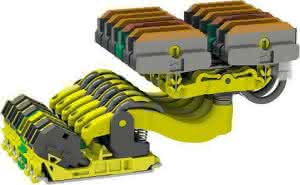
In addition to the conductor rail, the counterpart to the pantograph is the crossing cap at separations of the EMS profile such as at points and lifts. These components enable entry and exit at transition points and have a kind of funnel function. Due to the small installation space with small pole distances, the tolerances are physically very small. They must therefore be adapted to the tolerances of the conductor rail when designing and aligning lifters and switches. Due to higher loads, a lack of rigidity and limited adjustment options, switches and lifters are usually at the limits of the tolerances. The new generation of crossing caps in the ProEMS 0815 range allows the crossing situation to be subsequently adjusted.
Mounting expansion gap: snapping in is better
Another new addition to the ProEMS 0815 range is the factory-fitted expansion element. To compensate for building expansion, the EMS conductor rail must be provided with an expansion gap. This expansion must also be absorbed by the conductor rail. Previously, this was achieved using discrete expansion points that could only be adjusted on site. The module pre-assembled with ProEMS 0815 is snapped into the rail holders on the support profile as an assembly and the rail sections are connected to each other. It is not necessary to adjust the element.
Components required for positioning and data exchange, such as conductor rails, code tape carriers, slotted waveguides or leaky waveguides (coaxial cables) are accommodated by the rail holder. System solutions from Conductix-Wampfler are used as the communication channel for data exchange.
Exclude known sources of error
Investigations of classic EMS systems have shown that the reason for unachieved availability or unsatisfactory service life of the conductor rail components used often lies in the integration, installation and maintenance. Incorrect positioning of the current collectors in the trolley and exceeding the system tolerances on points and lifters are among the main sources of error. With the ProEMS 0815, Conductix-Wampfler has developed a solution that helps to eliminate common sources of error during the integration, installation or maintenance of power and data transmission solutions in EMS systems.
The authors: Dieter Seidel, Global Product Manager Conductor Rails and Gilles Hernandez, Global Market Manager Automotive (both Conductix-Wampfler)


You might also be interested in
Circular load carriers for more sustainable supply chains
With the planned Industrial Accelerator Act, the European Union wants to accelerate the transformation of industry towards low-carbon production processes and resource-efficient supply chains. Logistics and transportation are also increasingly...
 read more...
Integration of a robotics solution
Lyreco modernizes logistics center in France
Lyreco is pressing ahead with the automation of its central site in Villaines-la-Juhel with an investment volume of over 25 million euros.
read more...Dragsbæk halves pallet area
By using automated pallet solutions from Palomat, Dragsbæk has halved the space required for pallets, optimized processes and sustainably improved working conditions.
read more...Pixels instead of paper
With the solutions from Logistikbude, Bekuplast, manufacturer of plastic containers, keeps an eye on its load carriers, saves costs and can work more efficiently with forwarding partners.
read more...Flexibility in saving space
Purus Plastics has developed a new retail range. The company operates a processing plant for plastics; recycling creates new products from secondary raw materials, including pallets.
read more...Solutions for the food industry
At Werit, the focus is on customer-specific solutions, sustainable recycling and pooling systems and products made from recyclate. The stand concept is divided into four areas: Products and innovations in the food sector, customer solutions,...
read more...Pallets with QR code
At the Epal Germany stand, visitors can gain an insight into the reusable system propagated by Epal, the life cycle of an Epal pallet and the newly developed QR pallet.
read more...The path of the Euro pallet into the IoT
With the introduction of the EPAL Euro Pallet QR in 2024, the European Pallet Association (EPAL) aims to set a new standard for the classic Euro pallet, which has been used successfully for over 60 years, and pave the way for ecologically...
read more...Retail range: flexibility to save space
Purus Plastics has developed a new retail range that is designed to attract the interest of retailers in particular. The company operates a modern plastics processing plant in Arzberg, Bavaria; new products are created from secondary raw materials...
read more...