
Conveyor technology & components
Automatic storage of heavy bar stock
When Thöni Holding, based in Telfs, Austria, built a new pressing and anodizing plant as part of a capacity expansion, one of Thöni's requirements was a solution that would automatically transport the round bars with a diameter of approx. 250 mm and a length of 8 meters stored in front of the hall to the production warehouse, from where they would be fed into the heating process. An innovative solution was developed in collaboration with H+H Herrmann + Hieber.

The extrusion operation starts when the extruded bars between 6 and 8 meters in length stored in the factory yard are picked up and fed to the billet saw and then to the billet heating furnace. To ensure a continuous process, the bars to be processed are temporarily stored directly in front of the furnace and placed on the feed roller conveyor to the furnace on request.
This process was to be completely automated. The requirement was that bars with a diameter of 10 inches in the delivered pack of four were to be transferred to the feed system by a forklift in an uncontrolled manner. All other work steps, transport into the hall, intermediate storage in front of the kiln, removal from the warehouse and transfer to the saw and kiln were to be fully automated. For this purpose, the bars are deposited in bundles of four in front of the building. The stanchion store is located in the building, where the approximately eight-meter-long bars are stacked one on top of the other. The bar intended for further processing is placed on the feed roller conveyor to the oven.
A tailor-made concept
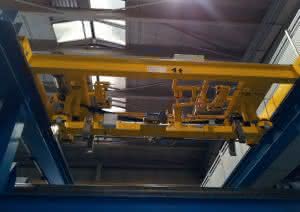
The task set by Thöni required a completely new, innovative solution to the problem. In this case, it was not possible to fall back on tried and tested components. The feeding station is installed outside the building. A forklift truck is used to place a bundle of four 10-inch bars on a support frame. When the strapping of the bundle is open, the bars can be freely distributed on this rack. In the first step, the four bolts are pre-sorted. In order to arrange them next to each other, a second support, the so-called lifting station, takes over the studs. lifting station, takes over the studs by lifting them. This support is geometrically designed in such a way that all four studs lie next to each other in one plane, pre-sorted in such a way that they can be fixed in a defined position in the next work step.
In the next step, the rods must be positioned exactly. To do this, the process described is repeated. Another - third - support, which is designed so that the four bolts are positioned next to each other at the same distance and fixed in this position, lifts the pre-sorted bolts in turn. In doing so, the bars roll automatically into the holders of the support. The entire device is mounted on a movable and rotatable carriage. The sliding carriage with the bolts moves through an opening into the interior of the building. Due to the spatial arrangement, the studs are initially in a 90° position transverse to the conveying direction into the heating furnace or through the press line. The four rods are aligned in the working direction as the turning device swivels through 90°.
The storage system is designed as a stanchion storage system with a maximum capacity of 130 bars. In the rotated position, the bars are placed individually between two stanchions by a two-axis gripper/manipulator. At this point, it is important that the holders are so stable that they do not deform. On request, the gripper removes the intended bar and places it on the feed roller table to the billet heating furnace. The entire process described is fully automatic. The control system is integrated into the plant's control system.
Good experiences
This warranty - in this case, H+H has contractually guaranteed 98.5 percent availability of the entire system - forces the supplier to identify and eliminate all sources of error in advance. An example of this in this particular case is the design of the stanchion bearing: this type of bearing is not new. Manual operation has shown that the stanchions can deform under the weight of the bars and due to unavoidable loads when inserting or removing them. This would lead to malfunctions in the automatic process. To prevent this, particular emphasis was placed on a stable design.
Thanks to these and numerous other design details, the system described has been operating trouble-free since it was commissioned. The company benefits from this system in several ways. First of all, a solution was found that takes into account the relatively difficult space conditions in this area. By feeding the bars in bundles and integrating the feed into the automatic operating sequence, considerable cost savings have been achieved. Subsequent processing also benefits because the bar surface is not damaged during transportation.
Peter Johne


You might also be interested in
"Logistics is a competitive factor for us"
With the move to the new "Campus Criesbach" site, the system manufacturer Bürkert Fluid Control Systems has significantly increased the level of automation. In the new building, planned and implemented by SITLog as general contractor for the...
 read more...
More transparency for production logistics
In order to supply production with the right amount of material at all times, Schmidt Technology needs full transparency of the stocks in the FIFO racks. The company found the answer to this in the simple retrofit solution...
read more...Digital oil lubricates the operational gearbox
Contract and procurement logistics is a particularly labor-intensive area in the portfolio of large logistics service providers. This also applies to Schenker Deutschland AG. This makes it all the more important to optimize the personnel and...
read more...Flexible pooling at fair conditions
In a joint statement, pallet pooling service provider PAKi and logistics service provider Dachser have given their thoughts on the practice of exchanging pallets in an open pool, which is being discussed in the market. Materialfluss documents the...
read more...Commitment to safety and environmental protection
Night after night, employees at the central warehouse of Palibex, Spain's first express distribution network for palletized goods, coordinate the dispatch of 2,500 pallets in Madrid. To accomplish this task in a safe and emission-free working...
read more...Material Flow Round Table: IFOY, hurray! This is what winners look like
On the evening of May 9, the industry celebrated the winners of the IFOY Awards 2017. The following morning, Materialfluss hosted the winners' round table. Curtain up for a conversation about products, innovations and industry visions. Oliver...
read more...Service makes the difference
Exceptional service is much more than a corporate trademark for Hamburg-based Still GmbH. It is an important differentiating factor with which Still has established itself as one of the leading providers of customized...
read more...All-rounder: double girder bridge crane with slewing trolleys
It weighs around 53 tons and is yellow. It can carry loads of up to 16 tons and has a span of 40 meters. On February 13, the overhead crane was delivered from Remscheid to the customer in Dormagen. The crane was designed and manufactured...
read more...Comprehensive range of tasks safely under control
Whether bridge and gantry cranes serving the entire hall or slewing jib cranes for workstations in assembly and production, whether loads weighing many tons or just kilograms - cranes prove to be versatile transport and handling equipment...
read more...