
From materialfluss 8-9/2019
materialfluss Round Table: "The inhibition threshold for automation is falling"
The materialfluss ROUND TABLE discussion was about nothing less than the future of conveyor technology. Or shall we say: About trends and a changing market. Curtain up for four bright minds and a tour of modern intralogistics.
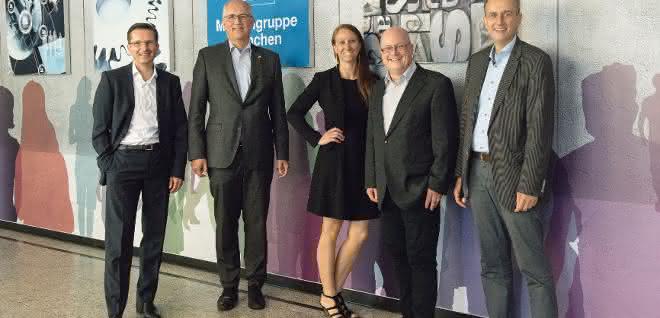
The round table at WEKA in Haar near Munich was attended by Andreas Koch, Head of Product Management at SSI Schäfer Automation Giebelstadt, Dr. Wilfried Kugler, Head of Automation & Software at the Gebhardt Group, Peter Schmidt, Head of Sales Tailor-Made Solutions at the Beumer Group and Victoria Stelzer, Product Management at Knapp.
materialfluss: To begin with, I would like to ask you what you and the company you work for are currently working on. Let's start with Mr. Schmidt: What can I understand by Tailor-Made Solutions?
Peter Schmidt: I've been with Beumer for around ten years, first as Area Sales Manager, then at the headquarters in Beckum as Head of the Center of Competence for Palletizing and Packaging Technology. I have been in charge of Tailor Made Solutions for around a year now, which is our response to the fact that our customers are increasingly requesting system solutions. Beumer comes from the classic product business. We are now positioned differently and can offer not only palletizing or packaging equipment, but also complete packaging lines. In other words, we can act as a general contractor, but also offer more specialized applications with a high level of engineering.
Wilfried Kugler: I have been working for the Gebhardt Group for three years and am responsible for the Software and Automation Technology division. Gebhardt was a component supplier for a long time and has also been in the systems business for around ten years. This now accounts for 60 to 70 percent of our turnover. We have a high level of vertical integration in the systems and will enrich these with additional software services in the next step.
Andreas Koch: I have been working at SSI Schaefer Automation for eight years and am responsible for product management. SSI Schaefer sees itself as a solution provider that offers everything from modular logistics systems to logistics software, on request as a general contractor. In the area of conveying, we have focused on AGVs and the combination of continuous conveyors and AGVs over the past two years. We have also expanded our shuttle portfolio in the area of highly dynamic systems and are continuing to do so.
Victoria Stelzer: I have been working at Knapp for almost seven years and am responsible for product management in the area of conveyor technology, currently for container and carton conveyor technology. Like SSI Schäfer, Knapp comes from the systems business and has a wide range of products. Our AGVs are genuine AMRs (Autonomous Mobile Robots), we call them Open Shuttles and they are also very important in our solutions. In the Evo+ concept, we combine open shuttles with warehouse technology and continue to develop the products. Micro fulfillment is also a topic for us, solutions for fine distribution in urban areas or warehouses with limited space.
mfl: Is the degree of automation steadily increasing?
Koch: Yes, because on the one hand it is becoming increasingly difficult to find employees in intralogistics, and on the other hand more attention is being paid to the health of the employees there. In Scandinavian countries, for example, legal regulations ensure that the total weight that employees have to lift per shift is limited. Automation is also increasing in the frozen food sector. In other words, everywhere where the strain on employees is very high. Nevertheless, people will still be picking in many years' time.
Kugler: Yes, despite the demographic change.
Schmidt: The shortage of skilled workers is serious, you can't even get forklift drivers anymore. In this respect, the demand for automation is increasing almost dramatically. From fully automated truck loading to pallet handling.
Koch: The inhibition threshold for using automation technology is decreasing. Nevertheless, it is a big step for a small company to switch from a purely manual warehouse, as it changes just as many internal processes.
Stelzer: We must not forget that the processes can no longer be mapped manually in the quality and speed required today. The end customer, who wants everything delivered immediately, contributes to this. However, we do not believe that full automation should replace people, as they can still do more than a machine. But it should make work easier for them.
Kugler: There are many Internet companies that have grown strongly in recent years and are now reaching the point where they can no longer be managed manually. These companies want automation concepts from us. First they invest in conveyor technology for order picking and then in the automation of warehouse technology.
mfl: Do customers already come with concrete ideas or do they first have a concept drawn up?
Stelzer: There are customers who have seen a robot at a trade fair and want to have it. Others let us plan first. We have to respond to both. Customers who have specific wishes are sometimes the more difficult customers, as we can't tell them directly that the solutions we have in mind make more sense (smiles).
Kugler: It is also much more difficult for customers today to classify the numerous providers and solutions correctly, the variety is now enormous.
Schmidt: It's all the better that customers trust us and all the companies sitting around this table. There is direct contact and we also offer engineering. The customer doesn't need an engineering office for that.
Koch: As a company, you have to weigh up exactly how to proceed. "Cherry-picking different components often leads to difficulties with the interaction in the overall system. In the end, no one bears overall responsibility and points the finger at the other.
Kugler: The projects that you cover completely yourself are usually the ones that run best and cleanest.
Koch: You are also challenged differently as a company than if you only supply one component.
Stelzer: All of the products and functions that you can supply from a single source are coordinated with each other and can be optimized for maximum performance.
mfl: What makes work difficult for intralogistics specialists?
Koch: The speed at which logistics has to run, coupled with the increasing variety of products on offer and the expectations of consumers who want everything delivered quickly.
mfl: What role does speed play in project planning and implementation?
Kugler: A contradictory topic. The customer wants it quickly, but the delivery times in almost the entire industry are currently very long. Even for small projects. No customer wants to hear that you can only deliver in a year's time. So you have to position yourself in such a way that you can push them in between. Personnel can also be a limiting factor, as employees who can put a system into operation are also in short supply.
Schmidt: Not to mention the maintenance of the system. Speed in project planning and implementation is now often a USP. Those who have countered the shortage of skilled workers in good time have an advantage, for example through higher training quotas and intensive cooperation with universities, but also overall through a high level of attractiveness as an employer.
mfl: And the aftersale? Is it still possible to differentiate here?
Stelzer: Yes, certainly. Keeping customers after the project has been completed and ensuring that they are happy to stay with us is what it's all about. If you drop a customer after completion, word gets around quickly.
Schmidt: Customer support accounts for up to a third of our turnover, which underlines its importance. And we are also constantly offering our customers new products in this area - for example in the digital field - to support them.
Kugler: Keeping an eye on the systems after they are running is important. This is where the Galileo IoT software connection helps us; we have all the systems in our dashboard and can make recommendations before anything happens. This is well received by customers and is actually booked with all new systems that we sell.
mfl: Which technological trend will bring the biggest change? Is it digitalization or do we need to look more towards materials?
Koch: Products will not fly in the coming years either. Networking and digitalization will increase. Also in the form of learning systems, keyword artificial intelligence. There will certainly be improvements to the technology as such, but I don't expect a revolution.
mfl: What does your team have up its sleeve, Mr. Schmidt?
Schmidt: I don't expect a revolution either, but what we have noticed is that more and more flexibility is required. The keyword is scalability. When some customers only hear the word continuous conveyor technology, it becomes difficult (laughs).
mfl: But "continuous" doesn't sound very innovative either ...
Schmidt: But there are applications in which it is unbeatable in terms of price and performance.
Kugler: And with which we all earn money (smiles).
Schmidt: That's true, and if the customer still wants to drive a "sexy" AGV, you can often quickly calculate that continuous conveyor technology is better for him.
Stelzer: One won't replace the other, it's about the combination.
mfl: Is it really a kind of law of nature that there is no way around continuous conveying?
Koch: Complex intralogistics processes only work if you can create a buffer at certain points. Wherever I need a buffer, conveyor technology with, say, five parcels on it is cheaper than five vehicles with one parcel each.
Kugler: With throughput rates of two or three thousand containers, this is currently only possible with conveyor technology. We have calculated a model in a pre-storage zone: According to this, an AGV would have to cost 3,000 euros in order to have comparable costs to conveyor technology. We are a long way from that. AGVs are perfect for networking production and logistics - tugger trains and forklift transports can be handled perfectly with them.
Stelzer: In the high-throughput sector, you simply need continuous conveyor technology, and AGVs only make sense for low throughputs - also in combination with long transport routes - or constantly changing sources and destinations.
mfl: How enthusiastic about technology are customers? Does it always have to be the hottest, most innovative? Is the "play instinct" still alive?
All (in unison): Yes!
Stelzer: There are definitely products that really excite customers, for example a robot as a replacement for a goods-to-person workstation. Or open shuttles. You can feel that.
Schmidt: There are customers who are willing to experiment and are also perceived as a beacon in their industry. Others take a wait-and-see approach that cannot be generalized.
Kugler: You have to try out new technologies and we don't develop them for fun either.
mfl: You all sound optimistic, which is why I hardly dare to ask about economic expectations. Is the time of full order books over?
Koch: If I have ten percent sales growth per year and expect to keep on growing, then I am being unrealistic as an entrepreneur. Where there is an "up", there must also be a "down", that's quite natural.
Stelzer: Because large projects naturally have longer lead times. At the moment, the situation is absolutely satisfactory. So I don't believe in panic scenarios.
Schmidt: We are just as optimistic and very diversified, both in terms of products and territories. A family business like Beumer wants to grow in a healthy, manageable and controllable way.
Kugler: In 2008, we were able to virtually buffer the crisis with a high order backlog, and the situation will be similar when the downturn comes again. A certain phase of consolidation has never done any industry any harm. In times of high capacity utilization, there is a risk of neglecting innovations.
mfl: Ms. Stelzer, gentlemen: Thank you very much for the interview.
The materialfluss ROUND TABLE took place
took place on July 17 at the Haar branch of WEKA BUSINESS MEDIEN. It was pure coincidence that German Chancellor Angela Merkel was celebrating her birthday on the same day, but it certainly encouraged the participants and the moderator Martin Schrüfer to make a "Merkel rue" or two.


You might also be interested in
Dematic and Hai Robotics launch partnership for flexible AMR solutions
Dematic and Hai Robotics have recently agreed a Europe-wide partnership to work together as integration partners in the field of warehouse automation. Through this cooperation, the provider of automation solutions for supply chains and the...
 read more...
The market for service robots
A recent report from IDTechEx analyzes the global market for service robots and examines key applications for delivery and logistics robots, cleaning and disinfection robots, social robots and more.
read more...Application phase for Innovation Award 2026 begins
How can robotics help to make packaging more sustainable? Kuka is looking for creative and innovative ideas in the new round of the Innovation Award.
read more...Exoskeleton with AI power
Robotics company German Bionic presents its most advanced exoskeleton model to date, called 'Exia', which is fully controlled by augmented AI.
read more...Strategic partnership for the promotion of AI
Jungheinrich and Merantix have announced a strategic partnership. The aim of the cooperation is to promote applications based on artificial intelligence (AI) in the industry.
read more...New robotics organization founded
Omron has announced the establishment of a global robotics organization effective April 1, 2025. It will operate in parallel with Omron's automation business so that both areas can complement and support each other.
read more...No-code tool for programming robot user interfaces
ABB provides 'AppStudio', a software tool that allows users of all skill levels to quickly and easily create customized, graphical user interfaces for robots.
read more...SLAM navigation in real time
'Freestyle Localize', 'Trailer Find' and 'Scanner Switch' are three new features of Sigmatek's real-time location software forcontour-based navigation 'SlamLoc'.
read more...Robotic solution: Aiming high under your own steam
The Skypod system is now used in more than 100 order picking warehouses worldwide by companies in all kinds of industries. The autonomous Skypod robots are able to overcome height differences of up to 12 meters.
read more...