
Important expansion step
Fully automated deep-freeze warehouse with added value
The expansion of the Neuhof cold store in Gossau, Switzerland, was officially inaugurated at the end of February 2019. The expansion of the fully automated deep-freeze warehouse was carried out by Gilgen Logistics. Kühlhaus Neuhof AG now has considerably more space and was also able to add value-added services to its range.
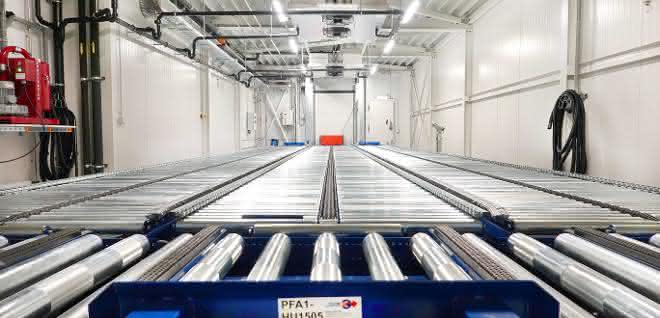
Kühlhaus Neuhof AG specializes in the storage of meat, processed potatoes, semi-finished vegetables and foodstuffs of all kinds. A new building with around 5,780 pallet spaces was constructed in 2010 and put into operation in 2012. At the time, Gilgen Logistics supplied the pallet conveyor technology and the truck docking stations. The freezer warehouse primarily offers food storage and handling services. Various customers use the logistics service to outsource their production volumes or as interim storage for raw materials. The doubling of capacity realized with the new building was already achieved towards the end of the second year of operation. This meant that the storage requirements of business partners could only be met to a limited extent. Just five years later, the logistics center is around one and a half times the size of the previous building. Gilgen Logistics AG was commissioned with the realization of the fully automated deep-freeze warehouse. In addition to the intralogistics with high-bay warehouse, pallet conveyor system and racking system, it supplied the control system, the warehouse management system with visualization and the material flow computer. Optimizations were also made to the existing system. The docking points were extended with two docking ramps and an external ramp.
Capacity increased to over 13,700 pallets
The deep-freeze warehouse has been designed for ergonomic work processes, high efficiency and end-to-end transparency. Optimized storage of frozen products and clear traceability of goods movements were the top priorities in the design. The project was planned by W+P Weber und Partner. After being unloaded from the trucks, the delivered food pallets are transferred to the 5°C refrigerated goods handling zone on the ground floor of the head-end building. The approximately 1,200 different items are transferred to the pallet conveyor system at the loading stations on the ground floor and are then transported to the manual pallet warehouse with picking area, if necessary to the blast freezer area with temporary storage or directly to the fully automated high-bay warehouse (HBW), where they are temporarily stored at a temperature of -28°C. It is possible to mix the pallets in the interim storage area. The pallet conveyor technology with two elevators was installed in the -28°C temperature range and partly in the -38°C shock freezer area.
The capacity of the existing high-bay warehouse was increased from 5,780 to over 13,700 pallet spaces with two additional fully automated storage aisles. The channel storage system can store three or six pallets deep. At the front of the first floor are the storage and retrieval routes for the infeed and outfeed to the transfer points of the storage and retrieval machines (SRMs). In order to achieve optimized utilization of the storage areas in the HBW, the warehouse management system controls the pallets with recompaction in the warehouse.
The stacker crane control system allows storage and retrieval orders to be processed in a route-optimized manner. Thanks to the minimal approach dimensions, the building cube can be used efficiently for TC storage. The SRMs are equipped with compartment fine positioning by means of a camera system and a further two cameras for monitoring.
Deep-freeze storage with new utilization options
Manual picking areas were installed on two floors in one part of the warehouse. The two new manual picking areas on two levels offer flexible usage options, for example for picking, defrosting, re-palletizing and price labelling. After picking, the pallets marked for dispatch and the single-item partial pallets are stored again in the high-bay warehouse.
Around 1/3 of the foodstuffs to be stored must be shock-frozen so that a specified frozen core temperature is reached within a defined time. This takes place in the automatic blast freezer system which was integrated on the 2nd floor. The system has 60 pallet freezer boxes, which are housed in the fully automated deep-freeze high-bay warehouse. A further 50 pallets can be placed in a waiting position in the buffer zone, which is cooled to +2°C in the head-end building. As soon as a space becomes available in the blast freezer, the pallet is conveyed to the blast freezer system via the automatic conveyor system and a transverse transfer carriage and stored in the automatic high-bay warehouse once the freezing process is complete.
Clear traceability of goods movements
The new warehouse management system (WMS/MFR, PLC control and visualization) manages and controls the high-bay warehouse and the entire internal material flow. The warehouse control center and the business intelligence tool provide an overview and a clear basis for decision-making in the warehouse. The movement of goods can be tracked by Kühlhaus Neuhof AG and various statistics on stock levels and movements per customer can be called up on an ongoing basis. The management of Kühlhaus Neuhof AG can see the registered goods movements for the next day in the central warehouse control center and can prepare the goods turnover accordingly.
Ecological and resource-saving
When planning the capacity expansion of the high-bay warehouse and designing the building structure and technology, various ecological and therefore resource-saving solutions were examined and taken into account. The waste heat from the refrigeration system is used to heat the offices and social rooms, to power the air insulation systems and to protect the deep-freeze warehouse from freezing. A photovoltaic system with a nominal output of 250 kWp was installed on the roof of the warehouse. The energy can be used by Kühlhaus Neuhof AG for refrigeration. Storage, refrigeration technology and the building envelope enable operation with low energy consumption.
Equipped for the future
In line with the planned construction schedule, the project was completed within 20 months. Thanks to the extension and the integrated additional functions, Kühlhaus Neuhof AG is equipped to meet the requirements of a frozen food logistics service provider and can offer block storage for industrial pallets, shock freezing, defrosting, order picking and price labeling in addition to storage in the high-bay warehouse.


You might also be interested in
Circular load carriers for more sustainable supply chains
With the planned Industrial Accelerator Act, the European Union wants to accelerate the transformation of industry towards low-carbon production processes and resource-efficient supply chains. Logistics and transportation are also increasingly...
 read more...
Integration of a robotics solution
Lyreco modernizes logistics center in France
Lyreco is pressing ahead with the automation of its central site in Villaines-la-Juhel with an investment volume of over 25 million euros.
read more...Dragsbæk halves pallet area
By using automated pallet solutions from Palomat, Dragsbæk has halved the space required for pallets, optimized processes and sustainably improved working conditions.
read more...Pixels instead of paper
With the solutions from Logistikbude, Bekuplast, manufacturer of plastic containers, keeps an eye on its load carriers, saves costs and can work more efficiently with forwarding partners.
read more...Flexibility in saving space
Purus Plastics has developed a new retail range. The company operates a processing plant for plastics; recycling creates new products from secondary raw materials, including pallets.
read more...Solutions for the food industry
At Werit, the focus is on customer-specific solutions, sustainable recycling and pooling systems and products made from recyclate. The stand concept is divided into four areas: Products and innovations in the food sector, customer solutions,...
read more...Pallets with QR code
At the Epal Germany stand, visitors can gain an insight into the reusable system propagated by Epal, the life cycle of an Epal pallet and the newly developed QR pallet.
read more...The path of the Euro pallet into the IoT
With the introduction of the EPAL Euro Pallet QR in 2024, the European Pallet Association (EPAL) aims to set a new standard for the classic Euro pallet, which has been used successfully for over 60 years, and pave the way for ecologically...
read more...Retail range: flexibility to save space
Purus Plastics has developed a new retail range that is designed to attract the interest of retailers in particular. The company operates a modern plastics processing plant in Arzberg, Bavaria; new products are created from secondary raw materials...
read more...