
Stationary conveyor technology
Cellumation's robot cells simplify the layout of depalletizing systems
The celluveyor DEPAL (cv.DEPAL for short) stands for a new type of depalletizing process. The system of hexagonal robot cells separates layers onto up to three conveyor lines.
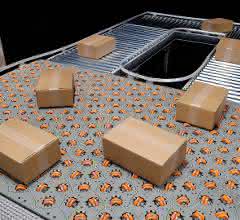
The cells, each with three wheels, are combined to form a surface and move several objects simultaneously and independently of each other in all directions. The special feature: a single celluveyor (short for cellular conveyor) reduces the space required by conventional layer separation systems by up to 95 percent. Thanks to the simplified layout, changeover times are eliminated and the high-performance celluveyor replaces additional depalletizing lines.
The system is tailored to the requirements of central warehouses and production facilities as well as all applications in pallet warehouses where objects are separated for further processing. While conventional layer separation systems require up to 50 to 60 m² of space, an omnidirectional celluveyor solution requires less than 3 m² to separate layers with a flat base. Thanks to the hexagonal shape of the individual cells, the system can be assembled into any layout in the form of a plane. With up to 400 separated layers per hour, users of the cv.DEPAL benefit from a high throughput with minimal space requirements. The separated objects can be distributed to up to three outputs for subsequent further processing according to the customer's logic.
A vision system with several 3D cameras recognizes the transported objects and provides feedback on their position in real time. The software corrects any deviations from the expected position. This means that layers can be separated without prior knowledge of the layer composition. The high level of reliability is guaranteed by the sixfold redundancy of the cells: If one cell operates incorrectly, the surrounding six neighboring cells are able to compensate for the failure. The effort required for a replacement is minimal: the defective cell is removed and a new cell connected in less than five minutes. Installation is automatic.
The robot cells are designed for use in a wide variety of areas - the hardware of the cell remains the same, while the intelligent software controls and defines the function. The celluveyor is able to perform all the tasks of conventional conveyor technology: With the right programming, the robots sort, orient, palletize, depalletize or separate objects in a targeted manner. Thanks to plug-and-play, the system can be integrated within a few days.


You might also be interested in
Dematic and Hai Robotics launch partnership for flexible AMR solutions
Dematic and Hai Robotics have recently agreed a Europe-wide partnership to work together as integration partners in the field of warehouse automation. Through this cooperation, the provider of automation solutions for supply chains and the...
 read more...
The market for service robots
A recent report from IDTechEx analyzes the global market for service robots and examines key applications for delivery and logistics robots, cleaning and disinfection robots, social robots and more.
read more...Application phase for Innovation Award 2026 begins
How can robotics help to make packaging more sustainable? Kuka is looking for creative and innovative ideas in the new round of the Innovation Award.
read more...Exoskeleton with AI power
Robotics company German Bionic presents its most advanced exoskeleton model to date, called 'Exia', which is fully controlled by augmented AI.
read more...Strategic partnership for the promotion of AI
Jungheinrich and Merantix have announced a strategic partnership. The aim of the cooperation is to promote applications based on artificial intelligence (AI) in the industry.
read more...New robotics organization founded
Omron has announced the establishment of a global robotics organization effective April 1, 2025. It will operate in parallel with Omron's automation business so that both areas can complement and support each other.
read more...No-code tool for programming robot user interfaces
ABB provides 'AppStudio', a software tool that allows users of all skill levels to quickly and easily create customized, graphical user interfaces for robots.
read more...SLAM navigation in real time
'Freestyle Localize', 'Trailer Find' and 'Scanner Switch' are three new features of Sigmatek's real-time location software forcontour-based navigation 'SlamLoc'.
read more...Robotic solution: Aiming high under your own steam
The Skypod system is now used in more than 100 order picking warehouses worldwide by companies in all kinds of industries. The autonomous Skypod robots are able to overcome height differences of up to 12 meters.
read more...