
Bin & pallet pooling
New building block for chemical logistics
Where, if not in the chemical industry, do load carriers have to meet the highest quality and safety requirements? After all, highly sensitive and highly hazardous products and substances are transported by road, air and sea or stored in high racks. The European Pallet Association e.V. (EPAL) has found an answer.
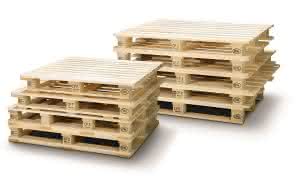
Safety plays a crucial role in the logistics of the chemical industry and it is critical if chemical pallets do not meet the high quality standards. In the past, increasing price pressure and the lack of independent quality assurance have sometimes led to chemical pallets not meeting the requirements for the safe transportation of chemical products.
ISPM 15 - Safety for export
Safety is also important for exports: all wooden packaging that touches the ground in a country outside the EU must be treated in accordance with the ISPM 15 standard and bear IPPC stamps. Without the prescribed heat treatment, neither the wooden pallet nor the goods transported on it will be allowed into the country. This prevents the introduction of wood pests and protects the forest stands. The EPAL quality standards naturally include treatment in accordance with ISPM 15, which means that all EPAL CP pallets are treated in accordance with the ISPM 15 standard and are suitable for the worldwide movement of goods.

"I am delighted that EPAL has been able to meet user requirements and add an important new component to the existing quality timber load carriers."Martin Leibrandt CEO of EPAL
The chemistry is right
In mid-November 2017, the European Pallet Association invited the trade press and representatives of the chemical industry to an international press conference in Düsseldorf under the motto "The chemistry is right" and presented the nine prototypes of the new EPAL CP pallets. Martin Leibrandt, CEO of EPAL: "I am delighted that EPAL has been able to meet user requirements and add an important new component to the existing quality wooden load carriers. Now it's up to the users to also rely on independently tested quality, safety and ecology in the logistics chain of the chemical industry with their demand for EPAL CP pallets."
The CEO of EPAL estimates the volume of EPAL chemical pallets in Germany for 2018 at 19 million. In addition to Germany, Poland, the Netherlands, the United Kingdom, France and Italy are also interested in the production of EPAL CP pallets. There is also potential in markets where EPAL is not yet active, such as the USA, Canada and large parts of Scandinavia. From January 2018, CP pallets can be produced worldwide under an EPAL license in accordance with EPAL's technical regulations.
Success with a strong brand
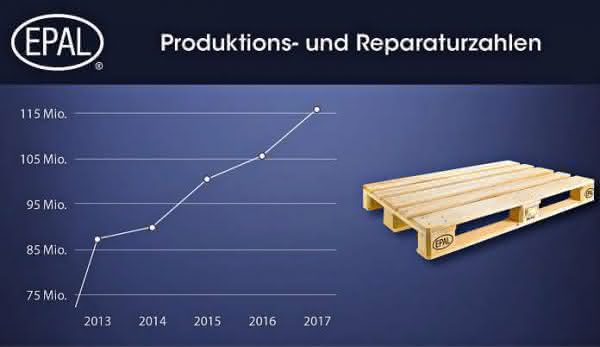
The continuous growth rates since August 2013, when the "EPAL in an oval" brand was branded on all four blocks, show that EPAL as a pallet organization is on the right track with the concept of independently quality-tested pallets.
2017 was another record year for EPAL: with 115.8 million EPAL pallets produced and repaired, a whopping increase of almost ten percent was achieved compared to the previous year. The pure production figures rose to 88.3 million EPAL pallets and the repair figures to 27.5 million. To ensure that "EPAL in the Oval" remains a strong brand, EPAL prosecutes infringements of trademark rights under criminal and civil law. The association works with customs authorities, police and lawyers in various countries to prevent the import and marketing of counterfeit EPAL Euro pallets at source.
Advantages of the EPAL system
The EPAL system with its three pillars of uniform international standardization, independent quality assurance and the safeguarding and tracking of trademark rights guarantees users high-quality load carriers for functioning global logistics. EPAL Euro pallets are reusable and can be repaired at low cost, thus conserving natural resources.
Andrea Engels


You might also be interested in
Circular load carriers for more sustainable supply chains
With the planned Industrial Accelerator Act, the European Union wants to accelerate the transformation of industry towards low-carbon production processes and resource-efficient supply chains. Logistics and transportation are also increasingly...
 read more...
Integration of a robotics solution
Lyreco modernizes logistics center in France
Lyreco is pressing ahead with the automation of its central site in Villaines-la-Juhel with an investment volume of over 25 million euros.
read more...Dragsbæk halves pallet area
By using automated pallet solutions from Palomat, Dragsbæk has halved the space required for pallets, optimized processes and sustainably improved working conditions.
read more...Pixels instead of paper
With the solutions from Logistikbude, Bekuplast, manufacturer of plastic containers, keeps an eye on its load carriers, saves costs and can work more efficiently with forwarding partners.
read more...Flexibility in saving space
Purus Plastics has developed a new retail range. The company operates a processing plant for plastics; recycling creates new products from secondary raw materials, including pallets.
read more...Solutions for the food industry
At Werit, the focus is on customer-specific solutions, sustainable recycling and pooling systems and products made from recyclate. The stand concept is divided into four areas: Products and innovations in the food sector, customer solutions,...
read more...Pallets with QR code
At the Epal Germany stand, visitors can gain an insight into the reusable system propagated by Epal, the life cycle of an Epal pallet and the newly developed QR pallet.
read more...The path of the Euro pallet into the IoT
With the introduction of the EPAL Euro Pallet QR in 2024, the European Pallet Association (EPAL) aims to set a new standard for the classic Euro pallet, which has been used successfully for over 60 years, and pave the way for ecologically...
read more...Retail range: flexibility to save space
Purus Plastics has developed a new retail range that is designed to attract the interest of retailers in particular. The company operates a modern plastics processing plant in Arzberg, Bavaria; new products are created from secondary raw materials...
read more...