
From LT-manager 3-4/2019
Drones, much more than just hype
Autonomous flying is a new, additional type of transportation that will take place in both the freight and passenger sectors. The arrival of drones in the transportation and logistics industry is coming sooner than some people imagine. Many companies and institutions are currently looking to Africa, where most experience with drones is currently being gained.
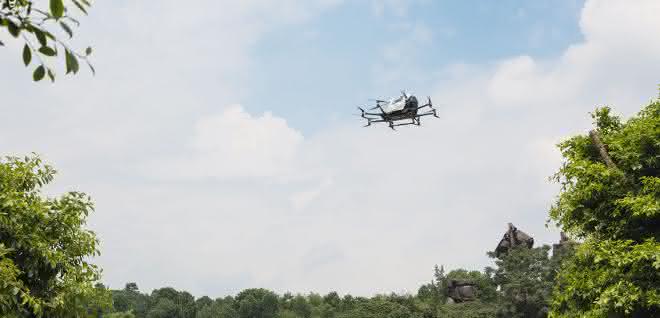
The International Air Transport Association (IATA) expects around 45 million drones to be flying around the world by 2020. Development activity is also increasing. While there were up to ten development projects in 2010/11, there are now 150 projects in the field of autonomous flying being massively advanced worldwide.
For many, such as the CEO of the Upper Austrian aircraft supplier FACC, Robert Machtlinger, autonomous flying will be possible sooner than autonomous driving, which is much more complex because "the spaces are much more restricted and the traffic density is much higher." The European aircraft manufacturer Airbus draws attention to the topic with impressive figures: in 2035, 156 aircraft are expected to be flying over the city of Paris every hour (in 2018 there were 80), 2,500 so-called Urban Air Mobility Vehicles (UAV) - in 2018 there was not a single one of these. There should then be 16,667 drones on the move every hour on delivery duty (there were zero in 2018), as well as 58 inspection drones (one in 2018). But all of this also calls for regulations in the operation of drones and so-called air cabs.
Drone pioneer Africa
Africa has the world's greatest expertise in the use of drones. Some countries use the low air traffic to supply remote and hard-to-reach regions with drones. At first glance, it sounds surprising. But a closer look at Africa's infrastructure reveals that this continent is virtually predestined for the use of drones in hard-to-reach regions. Take Rwanda, for example: the East African country was the first in the world to open a civilian drone airport. The mountainous landscape and the poor condition of the roads make transportation difficult in Rwanda. There are no tunnels, bridges or highways for fast journeys. Drones are now used to deliver commercial goods to remote or inaccessible areas, but above all to supply the population with medicines and blood reserves.
"The world's leading nations in the use of drones are Rwanda, Malawi and Tanzania. We see that Africa is leading the way, for example recently in Ghana. The country has the same approach as Rwanda and wants to introduce the transportation of medical goods this year," explains Céline Hourcade, Head, Cargo Transformation at the International Air Transport Association (IATA). "But also governments, private organizations or even the World Economic Forum, all of these are watching Africa to learn and really understand how to implement drones as a means of transport in other countries. In other words, to take on this expertise, for example in the delivery of emergency equipment," says Hourcade.
Medicine by parachute
In Rwanda, 20 percent of blood supplies are currently needed outside the capital Kigali. The procedure: The health center sends a request for the supplies via text message. The supplies are packed and the drone takes off in the next 30 to 45 minutes; at the destination, the drone drops the package, which is slowed down by a parachute. As mentioned at the beginning - the parliament of Ghana has also approved a drone project to deliver blood, medicines, vaccines and other medical supplies to health centers in remote areas.
Hourcade cites the Victoria Basin in East Africa, which is the most densely populated rural area in the world, as another possible application example. Despite this, its 30 million people are still poorly connected to ground transportation and basic services. Life-saving cargo such as blood packs, medicines, anti-poison serum or spare parts for hospital equipment often cannot be delivered on time. Drones can provide enormous support here.
Other ventures include a drone test corridor in Malawi, which is managed by the country's Civil Aviation Authority in collaboration with UNICEF. The government of Zambia is reportedly working with Sony's Aerosense on a pilot drone delivery program. Other projects are developing in Kenya, Tanzania and Benin. South Africa has also passed a commercial drone law to train and license drone pilots. The most important thing is to ensure that these unmanned vehicles can coexist safely and efficiently with commercial aviation without creating safety risks - as has been the case in Europe and North America in particular, with dramatic incidents at airports.
"We are planning our own cargo airline with drones. Kenya is perfect for this. Little air traffic, poor infrastructure. Our drones should be able to transport up to 250 kilograms across the flat country," explains Kenya Airways CEO Sebastian Mikosz in an interview with LT-manager. "Many of my airline colleagues have not yet realized how quickly this development will continue." The basic requirements for this venture in Kenya are already in place, both legally and technically.
Global interest: Africa gives private lessons
Africa's drone experiments are thus contributing to the development of these unmanned flying objects worldwide. And so there is great interest in collaborating on African projects and learning from them. Hourcade also explains other projects with cargo drones in other parts of the world: in Canada, for example, to serve remote communities where there is a lack of infrastructure and it is difficult to obtain basic goods. And even when they are available, they are expensive. Residents of a remote island in northern Ontario have been receiving supplies, medicines, food and mail via cargo drones since 2019. Air Canada, which has signed an exclusive distribution agreement with Drone Delivery Canada (DDC), markets their delivery services. The drone can carry five kilograms of payload up to a range of 30 kilometers. Initially, drone delivery services will be provided to remote communities in Canada. Over the next five years, 200 or 20 percent of these communities are to be supplied. Japan is testing cargo drones in remote and sparsely populated areas, such as the isolated island of Nokonoshima near Fukuoka. Experimental flights have also been carried out by the Ministry of Transport in mountainous regions such as Shizuoka Prefecture and Toyota together with Japan Post.
Asia is ahead, Europe is catching up
Over the next two to three years, drones will dominate the European environment, particularly in the freight sector, possibly starting with the supply of materials and tools to oil platforms. This field of application is an ideal platform for collecting further data: The routes of the drones to the oil platforms are flown automatically, with the input coming autonomously from a control center - similar to a tower. Drones will also be cheaper to use than expensive helicopters.
The payload is still limited
One example: drones can be a modular system with a payload of around 250 kilograms or even two passengers, with a range of 70 kilometers, which can be increased with further development. There are already areas of application today. One example: heavy snowfall in the Alps, the helicopter cannot fly, but a drone could be sent into the valley - no problem thanks to terrain recognition. It would also be technically feasible to carry out reconnaissance flights in the event of poisoning, searches for missing persons and evacuations. However, the payload is currently limited.
"It won't be the case that I buy a drone and fly it from home to the company. Rather, a concept will emerge with providers who have a fleet and the drones communicate with each other in a system. Providers could be airlines, transport associations or even start-ups," Machtlinger believes. Urban air mobility - i.e. taking an air cab to work - will become an issue in large cities with poor transport infrastructure, be it Sao Paolo or Guangzhou, and will also become relevant in Europe with a certain time lag. Second point: freight distribution. "I don't think it makes sense to fly an Amazon parcel weighing one kilo 50 kilometers through the air," says Machtlinger.
Acceptance and binding rules
Acceptance among the population as to whether and how privacy will be disturbed by increased drone traffic also remains a topical issue. In future, it will probably not be possible to fly drones without a dedicated flight area. Drones have already caused disruption to flight operations at various airports. Rules for drones are now being standardized across Europe. The responsible European Aviation Safety Agency (EASA) in Cologne has published regulations that must be transposed into national law by June 2020. In addition to technical requirements, the letter contains standards for safe operation: according to the EASA, a drone should be identifiable "so that the authorities can track an individual drone if necessary". The regulations are good for safety and at the same time respect the privacy of citizens, it said. Both commercial users and private individuals would have a clear idea of what is and is not permitted in future. Users would be able to use their drones according to the same rules in all EU countries - this is also important for companies that have integrated drones into their business model. Germany has long had regulations on the use of drones, some of which now need to be amended.
About the author: Kurt Hofmann lives and works as a freelance aviation journalist in Schörfling am Attersee, Austria. He has been writing about civil aviation around the world for international consumer and trade media since 1995, including Aero International, Business Traveler London, NZZ and Die Presse. As a correspondent for the US magazine Air Transport World, he reports daily on aviation issues. As an aviation expert, Hofmann is a frequent guest on television and radio stations (including ORF, SRF, ZDF, ATV, Puls 4, Servus TV).


You might also be interested in
Winner material flow PRODUCTS OF THE YEAR 2023
Conductix-Wampfler: ChargeLine 0865
Two-pole conductor rail segments for efficient opportunity charging of shuttles, suitable for thousands of cycles per day.
 read more...
Hermann Grewer celebrates his 80th birthday
Hermann Grewer, Honorary Chairman of the North Rhine-Westphalia Transport and Logistics Association (VVWL) and Honorary President of the German Road Haulage, Logistics and Disposal Association (BGL), celebrated his 80th birthday on June 6.
read more...Well chilled for sure
V-Zug Kühltechnik AG, developer and manufacturer of refrigeration appliances and part of the successful V-Zug Group, has set up a new production facility for refrigerators of all heights and dimensions at its Swiss site in Sulgen.
read more...Advantageous automation of small parts warehouses
The RSX1 shuttle system will be at the center of Rocketsolution's presence at this year's Logimat trade fair.
read more...Reduced energy requirements in the high-bay warehouse
One of Germany's leading premium car manufacturers is already focusing on energy efficiency in the production of its new SUV model with electric drive. The storage and retrieval machines in a high-bay warehouse at the production site have been...
read more...Low lift pallet truck for light duty applications
Clark has launched a new low lift pallet truck with the model designation LWio15 for light transport tasks. The truck has a load capacity of 1500 kg and is suitable for short distances in goods distribution, production or warehousing.
read more...Internationalization as an opportunity
E-commerce is in a state of flux. Changes in purchasing behavior and procurement problems are keeping e-commerce retailers busy. Logistics plays a decisive role in the overall online shopping experience.
read more...Fulfillment Center for Frisco.pl
Polish eGrocery specialist and TGW deepen partnership
TGW is building a highly automated fulfillment center for Frisco.pl in the Polish capital Warsaw. This is the second project in a row that the two companies have implemented together.
read more...Which world will it be in 2023?
Michael Schreckenberg teaches at the University of Duisburg-Essen as Professor of Physics of Transport and Traffic. Once a year, he addresses the readers of materialfluss, formerly LT-manager, with a critical and humorous expert article on transport...
read more...