
Storage processes in the beverage industry
Use of AGVs in block storage
Many industries are responding to increasing competitive pressure by automating their processes. Increasing efficiency is also required in the warehouse processes of the beverage industry. Warehouse automation of this kind can be achieved by introducing automated guided vehicles (AGVs).
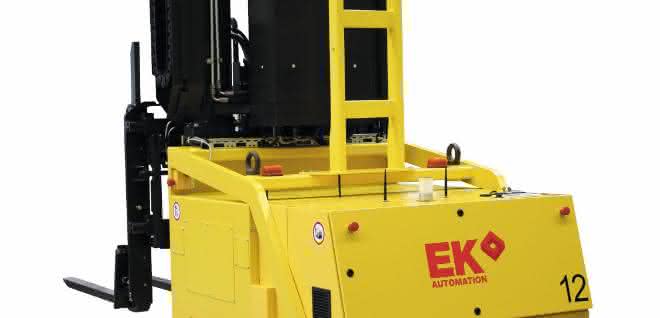
It is crucial to develop the right concept for optimizing the internal material flow in order to achieve improved efficiency. This is precisely what E&K Automation specializes in. The company offers transport robotics solutions for automated material flow and storage systems for customers from all industries. Its customers include companies from the beverage industry. Automated transport and material flow is ideal for this industry, whose storage processes often involve large quantities of uniform and easily stackable goods. This is because in the block storage systems used here, with a high degree of space utilization and a high degree of flexibility at comparatively low costs, automated processes can further reduce costs, save time and reduce sources of error.
Individual automation concept
To design the right automated guided vehicle system and ensure that an AGV delivers the desired results, a number of key questions need to be answered:
- Which load is to be transported and handed over and how?
- What are the dimensions of the loads to be transported?
- How maneuverable must the vehicle be, how much space is available?
- How long are the routes?
- How many transports are carried out per hour?
- Which lane guidance or navigation is best suited?
- What does the energy concept look like depending on the
duration of use?
- Are there special safety aspects or difficult environmental
environmental conditions?
- Is a simple call control system with traffic control sufficient or is a complex guidance system with a variety of functions, such as an avalanche transceiver, required?
"Based on this information, we then develop a customized automation concept that is designed to reduce costs and further increase productivity with well thought-out investments," explains Karsten Bohlmann, Head of R&D at EK Automation.
A case from practice
A company in the beverage industry was tasked with developing an AGV for a block storage system that was to hold 10,000 pallets on a storage area of 80 x 80 meters. The pallets were to be stacked automatically and precisely on top of each other on four levels. The top pallet had to be able to be set down or picked up again at a height of around 5.2 meters. The first important prerequisite is the tested quality of the pallets and a sufficiently level floor for an AGV. The layout of the storage blocks is then determined depending on the shape of the warehouse, the storage and retrieval points, the number of items, the storage strategy and the desired transport performance. As a proposed solution, EK opted for fully automated counterbalance trucks, which have a lift of 5.5 meters and are equipped with a double fork with fork adjustment for transporting two pallets at the same time. The Compact GG vehicles from the transport robotics specialist's range were suitable for this purpose. The Compact line comprises standardized automated guided vehicles (AGVs) that are optimized for the medium-heavy load range of up to 2,500 kilograms load weight. Thanks to its compact design and maneuverable chassis with a small turning radius, the robust Compact GG is ideal for use in block warehouses with narrow aisles. It can reach lifting heights of up to eight meters and travel speeds of up to 2 m/s forwards and backwards.
The Compact GG transport vehicles are flexible in terms of the use of navigation. Different types of navigation can be combined. In the case described, hybrid navigation was used, which is controlled via laser scanners and magnetic points. Laser navigation is used to determine the position. Magnetic point navigation uses magnets embedded in the floor along the lane to provide the route. Guidance is controlled via a PC server and all communication is via WLAN. An important aspect of an AGV system is the energy system. When selecting the energy concept, factors such as duration of use, shift operation, investment costs and flooring are taken into account.
Stacking upwards thanks to 3D pallet recognition
A special feature of the case described is the height that this block storage system reaches with a transfer height of 5.2 meters. This is only possible thanks to an innovative development: at EK Automation, the vehicles can be equipped with 3D pallet recognition for precise stacking at great heights. This enables precise evaluation of the actual position of the pallet. Special safety measures are required if a warehouse is to be automated in which people also move around. For this purpose, EK Automation has developed a modular system that can be used to put together a customized combination of safety devices. In applications such as block storage, the vehicles are equipped with personnel protection scanners at the front and rear. These safety scanners are indispensable in operations with personnel and at a speed of 2 meters per second for automated guided vehicles. The vehicle scans its surroundings accurately, even if it is traveling with its forks in front. If a person or object enters the protective field, the AGV brakes gently and thus ensures contactless safety.
Expandable, future-proof systems
Warehouses automated by AGVs can be designed in various forms in the beverage industry: From individual buffer rows for dispensing or picking up pallets provided in production or in the warehouse to area-filling buffer rows. "We use the components described above to develop an overall concept for our customers that is perfectly tailored to the existing conditions and makes optimum use of the available space with individually programmed storage and retrieval strategies. A classic example is production running over three shifts and goods issue running over two shifts. The automated guided vehicle system then takes over the buffering of ongoing production in a block storage system during the night shift, for example, and prepares the goods for dispatch in the outgoing goods area at the same time," explains Karsten Bohlmann.
EK Automation is increasingly using the Plant Simulation tool to create concepts. With the help of 3D laser scans, warehouses can be accurately mapped and the corresponding AGV simulated.


You might also be interested in
New Podcast: “AGVs: The Silent Logistics Pros”
AGVs in Use in Logistics and Production
Autonomous guided vehicles (AGVs) are becoming increasingly important in industry and intralogistics. In Phoenix Contact’s “Elektrisiert” podcast, Jörn Dauer explains the applications, technical requirements, and future prospects of these autonomous...
 read more...
HTEC and Embotech Expand Autonomous Industrial Logistics
HTEC and Embotech aim to accelerate the adoption of autonomous driving solutions in industrial logistics. The strategic partnership is intended to facilitate the rollout to additional vehicle platforms, customer projects, and locations.
read more...Standardized in design, flexible in use
Automated guided vehicles are increasingly in demand in production and logistics as they automate processes efficiently - but in addition to the vehicle, the right peripherals are also crucial for safe operation. A new solution consisting of a...
read more...Outdoor AGV networks production and logistics
An international company in the plastics industry is automating its intralogistics at its German site with a solution from ek robotics. A specially developed vehicle model from the Out Move series, an outdoor AGV, is being used.
read more...Transport systems for automated material flow
The Leo transporters from Bito make it easier for users to get started with the automation of material processes, which is possible from 20,000 euros. The system is a flexible all-in-one complete solution that is ready for immediate use and can be...
read more...Automated logistics for the university hospital
As part of the new construction of the University Hospital of Reims (CHU), France, the hospital has taken a number of steps to improve the needs of its patients and the working environment of its employees.
read more...K.Hartwall: Topping-out ceremony for the German site
The topping-out wreath was raised at the new building in the TIP Innovationspark Nordheide in Buchholz near Hamburg on February 27: The new K.Hartwall plant will comprise approx. 3,500 m² of hall space and around 2,000 m² of office and social areas.
read more...Noerpel Group tests driverless high lift trucks
The Noerpel Group has tested driverless pallet trucks in one of its two logistics facilities in Giengen. During a four-week trial, two autonomous systems were used to transport goods within the warehouse.
read more...Supply and disposal of printing machines by AGV
Numerous companies rely on AGVs in intralogistics to increase efficiency and meet challenges such as the shortage of skilled workers. One such company is GGP Media GmbH in Pößneck, Thuringia.
read more...