
AGVs and robotics
Overcome three levels autonomously
InSystems Automation has developed a material flow system with autonomously navigating transport robots for the Swiss technology company Dyconex. What is unusual about this is that the robots navigate across three floors using the existing elevator system and overcome various cleanliness zones as well as doors and airlocks.
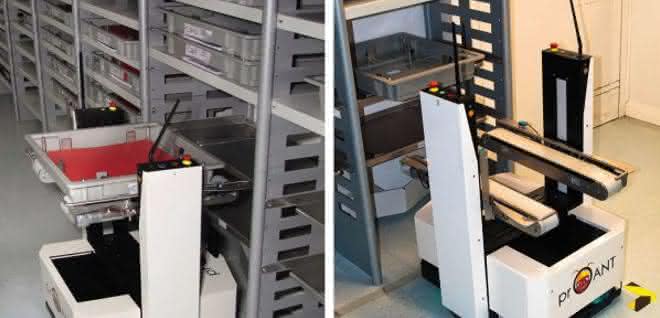
The three robots in use are the proANT AGV 436 model with lifting function and slightly modified load pick-up. Stackable KLT containers (590 x 470 x 95 mm) and standard KLT containers (600 x 400 x 300 mm) are transported.
The aim of the project is to eliminate manual material transportation through various departments and cleanroom zones. The transport robot system is intended to further increase cleanliness in production, as the customer has found it to be a decisive factor for quality and rejects. Furthermore, the employees are to be relieved of the work interruptions caused by the manual transportation of containers to other floors with other cleanroom classes, including changing clothes and protective clothing, which leads to a loss of productivity and costs.
The proANT system makes it possible to continue using the existing racking system with minor adjustments and to integrate the elevator system into the material flow concept without any structural measures. Storage compartment management and control of transport orders has been implemented with a touch panel solution.
The starting position
With over 50 years of experience, Dyconex AG is a leading global supplier of highly complex flexible, rigid-flex and rigid HDI/microvia PCB and chip substrate solutions for all applications where miniaturization, increased functionality, quality and maximum reliability play a role. The PCBs are manufactured under clean room conditions and the production processes are spread over three floors. Previously, the transport of PCBs, some of which are sensitive, was carried out manually by employees, who had to leave their workstations to do so, which was time-consuming. Employees often had to wait for the elevator and change their work clothes between the cleanroom zones due to high cleanliness standards.
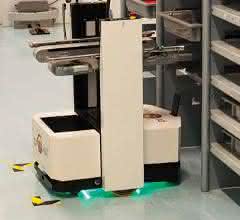
No joke: AGVs call the elevator on their own
The autonomously navigating transport robots move across three floors, call the elevator system independently and communicate with the controls integrated in the automatic doors via the company's own communication network. The vehicles make it easier to meet the high internal cleanliness standards than is possible for people wearing textile clothing. Special mats are laid out for the transport robots in the passages to the cleanliness zones, over which the vehicles roll for cleaning. The goods to be transported are currently handed over or picked up at twelve fixed ports or racks (passive stations). The transport robots have an active load pick-up with runners that can be moved to specific transfer heights of the individual compartments and can automatically pick up and transfer the containers.
The order management system has been specially developed with a warehouse management system to meet the customer's requirements and is operated via touchscreen panels at the individual stations. If an employee provides a transport box on the shelf for transportation, he informs the transport order management system via the software panel about the outstanding order with the corresponding destination. The fleet management system then schedules the most suitable transport robot for this order. The management system uses methods that are coordinated in such a way that all orders are processed as quickly as possible. These changes have a considerable influence on the effectiveness of the overall fleet.
proANT transport robots
InSystems Automation develops customized transport robots for loads from 30 to 1,200 kg and implements them as a fleet in the existing production control and manufacturing environment. Customized transport robots are suitable for special requirements and tasks, as they are adapted to customer requirements (loads, transfer heights, aisle widths, transfer points, degree of automation, interfaces to the production control system, software). Transport robots navigate automatically using laser scanners without floor loops or wall reflectors and react independently to changes in their working environment. The vehicles are safe for people, avoid obstacles and people independently or decide on alternative routes. As an independent fleet of vehicles, the transport robots organize all transport tasks for a fully automated, internal material flow. The vehicles communicate with each other via WLAN and drive around each other in good time. This avoids traffic jams or mutual obstructions.


You might also be interested in
HTEC and Embotech Expand Autonomous Industrial Logistics
HTEC and Embotech aim to accelerate the adoption of autonomous driving solutions in industrial logistics. The strategic partnership is intended to facilitate the rollout to additional vehicle platforms, customer projects, and locations.
 read more...
Standardized in design, flexible in use
Automated guided vehicles are increasingly in demand in production and logistics as they automate processes efficiently - but in addition to the vehicle, the right peripherals are also crucial for safe operation. A new solution consisting of a...
read more...Outdoor AGV networks production and logistics
An international company in the plastics industry is automating its intralogistics at its German site with a solution from ek robotics. A specially developed vehicle model from the Out Move series, an outdoor AGV, is being used.
read more...Transport systems for automated material flow
The Leo transporters from Bito make it easier for users to get started with the automation of material processes, which is possible from 20,000 euros. The system is a flexible all-in-one complete solution that is ready for immediate use and can be...
read more...Automated logistics for the university hospital
As part of the new construction of the University Hospital of Reims (CHU), France, the hospital has taken a number of steps to improve the needs of its patients and the working environment of its employees.
read more...K.Hartwall: Topping-out ceremony for the German site
The topping-out wreath was raised at the new building in the TIP Innovationspark Nordheide in Buchholz near Hamburg on February 27: The new K.Hartwall plant will comprise approx. 3,500 m² of hall space and around 2,000 m² of office and social areas.
read more...Noerpel Group tests driverless high lift trucks
The Noerpel Group has tested driverless pallet trucks in one of its two logistics facilities in Giengen. During a four-week trial, two autonomous systems were used to transport goods within the warehouse.
read more...Supply and disposal of printing machines by AGV
Numerous companies rely on AGVs in intralogistics to increase efficiency and meet challenges such as the shortage of skilled workers. One such company is GGP Media GmbH in Pößneck, Thuringia.
read more...Sophisticated automation: AGV and cobot combined
On behalf of Krefeld-based Saurer Technologies, the engineering team from Project Automation & Consulting developed a solution for production logistics that combines AGVs and cobots.
read more...