
Number 1 in Europe
Germany has the highest robot density
Germany is the most automated economy in Europe: robot density - i.e. the number of industrial robots per 10,000 employees - has risen to a new record of 371 units (2020).
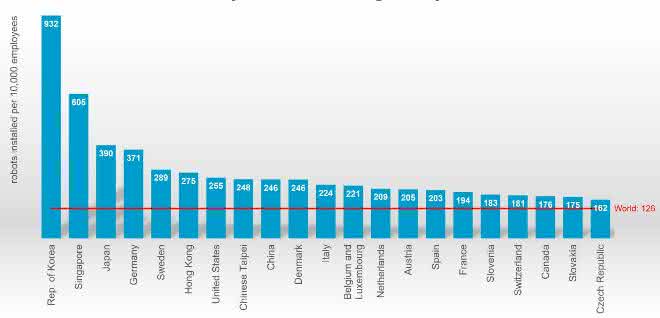
With a total of 230,600 units, Germany has a 38% share of the total number of industrial robots in operation in Europe. These are the findings of the World Robotics 2021 Report published by the International Federation of Robotics (IFR).
"Robot density is a very important indicator to understand the differences in the degree of automation in different economies," says Milton Guerry, President of the International Federation of Robotics. Globally, the average robot density has almost doubled over the past five years, rising to 126 units per 10,000 employees in 2020 (2015: 66 units).
Broken down by region, the average robot density in Western Europe is 242 units, in North America 167 and in Asia/Australia 134. The 5 most automated countries worldwide are: South Korea, Singapore, Japan, Germany and Sweden.
France has a robot density of 194 units (16th place worldwide). This puts Germany's neighbors well above the global average of 126 robots and puts them in a similar position to other EU countries such as Spain (203 units), Austria (205) and the Netherlands (209 units). In contrast, EU members such as Sweden (289 units), Denmark (246 units) and Italy (224 units) achieve a significantly higher level of automation through the use of industrial robots.
The UK is the only G7 country with a robot density of 101 units, which is below the global average (126 units) and puts it in 24th place. However, the trend here is also pointing upwards: Five years ago, the UK's robot density was 71 units. The exodus of foreign workers following Brexit has increased the demand for robots in 2020. This trend is likely to continue in the near future. The modernization of the manufacturing industry is being promoted by the government through a massive tax incentive, the "Super Deduction": From April 2021 to March 2023, companies can claim 130% capital allowance as tax relief for investments in plant and machinery.
From a global perspective, China is developing the most dynamically: due to the very strong installation figures, robot density rose from 49 units in 2015 to 246 in 2020. This puts China in 9th place worldwide - a big leap compared to 25th place just five years ago.


You might also be interested in
Dematic and Hai Robotics launch partnership for flexible AMR solutions
Dematic and Hai Robotics have recently agreed a Europe-wide partnership to work together as integration partners in the field of warehouse automation. Through this cooperation, the provider of automation solutions for supply chains and the...
 read more...
The market for service robots
A recent report from IDTechEx analyzes the global market for service robots and examines key applications for delivery and logistics robots, cleaning and disinfection robots, social robots and more.
read more...Application phase for Innovation Award 2026 begins
How can robotics help to make packaging more sustainable? Kuka is looking for creative and innovative ideas in the new round of the Innovation Award.
read more...Exoskeleton with AI power
Robotics company German Bionic presents its most advanced exoskeleton model to date, called 'Exia', which is fully controlled by augmented AI.
read more...Strategic partnership for the promotion of AI
Jungheinrich and Merantix have announced a strategic partnership. The aim of the cooperation is to promote applications based on artificial intelligence (AI) in the industry.
read more...New robotics organization founded
Omron has announced the establishment of a global robotics organization effective April 1, 2025. It will operate in parallel with Omron's automation business so that both areas can complement and support each other.
read more...No-code tool for programming robot user interfaces
ABB provides 'AppStudio', a software tool that allows users of all skill levels to quickly and easily create customized, graphical user interfaces for robots.
read more...SLAM navigation in real time
'Freestyle Localize', 'Trailer Find' and 'Scanner Switch' are three new features of Sigmatek's real-time location software forcontour-based navigation 'SlamLoc'.
read more...Robotic solution: Aiming high under your own steam
The Skypod system is now used in more than 100 order picking warehouses worldwide by companies in all kinds of industries. The autonomous Skypod robots are able to overcome height differences of up to 12 meters.
read more...