
Autonomous transport robots
Less walking - more time for innovation
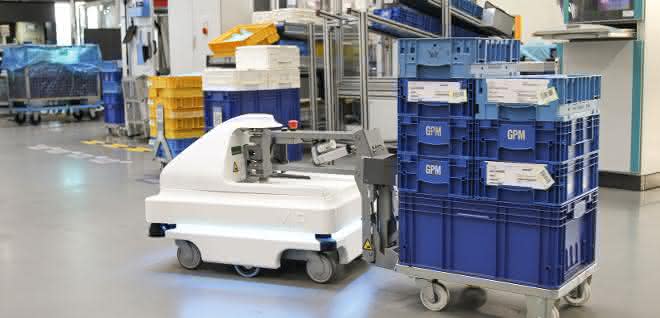
To keep production processes lean and inventories low, automotive supplier Nidec GPM Group relies on autonomous transport robots from Mobile Industrial Robots: at its site in Auengrund, Thuringia, three MiR100s equipped with the MiRHook pulling system transport material and empties between the warehouse and assembly lines.
The resources freed up can be converted into productive time. At the same time, this creates more room for innovation - an essential prerequisite for remaining competitive in the wake of e-mobility. The Nidec GPM Group has been developing innovative pump solutions for the automotive industry for around 70 years. Acquired by the Japanese Nidec Group three years ago, the former family business now wants to successfully establish itself on the market in the wake of e-mobility. A strong focus on research and development is crucial for this. In order to use the existing capacities as efficiently as possible, Nidec GPM has increasingly relied on the lean principle since the takeover: lean processes are intended to avoid wasting resources and maximize performance.
Flexible automation solution: sought and found
The company is increasingly using state-of-the-art robotics solutions on its production lines. Against this background, it seemed only logical to automate the internal material flow as well. Those responsible set out to find an automated guided vehicle system that would require no structural changes to the infrastructure and could be implemented quickly. At a trade fair, they came across the autonomous, mobile transport robots from Mobile Industrial Robots (MiR). "The robots immediately impressed us with their great flexibility," recalls Andreas Vogt, deputy production manager and lean expert at Nidec GPM. The agile MiR robots maneuver independently and safely. They recognize obstacles such as objects or employees at a distance and avoid them in good time or brake. Accordingly, they do not require magnetic strips or rails.
Well equipped with the Hook
After a short test phase, the decision in favor of MiR was soon made. Working closely with the local system integrator, the company introduced three MiR100s with the MiRHook pulling system in two different production areas one after the other. Thanks to their uncomplicated commissioning, Nidec GPM was able to quickly integrate them into the ongoing processes. Before being used for the first time, the robots first drive around the factory hall and map their future working environment. On this basis, the mobile helpers can later orient themselves and independently find the fastest route to their destination. Finally, the hook enables them to ideally grip floor rollers and shelf trolleys and move up to 300 kilograms per journey. They navigate autonomously between the warehouse and the assembly area and bring oil pump covers, water pump bearings and drive shafts to where they are needed.
Eleven kilometers of walking saved per robot per day
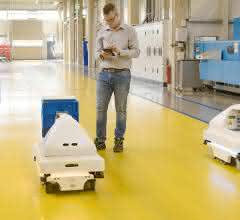
Franz Scheibe, team leader in the assembly department, programs the mobile robots for their daily use. To do this, he uses the MiRFleet control software, into which all three robots are integrated. "A typical route looks like this: As soon as the robot is called by an employee, it starts from its waiting position in the 'supermarket', i.e. the area where all our parts are in stock. There it attaches the appropriately loaded floor trolley - it recognizes it using a QR code - and sets off." The robot beeps as it moves so that the employees can hear it despite the noise of the machine and don't accidentally run it over.
"With the material in its luggage, the robot then drives to the assembly line where the respective parts are needed," continues Scheibe. "It uncouples the full floor roller and takes an empty one in return. It then takes this to the warehouse before returning to its waiting position in the supermarket." On the way, the robots also independently pass through an airlock gate that opens via contact with a magnetic loop in the floor. On average, each robot covers eleven kilometers per day - a distance that the employees are now spared.
MiR robots keep stocks low
In production area 5 of the plant, a robot supplies the employees at an almost fully automated system with material. In area nine, two mobile robots are used to supply each of the ten assembly lines there with components. This used to be done by a logistics specialist, reports Andreas Vogt. "Back then, there was usually far too much material on the assembly lines - and of course that costs money unnecessarily." Today, the robots supply the employees at the machines with exactly the amount of material they need at any given moment. For Nidec GPM foreman Johannes Otto, the effects are clearly noticeable in his day-to-day work: "We have much less material in production than before. That saves a lot of space." Nevertheless, some employees initially had doubts about the new "colleagues", reports Johannes Otto. "At first I found it a bit difficult myself. But then I quickly realized: this is progress and helps us in our daily work. I think that's good." The robots now relieve employees of repetitive transportation tasks. What's more, they are easy to use, which quickly dispelled any concerns. "The robots are really super intuitive to operate," says Franz Scheibe. "My colleagues quickly learned to generate new orders and have material delivered to them." To do this, they use a web-based user interface that can be accessed via tablet, cell phone or computer.
More resources for research
With MiR technology, Nidec GPM has found a way to automate its internal material flow cost-effectively. The purchase of two more robots is already being planned. The MiR100s are currently freeing up the resources of one full-time employee. Among other things, the reduction in workload helps to focus on productive working hours. It also pools resources in the area of research and development. This is an important aspect, as Nidec GPM would soon also like to offer its customers technological solutions and benefits with regard to electrically driven pumps. "Research and development is the basis on which we develop our sustainably innovative technologies," explains Andreas Vogt. "By automating intralogistics with Mobile Industrial Robots, we are also keeping pace with innovative solutions in production."


You might also be interested in
Dematic and Hai Robotics launch partnership for flexible AMR solutions
Dematic and Hai Robotics have recently agreed a Europe-wide partnership to work together as integration partners in the field of warehouse automation. Through this cooperation, the provider of automation solutions for supply chains and the...
 read more...
The market for service robots
A recent report from IDTechEx analyzes the global market for service robots and examines key applications for delivery and logistics robots, cleaning and disinfection robots, social robots and more.
read more...Application phase for Innovation Award 2026 begins
How can robotics help to make packaging more sustainable? Kuka is looking for creative and innovative ideas in the new round of the Innovation Award.
read more...Exoskeleton with AI power
Robotics company German Bionic presents its most advanced exoskeleton model to date, called 'Exia', which is fully controlled by augmented AI.
read more...Strategic partnership for the promotion of AI
Jungheinrich and Merantix have announced a strategic partnership. The aim of the cooperation is to promote applications based on artificial intelligence (AI) in the industry.
read more...New robotics organization founded
Omron has announced the establishment of a global robotics organization effective April 1, 2025. It will operate in parallel with Omron's automation business so that both areas can complement and support each other.
read more...No-code tool for programming robot user interfaces
ABB provides 'AppStudio', a software tool that allows users of all skill levels to quickly and easily create customized, graphical user interfaces for robots.
read more...SLAM navigation in real time
'Freestyle Localize', 'Trailer Find' and 'Scanner Switch' are three new features of Sigmatek's real-time location software forcontour-based navigation 'SlamLoc'.
read more...Robotic solution: Aiming high under your own steam
The Skypod system is now used in more than 100 order picking warehouses worldwide by companies in all kinds of industries. The autonomous Skypod robots are able to overcome height differences of up to 12 meters.
read more...