
Warehouse-/Picking technology
Years of collaboration bear new fruit
Storage capacity is exhausted: this is the problem that Hurst+Schröder, a manufacturer of switch handles and components, is facing. The last warehouse expansion only took place in 2010. This had already been realized by the shelving manufacturer Julius vom Hofe. So it was obvious that the second expansion should also be carried out with hofe.
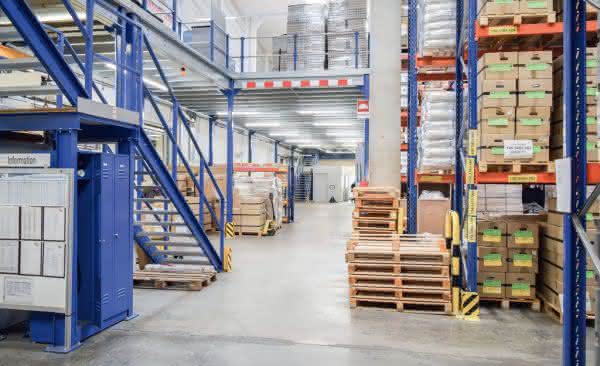
Hurst+Schröder manufactures switch handles and displays for household appliances and other electronic assemblies. The parts are usually manufactured to customer specifications and dispatched promptly. This explains why the finished goods warehouse only takes up around a third of the 1,200 square meter warehouse. The remaining two thirds are required for individual parts and the purchasing warehouse. The warehouse consists of pallet racks with around 1,050 storage spaces and is supplemented by shelving racks. The warehouse area also houses the workstations for incoming goods and dispatch.
A bridge connects old and new
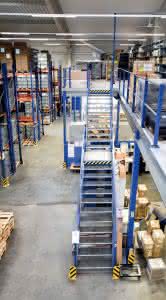
The first expansion of the storage area was due in 2010. After the shelving manufacturer Julius vom Hofe equipped Hurst+Schröder's new warehouse with pallet racking, the company turned to the supplier again. As no further space was available and incoming goods and dispatch could not be relocated, the company opted for a structural steel platform. This was manufactured precisely to the spatial conditions and space requirements and integrated into the existing warehouse. This created the first 200 square meters of additional storage space. But just six years later, the warehouse capacity has been exhausted again. Warehouse manager Philipp Lorei explains: "The steady growth of the company makes this step unavoidable. Until recently, we also used folding cartons as packaging. But now we are using new cardboard packaging that requires three times the volume."
As the spatial conditions have not changed and the stationary workstations and the parking spaces for the dispatch department were to remain, another solution had to be found that took all the requirements into account.
Successful integration of the new elements
"hofe Regalsysteme offered us the solution of a second structural steel platform. In order to really make optimum use of the warehouse, both platforms should be connected to each other," says Lorei. The spatial conditions, such as the hall columns, ceiling height and the existing pallet racking, did not allow for much freedom of design in the planning. Taking the customer's specifications into account, the second stage was manufactured to fit perfectly and set up. A bridge connects the two platforms. The integration of the two new elements worked so well that there is no discernible difference between old and new.
"hofe Regalsysteme offered us the solution of a second structural steel platform. In order to really make optimum use of the warehouse, both platforms needed to be connected"Philipp Lorei warehouse manager at Hurst+Schröder
LED lights provide brightness in the warehouse
During the planning phase, care was taken to ensure that the workstations were brightly lit and that light was evenly diffused. This is why modern, energy-saving LED lamps were used in the lower stage area. They provide daylight lighting conditions. This also made it possible to avoid a dark tunnel in the stage area and to integrate the lighting into the rest of the hall lighting.
With the completion of shelving racks on the upper floor of the steel construction platform, the desire for additional storage options was met. "It was easy to integrate a pallet loading station so that we could accommodate our packaging warehouse on the new upper floor," explains warehouse manager Philipp Lorei. With the construction of the second platform, the shipping, incoming goods and internal material flow departments could be retained in the lower area, so that the work processes at Hurst+Schröder could remain unchanged.
www.hurst-schroeder.dewww.hofe24.de


You might also be interested in
Circular load carriers for more sustainable supply chains
With the planned Industrial Accelerator Act, the European Union wants to accelerate the transformation of industry towards low-carbon production processes and resource-efficient supply chains. Logistics and transportation are also increasingly...
 read more...
Integration of a robotics solution
Lyreco modernizes logistics center in France
Lyreco is pressing ahead with the automation of its central site in Villaines-la-Juhel with an investment volume of over 25 million euros.
read more...Dragsbæk halves pallet area
By using automated pallet solutions from Palomat, Dragsbæk has halved the space required for pallets, optimized processes and sustainably improved working conditions.
read more...Pixels instead of paper
With the solutions from Logistikbude, Bekuplast, manufacturer of plastic containers, keeps an eye on its load carriers, saves costs and can work more efficiently with forwarding partners.
read more...Flexibility in saving space
Purus Plastics has developed a new retail range. The company operates a processing plant for plastics; recycling creates new products from secondary raw materials, including pallets.
read more...Solutions for the food industry
At Werit, the focus is on customer-specific solutions, sustainable recycling and pooling systems and products made from recyclate. The stand concept is divided into four areas: Products and innovations in the food sector, customer solutions,...
read more...Pallets with QR code
At the Epal Germany stand, visitors can gain an insight into the reusable system propagated by Epal, the life cycle of an Epal pallet and the newly developed QR pallet.
read more...The path of the Euro pallet into the IoT
With the introduction of the EPAL Euro Pallet QR in 2024, the European Pallet Association (EPAL) aims to set a new standard for the classic Euro pallet, which has been used successfully for over 60 years, and pave the way for ecologically...
read more...Retail range: flexibility to save space
Purus Plastics has developed a new retail range that is designed to attract the interest of retailers in particular. The company operates a modern plastics processing plant in Arzberg, Bavaria; new products are created from secondary raw materials...
read more...