
Cover story materialfluss 3/2019
Partner for SMEs
Daniel Morent is responsible for classic warehouse technology at intralogistics specialist SSI Schaefer. The Head of Product & Equipment spoke to materialfluss about clever combinations of warehouse technology and AGVs and reveals why he considers the German company to be the first choice for small and medium-sized companies.
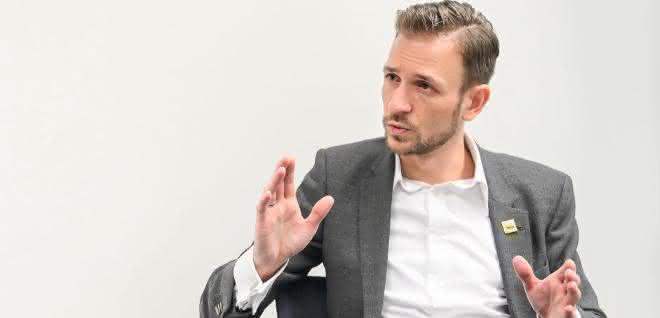
materiafluss: Mr. Morent, what conclusions can you draw from the trade fair today, after almost three days in Stuttgart?
Daniel Morent: Visitor interest was very high this year, even on Thursday afternoon there was still no sign of the influx of trade fair visitors calming down. We are very satisfied and would like to have even more space in Hall 1 (smiles).
mfl: SSI Schaefer is very well known for large warehouses, high-end solutions and complex systems. The reality in logistics in Germany is sometimes much less complex. What does SSI Schaefer have to offer, let's say, medium-sized companies?
Morent: SSI Schaefer has a very broad product spectrum, ranging from a simple box to full automation. And all of this from our own value creation. What sets us apart from other competitors is that we produce almost everything ourselves or have brought the expertise in-house through acquisitions or partnerships. Our roots lie in small, modular solutions and, historically speaking, we started out with containers and shelving. SSI Schaefer is still a leader in this area and we want to emphasize this again. Of course, a container is not as appealing as an automated shuttle. Nevertheless, the standard business is our basis. In addition, there is an increasing demand for solutions that include classic racking and containers as well as warehouse lifts, conveyor technology or AGVs.
mfl: Has SSI Schaefer also responded to this in organizational terms?
Morent: Yes, we are now better able to offer these complete solutions. Although this was also the case in the past, there was no central office that had an overview of the sales interfaces of the individual product groups. It's different in the automation sector, where there is a project manager who is responsible for all the interfaces between the trades. In the past, we acted like many of our competitors, selling products individually and the sales force was the link. However, SMEs and smaller companies in particular are increasingly demanding solutions that combine conventional technology and automation. We can now meet this demand perfectly. It is very important for us to demonstrate that we are not just in the automation sphere. From small to large, that is and remains our strength.
mfl: So what does the new sales structure look like?
Morent: We now have a sales department that has the expertise to find complete solutions. The structures in automation were the model. We are thus taking a huge step forward. There is a structure in the background that serves as a sparring partner for sales on the one hand and presents the customer with an optimum solution regardless of individual products on the other, because I can be sure that all the trades are coordinated in the overall package.
mfl: That sounds like a "back to the roots"?
Morent: Yes. We know that the automation market is growing strongly, so we only had to look around at the trade fair. However, this does not mean that conventional requirements no longer exist. SSI Schaefer is by no means saying goodbye to its core market.
mfl: How would you describe growth in the conventional sector?
Morent: It is stable, but also, as with automation, characterized by consolidation. The exciting thing is that the technical development of AGVs in recent years has opened up a relatively simple way of combining conventional warehouse technology with automation, and all this during ongoing operations. These modular and scalable solutions are therefore very attractive.
mfl: What role does the economy play in this?
Morent: The boom phase has been going on for a very long time, but there will be a rethink at some point. At the moment, fully automated solutions are very much in vogue, as the economy is stable and companies can plan optimally. However, a fully automated solution that ties me down for years is much less flexible than, for example, a combination of racking systems and AGVs, which can be flexibly adapted to new conditions. Due to these aspects, I see a very positive trend for the entire conventional warehouse technology sector.
mfl: You have described SSI Schaefer as a "leader" in the core area. How do you define the word "leading"?
Morent: In terms of turnover, it's very difficult to draw the line, but in terms of the breadth of the product range, I don't know of any other provider that can paint such a complete picture and play the entire range. We don't trade in trades, we produce them ourselves and supply a complete system including logistics software and after-sales services. This makes it easier and more manageable for the customer.
mfl: In terms of volumes, the core business is often also "small business". How do you ensure that the customer who needs 20 meters of shelving is also heard?
Morent: Below a certain threshold, a planning meeting with a sales representative makes less sense, that's true. That's why we have our online store or the catalog. And at the latest when we start talking about solutions, the sales force comes into play. Nowadays, you no longer have to travel in person for every appointment. Video conferencing is very often already the standard way of providing customers with comprehensive advice.
customers.
mfl: Has the sales department been staffed up?
Morent: Sales has been expanded, including with a complete project planning team.
mfl: Warehouse logistics that can be implemented quickly is desired in many places, and "plug & play" is a frequently discussed term in intralogistics. What else is possible here?
Morent: A great deal. Just look at how AGVs have already developed in recent years. This will go much further in a few years' time. And this would then make it even easier to automate individual process steps in the warehouse or to interlink existing processes and thus reduce transport and/or handling steps for employees - employees who are already hard to find on the job market today. The charm is that I can do this gradually and employees can slowly get used to it - a kind of "customized automation" that grows with them. This is particularly beneficial for SMEs. Small and medium-sized companies are already under global pressure to get a better grip on productivity, delivery performance, response times and costs. Against this background, partial or full automation with the interlinking element of AGVs is a simple and comparatively cost-effective way to get started.
mfl: Is an AGV a panacea?
Morent: No, but it is the most tangible trend. The technology is already usable today, that is the difference to other developments, but it still has to undergo one or two further developments. Autonomous driving provides the necessary tailwind for the development of navigation and safety sensors, decentralized control ideas à la swarm intelligence or combinatorics with robotics, to name just a few of the challenges. Today's range of AGV solutions in a closed space, on the other hand, is manageable. The faster this technology develops, the more companies are springing up to design applications around it. This trend is not abstract. The important thing for customers is that they receive a ready-made solution that is also integrated into the system and process. In addition to the AGV, intelligent fleet controllers, standardized third-party system integration and, as in the case of SSI Schaefer, complete intralogistics solutions must be considered and harmonized with the upstream and downstream process chains. Examples of this include production, storage, order picking or direct machine connections.
mfl: Is the AGV market already so crowded that you have to be the cheapest supplier? Or the one that can deliver the fastest?
Morent: The most important thing is proper advice that is embedded in a good overall solution. We place the core focus on this connection. Of course, many providers also have an interface to a third-party system, but it is much easier for the customer with one provider for everything. We want to be the best in consulting, and this is where we can score points with SMEs.
mfl: Suppose I wanted to use five Weasels in my warehouse. We would have already agreed on the price - when would they set off for the first time?
Morent: Although the Weasel is an entry-level solution, I still have to place the optical track guidance system including RFID tags - but commissioning does not require any further complex installations and can even be implemented at short notice during ongoing operations. However, the exact scheduling on site always depends on the complexity and the individual framework conditions.
mfl: How did your path lead you into the standard business?
Morent: I come from the standard business and have been working for SSI Schaefer for eight years. I started out as sales manager for Bavaria, then took over key account sales in Germany and finally became responsible for the Product & Equipment division in Germany via international sales management. Before that, I worked for Würth Industrie. So I am a salesman through and through.
mfl: What are you and your team aiming to achieve in the area of conventional storage technology by the end of the year?
Morent: We want to grow moderately across all areas and be perceived as an attractive and strong partner. This means that we offer our customers the optimum solution for their individual requirements. Our declared aim here is to cater specifically to medium-sized companies.
Marvin Meyke and Martin Schrüfer spoke to Daniel Morent on the third day of LogiMAT.


You might also be interested in
Standardized in design, flexible in use
Automated guided vehicles are increasingly in demand in production and logistics as they automate processes efficiently - but in addition to the vehicle, the right peripherals are also crucial for safe operation. A new solution consisting of a...
 read more...
Outdoor AGV networks production and logistics
An international company in the plastics industry is automating its intralogistics at its German site with a solution from ek robotics. A specially developed vehicle model from the Out Move series, an outdoor AGV, is being used.
read more...Transport systems for automated material flow
The Leo transporters from Bito make it easier for users to get started with the automation of material processes, which is possible from 20,000 euros. The system is a flexible all-in-one complete solution that is ready for immediate use and can be...
read more...Automated logistics for the university hospital
As part of the new construction of the University Hospital of Reims (CHU), France, the hospital has taken a number of steps to improve the needs of its patients and the working environment of its employees.
read more...K.Hartwall: Topping-out ceremony for the German site
The topping-out wreath was raised at the new building in the TIP Innovationspark Nordheide in Buchholz near Hamburg on February 27: The new K.Hartwall plant will comprise approx. 3,500 m² of hall space and around 2,000 m² of office and social areas.
read more...Noerpel Group tests driverless high lift trucks
The Noerpel Group has tested driverless pallet trucks in one of its two logistics facilities in Giengen. During a four-week trial, two autonomous systems were used to transport goods within the warehouse.
read more...Supply and disposal of printing machines by AGV
Numerous companies rely on AGVs in intralogistics to increase efficiency and meet challenges such as the shortage of skilled workers. One such company is GGP Media GmbH in Pößneck, Thuringia.
read more...Sophisticated automation: AGV and cobot combined
On behalf of Krefeld-based Saurer Technologies, the engineering team from Project Automation & Consulting developed a solution for production logistics that combines AGVs and cobots.
read more..."Herbie" robot in the Körber portfolio
Carrybots, a specialist in mobile robotics, is a new partner in the Körber supply chain ecosystem. The aim of this collaboration is to strengthen the position of both companies in intralogistics. Herbie" enables robot-based goods-to-person processes.
read more...