
Study by 4flow
Exciting: How does warehouse automation pay off with volatile demand?
4flow, a provider of logistics consulting, logistics software and logistics management, has published the results of its new study on warehouse automation and volatile demand. In the study "Warehouse automation and volatile demand - a strategic fit?", 4flow answers key questions in the field of warehouse planning for supply chain decision-makers: Under what conditions is the automation of a warehouse profitable? Can the service level requirements be met in view of possible flexibility restrictions of automated warehouse technologies?
Striking a balance between free capacity and maximum warehouse efficiency is an ongoing challenge for supply chain management and logistics. A warehouse that is too large is not cost-efficient - at the same time, opting for a design that is too compact can lead to significant losses in service levels, for example due to stock shortages. The efficiency of a warehouse depends not only on its size but also on the degree of automation. High costs for automation technology also make it difficult to decide on the optimal size of the warehouse. Companies also need flexibility in their operational processes - a requirement that automation technology cannot always meet. "Ultimately, the business case for automation depends on good planning and forecasting future requirements as accurately as possible," explains Wendelin Gross, Head of Research at 4flow. "The study highlights the key factors that need to be considered to make a more informed decision about warehouse automation."
To this end, the study compared a manual warehouse concept with forklift trucks and shelving racks with an automated warehouse solution that combines automated guided vehicles (AGVs) and a high-bay warehouse with storage and retrieval machines. The objective was to analyze the cost and performance indicators, the service level and the payback period for the automation solution.
The 4flow team analyzed various cost and performance drivers in detail and came to the conclusion that different demand volatility and costs caused by out-of-stocks in the case study under consideration lead to a payback period of between two and six years for the automated solution.
Based on the findings of the study, 4flow provides specific recommendations for companies considering automating their warehouse. This includes paying close attention to demand volatility, taking into account the development of location-specific factors such as rent and labor costs, and applying a standardized planning approach with 3D layout planning and a sensitivity analysis that considers all important cost and performance-related factors.
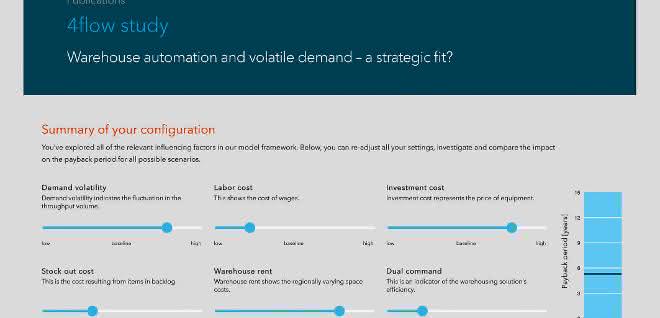
Interested users can explore selected results of the study themselves in an interactive web-based model. A large number of adjustable parameters make it possible to generate different scenarios and assess whether an investment makes sense based on the cost and performance figures.


You might also be interested in
HTEC and Embotech Expand Autonomous Industrial Logistics
HTEC and Embotech aim to accelerate the adoption of autonomous driving solutions in industrial logistics. The strategic partnership is intended to facilitate the rollout to additional vehicle platforms, customer projects, and locations.
 read more...
Standardized in design, flexible in use
Automated guided vehicles are increasingly in demand in production and logistics as they automate processes efficiently - but in addition to the vehicle, the right peripherals are also crucial for safe operation. A new solution consisting of a...
read more...Outdoor AGV networks production and logistics
An international company in the plastics industry is automating its intralogistics at its German site with a solution from ek robotics. A specially developed vehicle model from the Out Move series, an outdoor AGV, is being used.
read more...Transport systems for automated material flow
The Leo transporters from Bito make it easier for users to get started with the automation of material processes, which is possible from 20,000 euros. The system is a flexible all-in-one complete solution that is ready for immediate use and can be...
read more...Automated logistics for the university hospital
As part of the new construction of the University Hospital of Reims (CHU), France, the hospital has taken a number of steps to improve the needs of its patients and the working environment of its employees.
read more...K.Hartwall: Topping-out ceremony for the German site
The topping-out wreath was raised at the new building in the TIP Innovationspark Nordheide in Buchholz near Hamburg on February 27: The new K.Hartwall plant will comprise approx. 3,500 m² of hall space and around 2,000 m² of office and social areas.
read more...Noerpel Group tests driverless high lift trucks
The Noerpel Group has tested driverless pallet trucks in one of its two logistics facilities in Giengen. During a four-week trial, two autonomous systems were used to transport goods within the warehouse.
read more...Supply and disposal of printing machines by AGV
Numerous companies rely on AGVs in intralogistics to increase efficiency and meet challenges such as the shortage of skilled workers. One such company is GGP Media GmbH in Pößneck, Thuringia.
read more...Sophisticated automation: AGV and cobot combined
On behalf of Krefeld-based Saurer Technologies, the engineering team from Project Automation & Consulting developed a solution for production logistics that combines AGVs and cobots.
read more...