
Fuel cell truck
Hydrogen march!
With its hydrogen concept, Daimler is setting the course for the truck drive of the future. Until then, however, there is still a lot of work to be done on the road to zero-emission commercial vehicles.
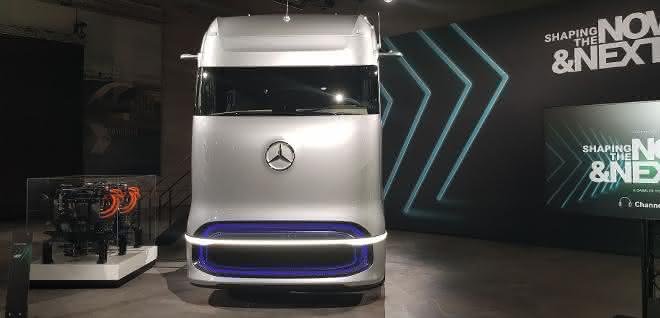
The transport market has been waiting a long time for the commercial vehicle giants to make a move. Now, just in time for the canceled IAA Commercial Vehicles, industry leader Daimler is setting the direction in which the globally operating commercial vehicle group will navigate in the future. Electric drive for the light and medium-duty truck cavalry and hydrogen drive for long-distance transportation is the motto that Daimler's commercial vehicle boss Martin Daum issued at the end of September.
It is interesting to note that Daimler and Volvo Trucks, the two largest global suppliers of commercial vehicles, are joining forces in a joint venture to achieve the complex development of a production-ready and, above all, practical hydrogen drive system for trucks. The cooperation between the two industrial giants is to result in the development and production of a joint fuel cell, which will then be installed - again completely separately - in the future vehicles or units of both groups. So there will not be a jointly produced hydrogen vehicle, which is important to the bosses of the two commercial vehicle manufacturers. It is quite possible that Daimler will also want to devote itself to building its own battery technology over the course of the development period, which will last several years. At present, the Stuttgart-based company is still purchasing the power storage units from Chinese battery experts CATL. In the passenger car sector, however, the company is already focusing on its own battery production.
Timetable for the revolution
Daimler CEO Martin Daum provided an initial outlook on the future strategy with the planned timetable for the introduction of the drive revolution. From next year, the electric Actros for heavy-duty distribution applications, which has been tested by selected customers for two years and has an admittedly rather modest battery range of around 200 kilometers, is to go into series production. The battery-powered eEconic municipal truck for urban tasks will follow a year later.
In 2024, Daimler strategists are planning the series launch of the electric version of the heavy-duty eActros Long Haul, which has been further developed and is designed to travel up to 500 kilometers emission-free with the appropriate battery technology under and next to the frame. The premier class - the GenH2 truck with fuel cell drive and additional battery storage - is due to start customer trials in three years' time, before heralding the revolution in heavy-duty road freight transportation as a series vehicle in the second half of the decade.
Years of practical testing
Why is this taking so long? some customers are asking themselves in view of the practical test of the Hyundai Xcient hydrogen truck that has already started in Switzerland (LT-manager reported on this in issue 5/19). The question is not entirely unjustified; after all, Daimler has been researching hydrogen for decades and, like the Asian H2 pioneers Hyundai and Toyota, can boast series-produced passenger cars. The Swabians have also gained many years of experience with Citaro city buses, which have covered millions of kilometers in practical use throughout Europe powered by fuel cells. However, the transfer of fuel cell technology from passenger cars to trucks is proving difficult to implement, and not just because of the different power requirements.
For use in long-distance trucks, a fuel cell with a permanently high power output, the corresponding electric drive motors and an adequate battery for intermediate storage of electrical energy and the provision of additional boost power must be developed. In addition, the GenH2 truck, which will one day be ready for series production, should not only be in no way inferior to its diesel-powered brothers in terms of performance, but also in terms of durability in customer use. This means a minimum service life of around ten years of operation and at least one million kilometers. These qualities can only be guaranteed in a long-term test procedure with corresponding practical use. Large-scale series development therefore takes longer than the quick, dedicated installation of a fuel cell that is already available today in an existing used vehicle.
Despite the agonizingly long wait for the environmentally friendly Daimler gift for many customers, the key data of the future hydrogen Actros is already known. Propulsion will be provided by two electric motors with a maximum output of 330 kW, which will be installed directly in the drive axles to save weight and space. The e-motors, with two 2071 Newton meters of torque, are powered by the fuel cell drive with two 150 kW continuous system outputs. A relatively compact 70 kW/h battery provides 400 kW - that's an impressive 545 hp! - of additional energy. The power storage unit also absorbs the recuperation energy when braking with the electric motors.
In addition to the provision of electrical energy, there is another major hurdle to overcome with hydrogen propulsion - the dissipation of the thermal energy that is released when hydrogen is converted into electricity. For this purpose, the GenH2 prototype has additional installation space behind the classic long-distance cab, which is required for the correspondingly extensive cooling system. In any case, the prototype will lose its futuristic fish face with the thick radiator lips of a catfish in the course of development. Instead, the design will be based on the successor to the reigning "Truck of the Year" Actros, which will also be on the road as a diesel version by the time the hydrogen truck goes into series production.
Cooled in the midship
With a range of up to 1,000 kilometers, the brave new world of truck propulsion should be able to play in the long-distance truck league. To achieve this, Daimler favors the use of cryogenic hydrogen, which is stored at a temperature of -253 degrees Celsius in two compact insulated tanks with a total storage capacity of 80 kilos amidships on the tractor unit. For Martin Daum, liquid hydrogen is the only viable option due to its significantly higher energy density compared to the gaseous state and the comparatively quick and uncomplicated refueling process. Even if the deep-freezing of the gas extracted from the water by electrolysis consumes additional energy. Daimler argues that hydrogen production is only economically and ecologically viable with renewable energy anyway. Hydrogen produced from coal-fired electricity would be completely unsuitable both in terms of cost and environmental aspects.
In any case, no customer can yet hope to save money when operating a hydrogen truck. Both in production and in use, the H2 truck will be significantly more expensive than its diesel counterpart, warns Daimler boss Daum today. The new technology can only be made competitive in the free transport market with the support of politicians, appropriate incentives via tolls and taxation and other economic incentives. Declarations of intent and the prospect of funding programs worth billions already exist today, according to the current Transport Minister Andreas Scheuer. According to Scheuer, politicians want to "reinvent the truck" and invest massively in the expansion of hydrogen filling stations.
Here, too, the well-known question of the chicken and the egg arises, or who dares to take the first step into the new drive technology. "We have to lay the egg now!" says top manager Daum, explaining the clear commitment to the future of hydrogen. However, it remains to be seen whether this will be able to hold a candle to the diesel engine, which has been perfected over 120 years of development and construction.
Bridge technology or not?
Daimler has announced that it will also offer carbon-dioxide-neutral drive systems exclusively for commercial vehicles in 2039. In the two decades in between, new innovative drives in combination with further optimized combustion technology will take care of the diverse transport tasks in the triad markets. The Daimler giants are clearly rejecting bridging technologies such as natural gas drives in trucks. "That helps a little," says Martin Daum, but is not part of the big, overall solution. The top Daimler trucker, a friend of clear statements, even considers the test use of overhead lines for partially electrified trucks, which is also being promoted by politicians, to be "utter nonsense and a waste of taxpayers' money". His slogan for the future of Daimler in the coming decades is as simple as it is clearly defined: Hydrogen march!
This is what the other manufacturers are planning:
With its strategic partnership with Daimler, Volvo has a clear focus on electrically powered trucks. Distribution trucks with electric drive are ready for series production and heavy-duty trucks are in the works. In the USA - as well as at Daimler subsidiary Freightliner - fully electric trucks are already driving on the highways. Fuel cell technology will guarantee range and security of supply in the future. Volvo currently still offers an LNG drive with diesel and Adblue as an auxiliary fuel.
Swedish competitor Scania also has an LNG drive and several battery-electric distribution trucks. Scania is also the only manufacturer to be involved in a test of hybrid trucks powered by overhead lines on sections of highway - also known elsewhere as railroad trucks - which is co-financed by the German government.
After several attempts, Group sister company MAN also has a battery-powered distribution truck in test runs with customers and is contributing the eTGE transporter with electric drive. Following the planned mass redundancies in the Group, the MAN management wants to realign itself and march towards the future with alternative drive concepts.
Iveco has caused quite a stir in the industry with its cooperation with Nikola. A battery-powered heavy-duty truck is soon to roll off the production line in Ulm, followed a few years later by a fuel cell Nikola. After the stock market turmoil surrounding the resignation of Nikola boss Trevor Milton, people are now eagerly awaiting the continuation of the seemingly fantastic Nikola story.
Renault Trucks has been committed to the topic of e-drive for years and has put a fairly respectable fleet of production-ready vehicles on its wheels. Natural gas variants are also available from Renault. The future will probably be based on the strategy of the parent company Volvo.
The Dutch manufacturer DAF is also committed to e-drive - not only in light distribution transport, but also in heavy-duty trucks up to the DAF CF tractor unit. Strong impetus on the subject of fuel cells and e-drive can be expected from Asia. Hyundai is already running fuel cell technology in customer trials with a fleet of medium-duty distribution trucks in Switzerland. And in just a few years' time, some manufacturers of alternative drive systems from China will venture onto the European market.
Innovations from Mercedes:
Ready for here and now: in addition to a lot of future-oriented music, Mercedes-Benz is also playing with familiar instruments. At the undead IAA 2020, there will be a slimmed-down Actros variant called the Actros F, which is intended to attract price-sensitive users to the side of the star. The fleet truck with 450 hp offers reasonably priced equipment at a reasonable price and, with the CompleteMile service contract, a good deal of planning security. You pay for what you drive and the monthly rates are based on the actual kilometers driven. CompleteMile will be available from March 2021, also for other Actros, Arocs and Atego models.
In addition to the Cinderella Actros F, Daimler is also launching the beautiful, rich sister Actros Edition 2. The limited-edition special model is designed to sweeten the working day for deserving drivers or owner-drivers with full-featured equipment. From the exclusive exterior design with lots of stainless steel, even on the rear axle pots, to the finest leather upholstery and ambient interior lighting, the star shines particularly brightly here.
From the middle of next year, the new cornering assistant ASGA (Active Side Guard Assistant) will also be available, which not only warns of unseen obstacles, but also brakes the truck to a standstill if there is a risk of collision. The ABA emergency brake assist is also being upgraded with a significantly enhanced version 5 with combined camera and radar monitoring and extended detection.


You might also be interested in
Winner material flow PRODUCTS OF THE YEAR 2023
Conductix-Wampfler: ChargeLine 0865
Two-pole conductor rail segments for efficient opportunity charging of shuttles, suitable for thousands of cycles per day.
 read more...
Hermann Grewer celebrates his 80th birthday
Hermann Grewer, Honorary Chairman of the North Rhine-Westphalia Transport and Logistics Association (VVWL) and Honorary President of the German Road Haulage, Logistics and Disposal Association (BGL), celebrated his 80th birthday on June 6.
read more...Well chilled for sure
V-Zug Kühltechnik AG, developer and manufacturer of refrigeration appliances and part of the successful V-Zug Group, has set up a new production facility for refrigerators of all heights and dimensions at its Swiss site in Sulgen.
read more...Advantageous automation of small parts warehouses
The RSX1 shuttle system will be at the center of Rocketsolution's presence at this year's Logimat trade fair.
read more...Reduced energy requirements in the high-bay warehouse
One of Germany's leading premium car manufacturers is already focusing on energy efficiency in the production of its new SUV model with electric drive. The storage and retrieval machines in a high-bay warehouse at the production site have been...
read more...Low lift pallet truck for light duty applications
Clark has launched a new low lift pallet truck with the model designation LWio15 for light transport tasks. The truck has a load capacity of 1500 kg and is suitable for short distances in goods distribution, production or warehousing.
read more...Internationalization as an opportunity
E-commerce is in a state of flux. Changes in purchasing behavior and procurement problems are keeping e-commerce retailers busy. Logistics plays a decisive role in the overall online shopping experience.
read more...Fulfillment Center for Frisco.pl
Polish eGrocery specialist and TGW deepen partnership
TGW is building a highly automated fulfillment center for Frisco.pl in the Polish capital Warsaw. This is the second project in a row that the two companies have implemented together.
read more...Which world will it be in 2023?
Michael Schreckenberg teaches at the University of Duisburg-Essen as Professor of Physics of Transport and Traffic. Once a year, he addresses the readers of materialfluss, formerly LT-manager, with a critical and humorous expert article on transport...
read more...