
Timocom transport barometer
European road freight transport proves its strength
The entire first half of 2022 was characterized by a massive imbalance on the European transport market. However, despite all the negative signs, the situation began to ease in the third quarter.
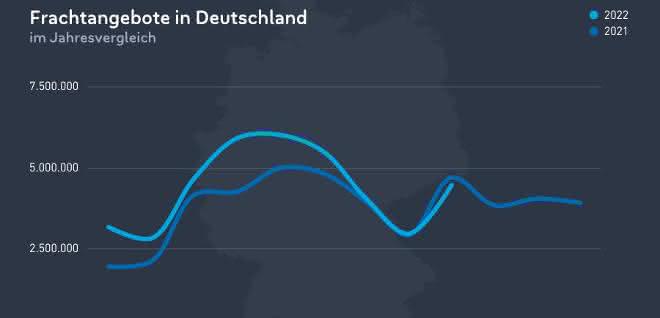
Although the ratio of offered freight to offered cargo space was still above the 70:30 mark, the curve is approaching the 2021 level. The Timocom Transport Barometer registered a total of 41.9 million freight entries in Q3 2022, which corresponds to an increase of 10% compared to the same period last year.
"The significant freight surpluses of the 2nd quarter are not evident in the 3rd quarter," says Gunnar Gburek, Head of Business Affairs at Timocom. "Instead, there was a seasonal slowdown in the transport market, as we usually see in the summer months." This downturn is even particularly pronounced in 2022. Across Europe, 28% less freight was entered into the Timocom freight exchange in the 3rd quarter than in the 2nd quarter, while the change in domestic German traffic was as much as -34%.
The reasons for this include the disruption to international supply chains as a late economic consequence of the coronavirus pandemic and the war in Ukraine. As a direct consequence, prices for fuel and vehicles have risen massively and high inflation has led to a drop in demand and an increase in inventories. The Purchasing Managers' Index of the German Association for Materials Management, Purchasing and Logistics fell into negative territory for the first time in July and the economic outlook is pointing downwards.
Shortage of cargo space - a European phenomenon
The biggest long-term challenge for the transport market is undoubtedly the shortage of drivers. The International Road Transport Union (IRU) estimates that there will be a shortage of 185,000 professional drivers in Germany alone in five years' time. This would triple the existing shortage, which was recently quantified scientifically for the first time: a study on capacity bottlenecks in logistics, in which Timocom is involved, found that the German transport market is currently 56,000 skilled workers short.
The effects can be seen directly in the truck capacity entries in the Timocom freight and loading space exchange: Across Europe, offers of loading space in 2022 remained at the same level as the previous year. "If you take a closer look, however, there are worrying signs," says Gunnar Gburek. "In Germany, the trend is clear: much less loading space is being offered than in previous years." On average, 24% less capacity was placed on the Timocom freight exchange in the first nine months of the current year than in the previous year.
And there is also less and less capacity coming from the carrier countries Poland, Hungary and Romania. Since the beginning of the year, companies from these three countries have placed an average of 8% less cargo space on the Timocom marketplace than in the same period in 2021. One reason for this, in addition to the sharp rise in costs, is the lack of personnel. "Anyone who thinks that qualified specialists will follow from abroad is mistaken," says Gunnar Gburek and appeals: "Market participants must react urgently and reduce inefficiencies such as empty runs and waiting times at loading and unloading points."
Poland and Lithuania - hope for new cargo space?
The shortage of cargo space will increase in view of the figures to date and the upcoming Christmas business. In the coming quarter, Gburek anticipates further capacity shortages and rising transport costs across Europe. Lithuania and Poland could be exceptions: Here, the supply of loading space or the number of large trucks is increasing. "Many Polish transport companies have previously relied on vans with a gross vehicle weight of 3.5 tons," explains Denis Pasala, Director at the Poland site. "However, with the mobility package and the change in the road haulage permit, keyword EU license, this is becoming increasingly unattractive and many are now switching to larger trucks." The Polish Automobile Association PZPM registered significantly more new truck registrations in the third quarter of 2022, with 34% more in August than in the previous year and 17% in September. However, the registration of vehicles up to 3.5 tons decreased.
Closing ranks - road freight transport as a reliable constant
Paradoxically, the extreme imbalance between capacity requests and offers in connection with the massive price increases for personnel, vehicles and fuel has led to a new strength in road freight transport. While the lack of cooperation was still criticized in previous pandemic years, the exceptional year 2022 has caused those involved in road freight transport to rethink. To put things in perspective: whether diesel, LNG or AdBlue, energy costs have risen so sharply since the outbreak of war in Ukraine that some fleet operators have already decommissioned vehicles. LNG trucks in particular have been taken out of service due to the high price of gas and are currently no longer available on the transport market. In view of the shortage of drivers, it is completely unclear whether and when these capacities will be returned to the market.
The reaction of clients to the threatening economic situation for many transport service providers was prompt: many agreed to short-term price adjustments and agreed both diesel and energy floaters with their service providers. The unquenchable demand for loading space gave transport companies the necessary leeway to pass on their rapidly rising transport costs to their clients at shorter notice than usual. "With our digital marketplace, we were able to make a significant contribution to stabilizing road freight transport in these difficult times," says Gunnar Gburek. "This is because the spot market has ensured the greatest possible flexibility and our large network has provided the necessary solidarity between shippers and transport service providers."
Further easing is in sight for the coming year: the looming recession in Germany will reduce the number of freight offers and thus reduce the pressure on road freight transport. Gunnar Gburek expects the seasonal slump in demand for transport capacity in January 2023 to be stronger than in previous years. As a result, the lack of capacity will decrease and with it transport prices, which will at least stagnate at a high level.


You might also be interested in
Winner material flow PRODUCTS OF THE YEAR 2023
Conductix-Wampfler: ChargeLine 0865
Two-pole conductor rail segments for efficient opportunity charging of shuttles, suitable for thousands of cycles per day.
 read more...
Hermann Grewer celebrates his 80th birthday
Hermann Grewer, Honorary Chairman of the North Rhine-Westphalia Transport and Logistics Association (VVWL) and Honorary President of the German Road Haulage, Logistics and Disposal Association (BGL), celebrated his 80th birthday on June 6.
read more...Well chilled for sure
V-Zug Kühltechnik AG, developer and manufacturer of refrigeration appliances and part of the successful V-Zug Group, has set up a new production facility for refrigerators of all heights and dimensions at its Swiss site in Sulgen.
read more...Advantageous automation of small parts warehouses
The RSX1 shuttle system will be at the center of Rocketsolution's presence at this year's Logimat trade fair.
read more...Reduced energy requirements in the high-bay warehouse
One of Germany's leading premium car manufacturers is already focusing on energy efficiency in the production of its new SUV model with electric drive. The storage and retrieval machines in a high-bay warehouse at the production site have been...
read more...Low lift pallet truck for light duty applications
Clark has launched a new low lift pallet truck with the model designation LWio15 for light transport tasks. The truck has a load capacity of 1500 kg and is suitable for short distances in goods distribution, production or warehousing.
read more...Internationalization as an opportunity
E-commerce is in a state of flux. Changes in purchasing behavior and procurement problems are keeping e-commerce retailers busy. Logistics plays a decisive role in the overall online shopping experience.
read more...Fulfillment Center for Frisco.pl
Polish eGrocery specialist and TGW deepen partnership
TGW is building a highly automated fulfillment center for Frisco.pl in the Polish capital Warsaw. This is the second project in a row that the two companies have implemented together.
read more...Which world will it be in 2023?
Michael Schreckenberg teaches at the University of Duisburg-Essen as Professor of Physics of Transport and Traffic. Once a year, he addresses the readers of materialfluss, formerly LT-manager, with a critical and humorous expert article on transport...
read more...