
Security for cobots
Constructive measures tame the robot
There is no way around automation. Cobots play a key role in this. However, many SMEs are reluctant to get started with the new technology because they feel overwhelmed by the complex safety aspects. This need not be the case, as cobots can be easily and safely integrated into production with flexible designs.
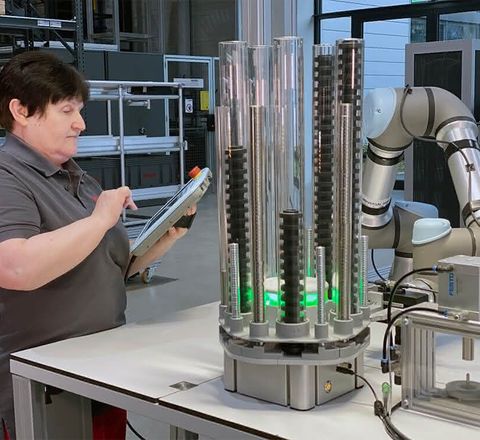
Cobots are currently all the hype in automation. According to the International Federation of Robotics (IFR), 55,000 models were sold worldwide last year, which corresponds to growth of 31%. Cobots now account for 10% of robots sold globally. And they also show where the journey in robotics is heading. Some cobots already have all the technologies of the future on board, including artificial intelligence, making them easier to implement. They prove that the balancing act between high-tech and simple operation is possible and that even employees without specialist knowledge can benefit from AI. Hannes Fröhlich, Product Manager for Robotics at Item Industrietechnik in Solingen, also sees the Cobot as an ideal introduction to automation: "Manufacturers are focusing on plug-and-play and simple handling. The user doesn't need to be a robotics expert to get to grips with the technology." The models can also be used flexibly at different points in the production line. "For example, if increased quantities need to be implemented, the user can add one or more cobots instead of expanding the assembly line with another station with an industrial robot," says Fröhlich.
120 sample solutions
Despite all their intelligence, cobots cannot simply be parked on the production line. They need peripherals tailored to them and, above all, all safety requirements must be met. Item recognized this years ago and expanded its modular system to accommodate cobots. The modular system consists of around 4,500 components. The aluminum profiles can be bolted together using flexible connection technology to create individual constructions. Item is currently showing 120 sample solutions on its website. These are intended to show potential customers what is possible with the modular system. There are 19 suggestions on the subject of robotics alone. These include, for example, mobile robot islands for cobots with central cable routing, compact robot columns with levelable floor mounting or partially enclosed cabins for cobot use. Most of the solutions can be ordered directly or serve as a source of inspiration. Many sample solutions can be individually redesigned with the help of Item's engineering tool and adapted to production requirements.
Security is right at the top of the agenda for all solutions from the modular system. This starts with the individual components. Pretensioning in the flanks of the profiles ensures stability and a strong hold, even under heavy loads. The mobile structures are equipped with swivel or lifting castors and can therefore be easily moved from one place of use to the next. As transportation does not involve strenuous work, the employer is also on the safe side with regard to health and safety regulations. Item also has safe cable management in mind. "The majority of the solutions are designed in such a way that there is always a way to route the cables optimally," says Hannes Fröhlich. The profiles are equipped with intelligent cable routing, which also protects the cables. The cable duct is accessible from the outside so that the cable routing can be changed or adapted at any time. The developers have ensured that all cables can be routed from the supply level to the cobot without being kinked or pinched. The cables run through sealed brush strips so that dust and dirt cannot penetrate. The cobot is connected to the structure via mounting plates. The user can choose between the plates for the various manufacturer models. "Here, too, we support the plug-and-play principle," emphasizes Fröhlich. "The user doesn't have to worry about a milled plate with threaded holes, they simply order it." However, there are also universal mounting plates with exclusive drilling patterns for individual processing.
Load test ensures safety against tipping
The design with a cobot literally stands or falls with the tipping safety. In addition to the installation area and the center of gravity properties of the overall solution, the weight of the robot, the payload, the travel speed and the reach are decisive for a secure stand. Item has worked intensively on this complex topic. A calculation aid can be downloaded from the website, which the customer can use to check their system with the given figures. "The customer doesn't need a degree in mechanical engineering to make the calculation; the basics of classical mechanics are sufficient," emphasizes Hannes Fröhlich. "However, if the customer chooses to use a sample solution, they can also hand over the test to us."
Item considers the extreme case of tipping safety. The robot moves at maximum speed and maximum payload with an outstretched arm, and at the same time the employee presses the emergency stop button at the critical point. If the design can withstand the forces that occur during this test, then nothing can happen even in industrial use under the heaviest loads.
Enclosure enables higher travel speed
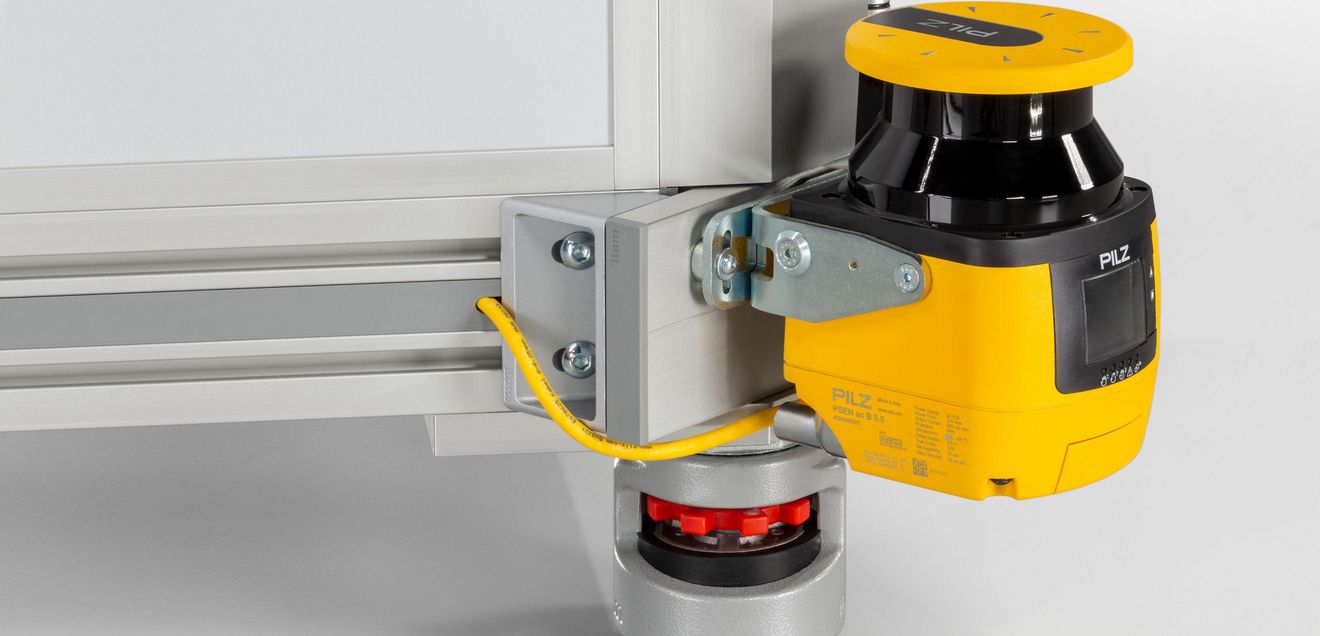
If the cobot is standing freely on a structure and no other protective measures such as safety sensors are used, it may only move at the so-called collaborative speed, which is 0.25 m/s, for safety reasons. However, this is only an orientation value. Depending on the travel height and the workpiece hanging on the gripper, further safety measures must be taken. To ensure an efficient process nevertheless, the solution can be supplemented with an area sensor, for example, which is attached to the structure near the floor. If an employee approaches the cobot, the sensor sends a signal to the controller in good time and the cobot switches to collaborative mode.
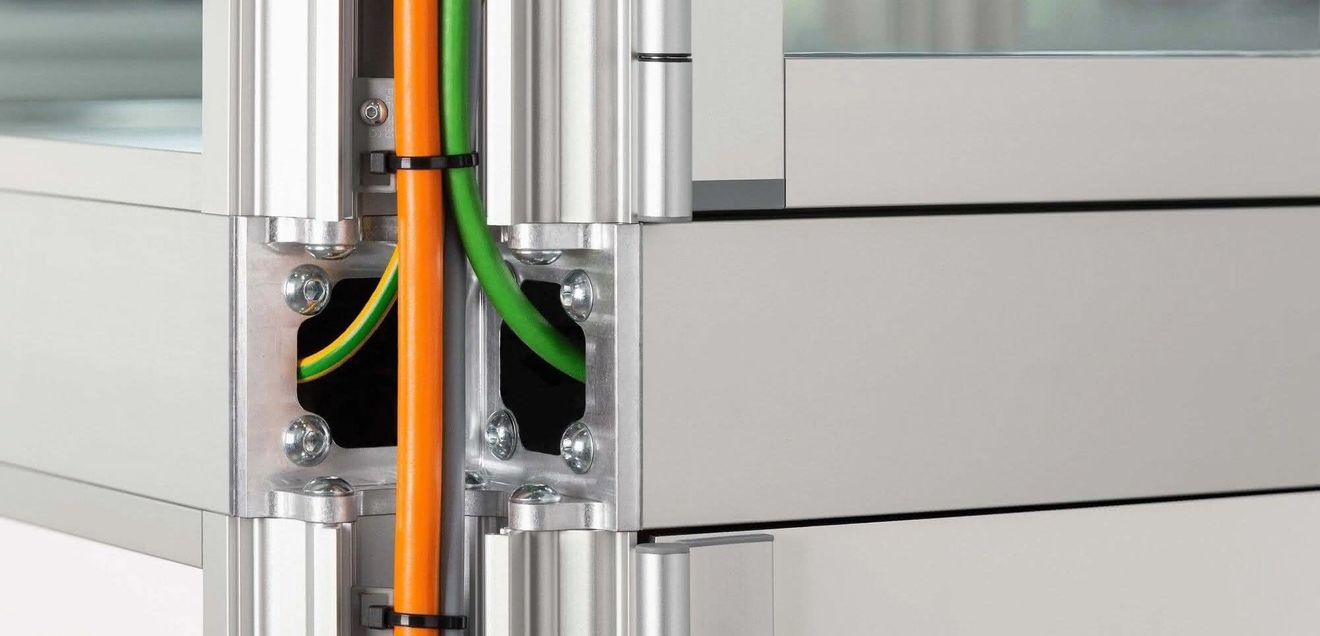
Those who do not want to do without speed are well served with a partial or complete enclosure of the cobot. This variant is implemented in some sample solutions, but can also be retrofitted if required. Behind the large, impact-resistant panes of the enclosure, the cobot can move at a constant speed. The employee is optimally protected from the robot and still has a good view of the process. Additional operating elements are simply snapped into the integrated cable duct. If required, all cables run safely and securely within the profile frames. Special connection sets serve as cable passages between the vertical and horizontal profiles and ensure a kink-free transition of the cables.
The process determines when an enclosure makes sense. "If the cobot is working collaboratively all the time, I don't necessarily need an enclosure," says Hannes Fröhlich. "This also applies if the employee works together with the machine and, for example, regularly restocks material and has to constantly open and close the door to do so."
The customer should feel safe
There are many aspects to consider when planning a solution. This is why Item provides a guideline that customers can use as a guide. This allows potential risks to be identified in advance and suitable protective measures to be taken. "We don't just want the customer to end up with a secure solution that suits them," emphasizes the product manager. "They should also be sure that they are on the right track to drive automation in their company."
|
on
Item, en.item24.com


You might also be interested in
Standardized in design, flexible in use
Automated guided vehicles are increasingly in demand in production and logistics as they automate processes efficiently - but in addition to the vehicle, the right peripherals are also crucial for safe operation. A new solution consisting of a...
 read more...
Overhead conveyor systems - an alternative to KLT transport
In logistics, companies are faced with the challenge of optimizing their internal material flow in order to maximize productivity, cost savings and efficiency. Overhead conveyor systems play an important role in this context. Due to their flexible...
read more...Industry is once again facing material shortages more frequently
According to the ifo Institute, material shortages in the industrial sector worsened in June. The chemical, electronics, and electrical industries have been particularly hard hit.
read more...Interpack 2029: New Date in June and a Shorter Event Duration
Interpack is revamping its trade show schedule: Starting in 2029, the world’s leading trade show for processing and packaging will take place in early summer for the first time and will also feature a new daily schedule.
read more...TG-Group Strengthens Its Robotics Business with Pick Place
The TG Group and the Swiss robotics company Pick Place are merging. By combining their expertise, both companies aim to expand their offerings in the fields of packaging, robotics, and industrial automation.
read more...Sustainability needs decisions
To mark Earth Day, Nagarro is calling for a rethink: sustainability should no longer be documented, but actively managed - with artificial intelligence as a central lever. Because AI brings light into the darkness of global supply chains.
read more...Kion significantly increases order intake
Kion holds its own in a difficult environment in 2025, increases order intake significantly and looks ahead to profitable growth in 2026 with a new segment name and efficiency gains.
read more...Agentic AI as a basis for success for start-ups
January 2026 started with a record for start-ups, with almost a third more start-ups being founded in Germany. With 3568 newly created companies, a new high was reached, as announced by the Start-up Association - also thanks to AI. Nico Gaviola, VP...
read more...Who will make it into the Logistics Hall of Fame 2026?
The Logistics Hall of Fame is entering a special election year: in 2026, several new members will be inducted by decision of the Council. Nominations are now open and the gala will return to Vienna in December.
read more...