
Software
Targeted optimization of the internal material flow
Where is my material at what time? How can I display my material flow dynamically? What happens if the production volume doubles? Will my resources be sufficient in this case, or will I need new equipment? Modern software tools provide answers to these questions.
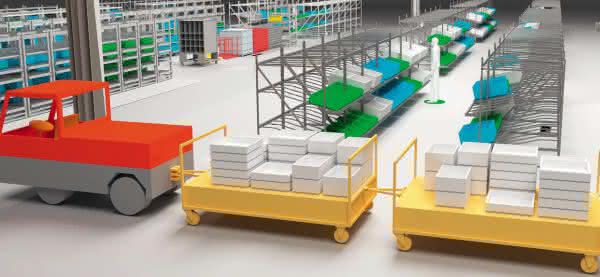
There are many questions that need to be answered in sustainable production logistics planning. Individual products, high variances and widely varying production processes push far-reaching planning to its limits, especially in production logistics. Endless calculations in Excel usually lead to results that are difficult to comprehend, and these often deviate greatly from reality due to calculation or estimation errors. If the planning is also to be simulated, this is very complex, time-consuming and requires specialists. There are simple solutions that make these issues tangible, tangible and holistically plannable. Modern software tools, such as IPO.Log from IPO.Plan GmbH, digitize the planning process and quickly deliver a result that can withstand future challenges and with which the customer can safely achieve their goals.
In the IPO.Log software solution, the digital twin of production and logistics forms the basis for efficient and precise material flow planning. This approach allows the planner to identify correlations and potentials from goods receipt to the assembly line and leads to the best result, as optimizations are carried out directly in the 3D model. The effects of changes thus become visible so that the inputs can be evaluated at any time and the result can be implemented 1:1 in reality.
Simulate production facilities and logistics
IPO.Log is all about networking state-of-the-art digital solutions with industrial manufacturing, i.e. connecting the virtual manufacturing world with the real manufacturing world. In concrete terms, this means that production facilities and production lines as well as production and logistics processes are designed and optimized in 3D using simulation solutions during the planning stage. Associated key figures round off the visualization of the value chain and create digital intelligence for production and logistics planning. This makes the production infrastructure highly flexible and significantly faster, as errors are eliminated in advance and everything is optimally designed before the solution found is implemented 1:1 in the real world.
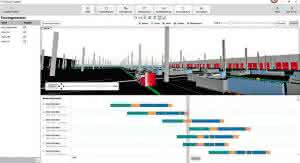
Based on a real production program, the earliest and latest possible provision times are calculated "line-back" from the installation location. This ensures that the required materials are provided at the right time and at the right place. With IPO.Log, the customer can quickly and easily evaluate which transportation resources should be used most profitably and how many resources are ultimately required. Temporary peak loads are validated in various scenarios, calculated against each other and transports are efficiently utilized.
Here, the connection between individual staging points for materials and warehouses as well as transshipment areas is established by intelligent means of transportation planning. Decision trees clearly show the reasons why different means of transportation should be used. The requirements for forklifts, tugger trains and AGVs are calculated fully dynamically and compared with each other.
Picking areas can also be planned
In the form of a dynamic heat map, the density of the traffic volume in the hall can be displayed at any time and conclusions can be drawn about the traffic flow. Evaluations such as the Sankey diagram are used to identify bottlenecks and develop and simulate the optimum material flow directly in the software. However, not only transport resources, but also picking areas such as supermarkets can be planned in detail. The interactive and precise placement of materials in the software shortens walking distances and the time required by workers.
The planner saves time, gains certainty about his planning concept and receives a realistic picture of the planning in the holistic 3D model. This allows them to completely rethink conventional processes and meet the highest planning requirements. This equips logistics with an innovative and efficient solution and optimum resources for the future.
This means that precise statements can be made about current daily requirements and capacity utilization in both rough planning and detailed planning or operations. The results are evaluated statically and dynamically and thus provide well-founded statements that are simple, understandable and tangible thanks to the 3D model. While logistics key figures, such as the required tours per day or the number of load carriers per day, form the framework of the static evaluation, the dynamic evaluation provides time-dependent graphics such as the dynamic heat map.
The results of the holistic evaluations include precise resource requirements, required employees, space requirements in logistics areas, traffic density as well as order lists with delivery times and the exact position of the required material, which can be passed on to the logistics specialists.
The expert tool IPO.Log enables a simple and intuitive approach. Sharing projects and a role and rights model ensure an efficient and error-free workflow. IPO.Log customers such as Magna Steyr confirm that this tool offers a head start in the planning of assembly and logistics and makes efficiency visible.


You might also be interested in
Standardized in design, flexible in use
Automated guided vehicles are increasingly in demand in production and logistics as they automate processes efficiently - but in addition to the vehicle, the right peripherals are also crucial for safe operation. A new solution consisting of a...
 read more...
Outdoor AGV networks production and logistics
An international company in the plastics industry is automating its intralogistics at its German site with a solution from ek robotics. A specially developed vehicle model from the Out Move series, an outdoor AGV, is being used.
read more...Transport systems for automated material flow
The Leo transporters from Bito make it easier for users to get started with the automation of material processes, which is possible from 20,000 euros. The system is a flexible all-in-one complete solution that is ready for immediate use and can be...
read more...Automated logistics for the university hospital
As part of the new construction of the University Hospital of Reims (CHU), France, the hospital has taken a number of steps to improve the needs of its patients and the working environment of its employees.
read more...K.Hartwall: Topping-out ceremony for the German site
The topping-out wreath was raised at the new building in the TIP Innovationspark Nordheide in Buchholz near Hamburg on February 27: The new K.Hartwall plant will comprise approx. 3,500 m² of hall space and around 2,000 m² of office and social areas.
read more...Noerpel Group tests driverless high lift trucks
The Noerpel Group has tested driverless pallet trucks in one of its two logistics facilities in Giengen. During a four-week trial, two autonomous systems were used to transport goods within the warehouse.
read more...Supply and disposal of printing machines by AGV
Numerous companies rely on AGVs in intralogistics to increase efficiency and meet challenges such as the shortage of skilled workers. One such company is GGP Media GmbH in Pößneck, Thuringia.
read more...Sophisticated automation: AGV and cobot combined
On behalf of Krefeld-based Saurer Technologies, the engineering team from Project Automation & Consulting developed a solution for production logistics that combines AGVs and cobots.
read more..."Herbie" robot in the Körber portfolio
Carrybots, a specialist in mobile robotics, is a new partner in the Körber supply chain ecosystem. The aim of this collaboration is to strengthen the position of both companies in intralogistics. Herbie" enables robot-based goods-to-person processes.
read more...