
Software
Faster picking with a finger scanner
Hanseatische DS Produkte GmbH sells 4,000 non-food products online and via home shopping channels. The B2C share is steadily increasing. The goods are shipped from the logistics center in Gallin in Mecklenburg-Western Pomerania. Supplier Jungheinrich scored with a package comprising software, warehouse technology and industrial trucks.
Diplom-Betriebswirt Frank Müller, Logistics Operations Manager at DS Produkte GmbH, gives a tour of the Gallin logistics center in Mecklenburg-Vorpommern and explains: "Due to expanded customer and order structures as well as growing sales, it was essential to invest in a WMS that fully maps our intralogistics processes. The warehouse management system previously used by another provider was no longer up to date because it could only manage the stocks in the high-bay warehouse." The basic version of the Jungheinrich WMS already contains extensive warehouse modelling, material flow control and optimization functions as well as central master data management. In addition, the standard version offers a comprehensive reporting system with individually configurable evaluations and thus complete process transparency. There are also numerous standard interfaces that can be used to connect the WMS to existing system environments.
Müller begins the tour in the WMS work preparation department, where employees monitor all processes on their screens and initiate and control orders. "We were looking for a WMS provider that was able to meet our highly complex customer and item-specific requirements."
WMS connects intralogistics areas
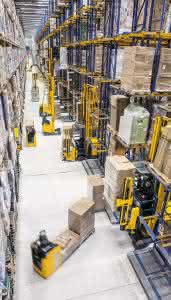
First of all, the complexity is due to the many intralogistics areas that are connected to the logistics center's WMS. These include incoming goods, which receives items with a volume of 500 pallets every day, a narrow-aisle warehouse around 13 meters high, equipped with 32 aisles each 37 meters long and 17,000 pallet spaces, as well as cantilever racks installed at the front of the high-bay warehouse, which serve as transfer points. In addition, there are the packing and loading areas, a wide-aisle picking warehouse and the outgoing goods area, which has to handle around 500 pallets and 5,500 packed parcels every day. In addition to the 30,000 pallet spaces available in the logistics center, the WMS manages 5,000 additional pallet spaces in external warehouses.
The operator's wide range of tasks also contributes to the high level of complexity. One solution highlight is the packing areas, for which the WMS, equipped with an adapted and extended packing functionality, receives customer-specific packing instructions from the ERP system and processes the orders accordingly. To demonstrate the complexity of the tasks involved, Müller takes a look at the B2C packing area.
"Delivery bills, invoices and return labels are printed out here - controlled by the WMS - and enclosed with the goods together with flyers if necessary."
Very quick: hold the parcel and scan the barcode
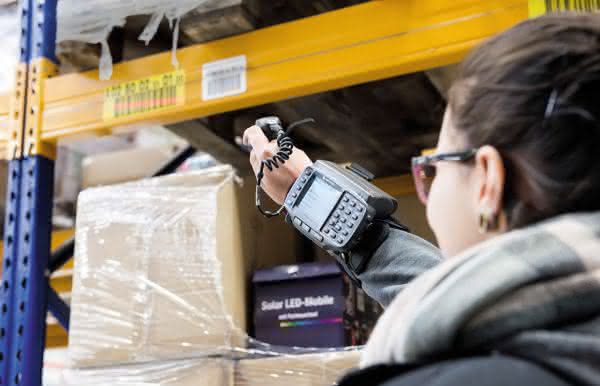
DS Produkte also uses the WMS to control a bypass function at the narrow-aisle warehouse, one- and two-stage picking at the logistics center and returns processing. Apart from this, Jungheinrich is aiming for time-optimized processes. One example of this is order picking with finger scanners, which enables employees to hold a parcel with both hands and scan its barcode at the same time. A second example can be found at the cantilever racks. There, the WMS ensures accuracy with the help of RFID transponders. This applies both to the transfer of goods delivered by reach trucks and to their collection by narrow-aisle forklifts controlled via warehouse navigation.
The combination of WMS and RFID saves time
The use of the WMS in conjunction with the RFID transponders leads to a time saving of around 20 percent when processing orders. In addition, the WMS offers simpler and more efficient inventory management, processes that can be mapped and executed much better and a high level of adaptability to new requirements.
The modules of the Jungheinrich WMS used by the operator include multi-client capability, the material flow computer, batch and MHD management as well as the returns module specially developed for DS products. In addition, a forklift control system was implemented, which uses radio data transmission to ensure that the fleet of industrial trucks supplied by Jungheinrich is utilized as evenly as possible. This includes four narrow-aisle trucks, eight reach trucks, nine three-wheel forklifts, five high-speed trucks and nine low-lift sit-on trucks.
Entry with the light version DS Produkte and Jungheinrich have been working together as partners since 1995. Back then, the consumer goods manufacturer headquartered in Stapelfeld planned its logistics center in Gallin, focusing on high flexibility and performance and investing in material handling equipment, racking and planning support from Jungheinrich, for example. Müller recalls: "Jungheinrich scored particularly well as a full-service provider. We were convinced by the coherent system consulting and the practical experience based on the realization of a number of similar projects. We also liked the fact that our wishes with regard to system safety and occupational health and safety were taken into account."
The WMS initially implemented DS products in a light version. Twelve months later, the other functions were added. Operations manager Müller is particularly satisfied with the high availability of the WMS, which is in use six days a week. His conclusion: "As a result, we have faster processes, greater transparency with regard to data and goods in all warehouse areas, a noticeably reduced error rate and greater productivity. We are able to process a significantly larger number of orders with the same number of staff and the same amount of time."
Jürgen Warmbold
Contact: DS Produkte GmbH 22145 Stapelfeld Tel.: 0 40 / 6 75 73-0 E-Mail:
Jungheinrich AG 22047 Hamburg Tel.: 0 40 / 69 48-0 E-Mail: [email protected] www.jungheinrich.de


You might also be interested in
Winner material flow PRODUCTS OF THE YEAR 2023
Conductix-Wampfler: ChargeLine 0865
Two-pole conductor rail segments for efficient opportunity charging of shuttles, suitable for thousands of cycles per day.
 read more...
Hermann Grewer celebrates his 80th birthday
Hermann Grewer, Honorary Chairman of the North Rhine-Westphalia Transport and Logistics Association (VVWL) and Honorary President of the German Road Haulage, Logistics and Disposal Association (BGL), celebrated his 80th birthday on June 6.
read more...Well chilled for sure
V-Zug Kühltechnik AG, developer and manufacturer of refrigeration appliances and part of the successful V-Zug Group, has set up a new production facility for refrigerators of all heights and dimensions at its Swiss site in Sulgen.
read more...Advantageous automation of small parts warehouses
The RSX1 shuttle system will be at the center of Rocketsolution's presence at this year's Logimat trade fair.
read more...Reduced energy requirements in the high-bay warehouse
One of Germany's leading premium car manufacturers is already focusing on energy efficiency in the production of its new SUV model with electric drive. The storage and retrieval machines in a high-bay warehouse at the production site have been...
read more...Low lift pallet truck for light duty applications
Clark has launched a new low lift pallet truck with the model designation LWio15 for light transport tasks. The truck has a load capacity of 1500 kg and is suitable for short distances in goods distribution, production or warehousing.
read more...Internationalization as an opportunity
E-commerce is in a state of flux. Changes in purchasing behavior and procurement problems are keeping e-commerce retailers busy. Logistics plays a decisive role in the overall online shopping experience.
read more...Fulfillment Center for Frisco.pl
Polish eGrocery specialist and TGW deepen partnership
TGW is building a highly automated fulfillment center for Frisco.pl in the Polish capital Warsaw. This is the second project in a row that the two companies have implemented together.
read more...Which world will it be in 2023?
Michael Schreckenberg teaches at the University of Duisburg-Essen as Professor of Physics of Transport and Traffic. Once a year, he addresses the readers of materialfluss, formerly LT-manager, with a critical and humorous expert article on transport...
read more...