
Guest article: Warehouse Performance Part 2/4
Breaking new ground with optimized inventory reservation
In our last article "Warehouse Performance: Discover and utilize hidden potential in the warehouse through the consistent use of data! (Part 1/4)", we gave you an initial overview of the options for increasing your warehouse performance. This time, we would like to introduce you to the first phase of optimizing your warehouse performance, namely the optimization of inventory reservations.
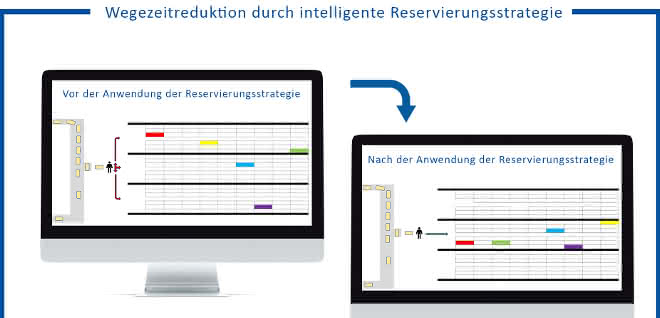
Whether and to what extent an optimization of the stock reservation makes sense at all depends primarily on the putaway strategy currently in use. As a rule, there is only potential for optimization if the stored items in your inventory are located in several places in the warehouse - which sometimes also means different aisles. This is because these many reservation options for individual order items are one of the main reasons for excessively long picking routes and times for employees in the warehouse. The aim of optimizing stock reservation is therefore to form strategically sensible combinations from the various available options in order to keep the walking distances for an order as short as possible.
With regard to the use of a putaway strategy in which the stock of an item is stored in a single location, there is initially no alternative for optimized stock reservation. However, this does not mean that optimization measures cannot also be implemented in this case, for example through intelligent stock transfer processes as part of the "warehouse healing" strategy, which we will discuss in more detail in another article.
But let's take this opportunity to briefly illustrate the optimization of stock reservations using a concrete example from practice:
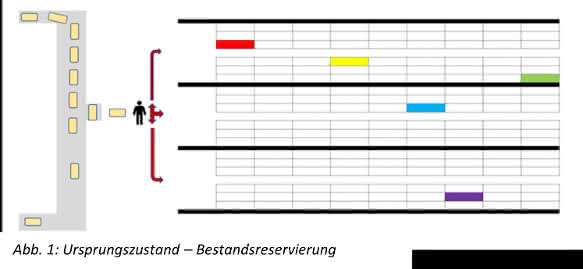
The different colored elements indicate the individual storage locations where the goods to be picked are located.
One thing is noticeable at first glance: the reserved items are stored in different aisles, the storage locations are apparently "far" apart, so that the walking routes for the employees during the picking round take up a lot of time. This process can be solved in a much smarter way if the items are stored in several locations in the warehouse.
What does this look like in practice? Optimization of stock reservation is initially based on the typology and layout of the picking areas in the warehouse. On this basis, the individual check sequences must also be configured to the requirements and conditions in each area. The overriding aim of stock reservation within an order is to minimize the distances covered in relation to the stock to be reserved. In short: in the course of stock reservation, the system checks at which point in the warehouse the individual items can be reserved as close together as possible in order to achieve the "dense" picking of the order. As a result of the stock reservation, the stock initially remains physically in the warehouse, but is no longer freely available.
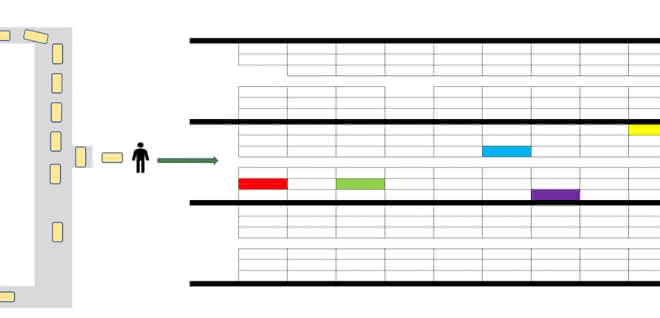
Can you see the difference in Figure 2? That's right: in relation to an order, all items have now been reserved in just one aisle so that picking routes and times are kept to a minimum for employees in a round trip. This not only ensures increased efficiency when picking orders, but is also a first step towards optimizing the intralogistics processes in the warehouse as a whole.
As a connoisseur of the subject, you will now interject: But what about the other relevant reservation parameters such as FIFO, batch numbers, remaining lead times? You are of course right that these must still be adhered to within the picking route reduction, or at least to a certain extent.
Would you like to find out more about the individual phases for optimizing your warehouse performance? Then also read "Warehouse performance: from optimized stock reservation to intelligent batch planning for efficient warehouse logistics! (Part 3/4)"


You might also be interested in
Winner material flow PRODUCTS OF THE YEAR 2023
Conductix-Wampfler: ChargeLine 0865
Two-pole conductor rail segments for efficient opportunity charging of shuttles, suitable for thousands of cycles per day.
 read more...
Hermann Grewer celebrates his 80th birthday
Hermann Grewer, Honorary Chairman of the North Rhine-Westphalia Transport and Logistics Association (VVWL) and Honorary President of the German Road Haulage, Logistics and Disposal Association (BGL), celebrated his 80th birthday on June 6.
read more...Well chilled for sure
V-Zug Kühltechnik AG, developer and manufacturer of refrigeration appliances and part of the successful V-Zug Group, has set up a new production facility for refrigerators of all heights and dimensions at its Swiss site in Sulgen.
read more...Advantageous automation of small parts warehouses
The RSX1 shuttle system will be at the center of Rocketsolution's presence at this year's Logimat trade fair.
read more...Reduced energy requirements in the high-bay warehouse
One of Germany's leading premium car manufacturers is already focusing on energy efficiency in the production of its new SUV model with electric drive. The storage and retrieval machines in a high-bay warehouse at the production site have been...
read more...Low lift pallet truck for light duty applications
Clark has launched a new low lift pallet truck with the model designation LWio15 for light transport tasks. The truck has a load capacity of 1500 kg and is suitable for short distances in goods distribution, production or warehousing.
read more...Internationalization as an opportunity
E-commerce is in a state of flux. Changes in purchasing behavior and procurement problems are keeping e-commerce retailers busy. Logistics plays a decisive role in the overall online shopping experience.
read more...Fulfillment Center for Frisco.pl
Polish eGrocery specialist and TGW deepen partnership
TGW is building a highly automated fulfillment center for Frisco.pl in the Polish capital Warsaw. This is the second project in a row that the two companies have implemented together.
read more...Which world will it be in 2023?
Michael Schreckenberg teaches at the University of Duisburg-Essen as Professor of Physics of Transport and Traffic. Once a year, he addresses the readers of materialfluss, formerly LT-manager, with a critical and humorous expert article on transport...
read more...