
From materialfluss 5/2020
Printing requirements in the catering industry
Since the beginning of the year, stricter rules have been in force in the hospitality industry: the German Cash Register Security Ordinance (Kassensicherungsverordnung) means that retail businesses and restaurant operators who use electronic recording systems are now obliged to issue receipts. The desktop and mobile printers from TSC can handle the printing requirements.
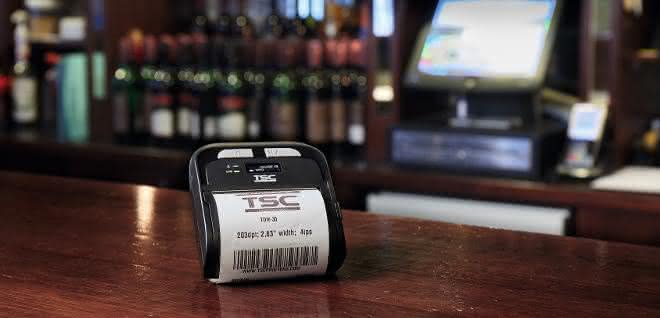
With the amendment of the Cash Register Security Ordinance on January 1, 2020, the obligation to issue receipts was introduced in Germany, which obliges all operators of electronic cash register systems to offer their customers a receipt for every single business transaction. Although restaurants, bistros, pubs and cafés have been subject to the obligation to issue receipts for several years now, this has not yet been implemented across the board. For all these businesses, as well as for retailers, the stricter regulation means significantly more effort and higher costs, but it also offers opportunities in terms of greater customer confidence as a result of greater transparency and greater reliability.
Challenges and opportunities of the obligation to issue receipts
Even if fines or other sanctions are still generally waived for non-compliance with the obligation to issue receipts, it makes perfect sense to implement the new requirements in your own business now and thus comply with the law. This will greatly simplify the seamless transmission of business transactions in the event of any cash audits and significantly reduce the time and effort involved in stocktaking, for example.
In principle, a receipt must be offered to every customer either in paper form or electronically. In the case of electronic transmission, however, it is not sufficient if the guest can view their bill on the display of the waiter's mobile device or the customer in the bakery or greengrocer, for example, can view their receipt on the checkout display. The receipt must be transferred as a file to a customer device - such as a smartphone or tablet - and the file format must be able to be opened with common programs such as JPG or PDF. The advantage of electronic transmission is that there is no need to print out the receipt in paper form. However, in this case, cooperation and thus additional effort is necessary for the customer, so that this variant is not yet favored over the paper form.
Regardless of the method of transmission, the form and content of the receipts must follow fixed specifications: In addition to the type and quantity of goods or services sold, the date and time of issue must also be included. For catering businesses in particular, the time of the first order is required. For all products or services sold, the invoice amount with tax rate and, if applicable, the amount per payment method must be stated. In addition, the receipt must contain a range of control data. Specifically, this includes a transaction number that can be clearly assigned to the transaction, including the check value and the serial number as well as the signature counter of the POS system. Finally, the full name and address of the company are also mandatory. Optionally, this information can also be displayed in plain text in the form of a QR code. This offers the advantage that the auditor has all the required data available with a simple and quick scan during a cash register inspection, making lengthy data exports unnecessary.
Smooth processes in a hectic working day
However, printing tasks in the catering industry are not only carried out by service staff in the form of invoices for guests - easy-to-use printing systems are also required in the kitchen and at the drinks counter. The kitchen receipts, which are created for each order and attached to a receipt strip in chronological order, give the employees at the individual kitchen stations their next task. Once an order has been fully processed and the dish has been served to the guest, the employee announcing the order saves the corresponding kitchen receipt as completed or places it in a container. The same applies to serving drinks or the bar.
For use in the hospitality industry, printers not only need to be space-saving and powerful, but above all easy to use for untrained and hectic staff. Compact desktop models such as the TDP-247, TE200, TC, TX200 and DA210 series are suitable for this purpose. The printer manufacturer TSC, which is one of the world's five leading manufacturers of barcode label printers, offers a total of three model series in the 2" printer segment alone and seven model series in the 4" printer segment, which are suitable for almost all common printing requirements in the industry. According to the company, the direct thermal and thermal transfer printers impress with their performance features and reliability and, above all


You might also be interested in
Winner material flow PRODUCTS OF THE YEAR 2023
Conductix-Wampfler: ChargeLine 0865
Two-pole conductor rail segments for efficient opportunity charging of shuttles, suitable for thousands of cycles per day.
 read more...
Hermann Grewer celebrates his 80th birthday
Hermann Grewer, Honorary Chairman of the North Rhine-Westphalia Transport and Logistics Association (VVWL) and Honorary President of the German Road Haulage, Logistics and Disposal Association (BGL), celebrated his 80th birthday on June 6.
read more...Well chilled for sure
V-Zug Kühltechnik AG, developer and manufacturer of refrigeration appliances and part of the successful V-Zug Group, has set up a new production facility for refrigerators of all heights and dimensions at its Swiss site in Sulgen.
read more...Advantageous automation of small parts warehouses
The RSX1 shuttle system will be at the center of Rocketsolution's presence at this year's Logimat trade fair.
read more...Reduced energy requirements in the high-bay warehouse
One of Germany's leading premium car manufacturers is already focusing on energy efficiency in the production of its new SUV model with electric drive. The storage and retrieval machines in a high-bay warehouse at the production site have been...
read more...Low lift pallet truck for light duty applications
Clark has launched a new low lift pallet truck with the model designation LWio15 for light transport tasks. The truck has a load capacity of 1500 kg and is suitable for short distances in goods distribution, production or warehousing.
read more...Internationalization as an opportunity
E-commerce is in a state of flux. Changes in purchasing behavior and procurement problems are keeping e-commerce retailers busy. Logistics plays a decisive role in the overall online shopping experience.
read more...Fulfillment Center for Frisco.pl
Polish eGrocery specialist and TGW deepen partnership
TGW is building a highly automated fulfillment center for Frisco.pl in the Polish capital Warsaw. This is the second project in a row that the two companies have implemented together.
read more...Which world will it be in 2023?
Michael Schreckenberg teaches at the University of Duisburg-Essen as Professor of Physics of Transport and Traffic. Once a year, he addresses the readers of materialfluss, formerly LT-manager, with a critical and humorous expert article on transport...
read more...