
Scanners & Printers
Correctly identified - from rubber to the finished tire
Raw materials such as rubber, textiles and steel as well as various chemicals and fillers are used to manufacture tires. Numerous production steps are required to manufacture tires from this variety of materials. Identification solutions from Sick identify the material used during the production process and ensure complete traceability of the finished tire.

The composition of the individual components varies depending on the type and size of a tire. A summer tire on a car therefore has a different "recipe" than a winter tire. In addition, tires can be assigned to different speed classes, meaning that the composition of a tire varies depending on the speed class. Numerous production steps in various machines are required to manufacture tires from the multitude of materials. It must be ensured that the right material or the right component is available at each machine in the desired processing state for the upcoming production step.
Reliably identify the correct component
Established identification solutions such as handheld scanners, barcode scanners, camera-based code readers and RFID read/write devices can be used for this purpose. Identification solutions from Sick are used at various points during tire production. After completion, they help to ensure that the right tires are delivered on the right day. All identification solutions from Sick have a standardized connection technology, user interface and accessory concept. The devices are also compatible and interchangeable. Sick's 4Dpro label stands for this compatibility. With 4Dpro, the integration effort is reduced and the choice of technology is flexible.
In pre-production, individual tire components such as treads, inner layers and inserts are manufactured. Each tire component goes through individual production steps: for example, treads are formed and cut from raw rubber in the extruder. Inner layers can be produced from textile fabric and raw rubber in the calendering machine and cut and spliced in another machine. The materials required to manufacture the tire components are available on the corresponding machines. The containers for this vary depending on the material and machine: natural rubber and raw rubber are transported in mesh boxes and on pallets, while countless rolls of material in cassettes are used for textiles and calendered materials. Narrow strips of material can be wound onto spools and transported, and rack trolleys are available for running strips.
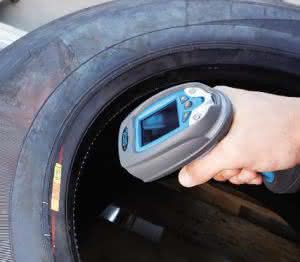
Before materials are fed into a machine for processing, they must be clearly identified. After processing into a tire component, they must be identified again. Until now, manual identification using paper lists and barcodes that encode the article number has been common practice. Barcode labels are attached to the material carriers. Mobile handheld scanners from Sick's IDM16x product family decode the codes on the individual machines.
Read and save data via RFID
Automatic identification with passive RFID technology offers an alternative approach. The various material carriers are each given an RFID transponder, which is identified by an RFID read/write device. In addition, the transponder at the output of each machine can be written with information on the last or next process step. A mixture of centralized and decentralized material management is possible via the MES (Manufacturing Execution System) production control system, so that process information can also be stored decentrally on the product. Both HF and UHF technology is suitable for this.
A barcode label is either automatically or manually applied to the green tires in the tire building machine for identification in the subsequent production process. The tire ID number is encoded on the label as a barcode. The CLV61x barcode scanner from Sick checks the barcode in order to clearly assign the tire to the ID number. The CLV61x is characterized by reliable reading properties, has all the integration interfaces commonly used in the industry and enables simple connection to control systems.
Each tire has its own ID
The Tire Lector Array tire code reading system is used in conveyor technology to identify raw and finished tires regardless of their size. The modular system consists of high-resolution Lector65x camera-based code readers and can be individually adapted to the width of the conveyor system. The Lector65x identifies and decodes all common 1D and 2D code types, even if they are of poor quality. The code reader is also available as a matrix camera version with a dynamic focus. This enables high-resolution and homogeneous images to be generated even with different tire heights, such as truck tires. The Tire Lector Array code reading systems identify the barcodes on the tires regardless of how the tires are positioned on the conveyor system.
Ensuring the right "baking time" A green tire is given its final shape and profile in a heating press, where it is vulcanized. Under the influence of heat and air pressure from the inside, the individual layers are "baked" together for a certain period of time. A green tire must fit the respective tire shape. To ensure that the right type of tire is vulcanized in the right composition, the IDM162 mobile handheld scanner reads the barcode of the green tire.
This is followed by quality checks and the finished tire is subjected to a final tire inspection. Ready-to-ship tires are stored in shipping racks in the picking station. Robust RFID transponder labels on the racks ensure that the racks can be traced along the entire transportation route.
In the robot cell, the RFU62x RFID read/write device from Sick identifies the transponder labels, which are written with information on the dispatch of the tires. The corresponding data can be transferred directly to the warehouse management system.
Contact:Sick AG 79183 Waldkirch Tel.: 0 76 81 / 2 02-0 E-Mail: [email protected] www.sick.de


You might also be interested in
Datalogic: Gryphon GD4600 Series
High performance 2D handheld scanner
The Gryphon GD4600 series from Datalogic offers professional 2D handheld scanners for retail, industry, logistics and healthcare.
 read more...
Intelligent Kanban solution thanks to RFID
Kanban systems make everyday production easier - Otto Roth showed what this looks like in concrete terms at Logimat in Stuttgart. The C-parts management expert presented its wide range of products.
read more...When the manhole cover recognizes the car
Tönnjes and Kathrein develop the ID e-reader Inroad with integrated RFID technology.
read more...CCL Faubel shows applications of smart labels
Paper labels can only represent one status of a container or storage bin. Every change in status requires a new label. CCL Faubel will be demonstrating at Logimat 2024 how this time-consuming process of manual replacement can be replaced.
read more...Secure keys for automated intralogistics processes
Euchner's new CKS2 key system promises significantly simplified handling to safely start or stop dangerous machine movements.
read more...Identification technology and RFID
Networked container terminals: 5G campus networks for Eurogate
Deutsche Telekom is equipping port terminals in Hamburg, Bremerhaven and Wilhelmshaven with local 5G networks by spring 2024.
read more...Cooperation for load carriers
The Munich-based family business Baumann Paletten will be working with Logistics Arts on the digital development of EUR load carriers in future
read more...Winner material flow PRODUCTS OF THE YEAR 2023
IPP: RUDi - innovative returnable display for the POS
Every year, around 30 million disposable displays are placed on the market in the D-A-CH region. The majority of these displays are constructed on quarter pallets or dollies, the rest are purely disposable constructions.
read more...Battery-free and cloud-based
Faubel has launched battery-free smart labels that work via a cloud application.
read more...