
High-ranking visitor to Mittenwalde
Minister President Woidke praises the work of the Raben Group during the crisis
Despite the ongoing coronavirus crisis, Raben Trans European Germany GmbH says it is able to maintain its supply chain. The Minister President of Brandenburg, Dr. Dietmar Woidke, was convinced of this.
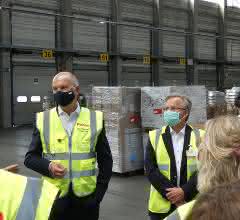
The head of government was a guest at the Mittenwalde branch during his working visit "Politics and business in times of corona". At the Raben site south-east of Berlin, he gained an impression of the work of the international logistics service provider and how the pandemic is affecting day-to-day processes. "The fact that we managed to maintain the supply chains during the lockdown is primarily thanks to their work. This is not a matter of course and is an outstanding achievement," said Woidke. Stephan Loge, District Administrator of the Dahme-Spreewald district, pointed out the importance of the logistics industry, especially in times of coronavirus: "Only with the help of this multiple entrepreneurial commitment was it possible to compensate for bottlenecks on the shelves, secure our basic supply and thus also maintain public life." Loge accompanied the tour together with Mittenwald's mayor Maja Buße. "Despite the coronavirus crisis, the site in Mittenwalde has managed to ensure the availability of essential goods at all times with the help of a comprehensive catalog of measures," says Managing Director Ewald Raben.
The Raben branch in Mittenwalde is celebrating its 30th anniversary this year. Just outside Berlin, 1,000 consignments are handled daily in the 6,100 square meter warehouse. Every day, the Mittenwalde branch supplies the areas of Berlin, Brandenburg and parts of Mecklenburg-Western Pomerania with 60-70 trucks. "This gives us the largest delivery area within the Group," says branch manager Frank Ostroga. In addition to the automotive, technology and chemicals sectors, food logistics accounts for almost a third of the company's business.
On his tour of the large transshipment hall, Raben and Ostroga showed the Prime Minister how customers' consignments are handled and picked at the cross dock in the shortest possible time and using a state-of-the-art management system. During the lockdown in March and April, the international logistics service provider was faced with the challenge that the structure and type of goods changed completely from one day to the next. "The demand for basic goods and cleaning products increased significantly, while at the same time the volume of goods from the automotive sector, for example, fell sharply," says Ostroga. As a result, the warehouse was suddenly no longer stacked with motorcycles, but bicycles. Instead of automotive components, the cross dock was now handling DIY accessories from DIY stores for end customers. "The fact that this worked so smoothly is thanks to our outstanding international groupage network, our own fleet and our excellent transport management system," says Ostroga.
The early protective measures formed the basis
Increased hand hygiene, social distancing rules and avoiding shaking hands - the Raben Group had already introduced numerous new rules for daily work at the beginning of February. The fact that this early action was also correct in Mittenwalde became clear in mid-March at the latest, when the virus brought public life in Europe to a standstill. In Mittenwalde, Woidke gained a good impression of how the 55 employees at the site are strictly adhering to the hygiene regulations and restrictions of the World Health Organization (WHO). The specially established crisis management team is monitoring the situation and supporting the employees.
Among other things, Raben has provided clinical thermometers, disinfectant and face masks at the entrances to the buildings. If the temperature reaches 37.3 degrees Celsius, employees are sent home with a request to report to the doctor or health authority. In addition, all utensils, sanitary facilities and common rooms are cleaned and disinfected more frequently. Raben also distributes disposable protective gloves and face masks for employees in the warehouse and for those employees who have contact with external people. "The measures may often be disruptive in everyday working life. However, we wanted to ensure from the outset that no one gets infected. An infected employee would shut down the entire general cargo network and not just one branch," emphasizes Raben.
At the beginning of the crisis, the widest possible distancing rules and access restrictions were in place in the operational area. Truck drivers were informed in several languages about how they should behave on the premises. In some cases, drivers only passed the freight documents through a slot and remained in the cab while the truck was being loaded or unloaded. Where possible, office staff worked from home. Teams were split up and worked alternately at home and in the office.


You might also be interested in
Winner material flow PRODUCTS OF THE YEAR 2023
Conductix-Wampfler: ChargeLine 0865
Two-pole conductor rail segments for efficient opportunity charging of shuttles, suitable for thousands of cycles per day.
 read more...
Hermann Grewer celebrates his 80th birthday
Hermann Grewer, Honorary Chairman of the North Rhine-Westphalia Transport and Logistics Association (VVWL) and Honorary President of the German Road Haulage, Logistics and Disposal Association (BGL), celebrated his 80th birthday on June 6.
read more...Well chilled for sure
V-Zug Kühltechnik AG, developer and manufacturer of refrigeration appliances and part of the successful V-Zug Group, has set up a new production facility for refrigerators of all heights and dimensions at its Swiss site in Sulgen.
read more...Advantageous automation of small parts warehouses
The RSX1 shuttle system will be at the center of Rocketsolution's presence at this year's Logimat trade fair.
read more...Reduced energy requirements in the high-bay warehouse
One of Germany's leading premium car manufacturers is already focusing on energy efficiency in the production of its new SUV model with electric drive. The storage and retrieval machines in a high-bay warehouse at the production site have been...
read more...Low lift pallet truck for light duty applications
Clark has launched a new low lift pallet truck with the model designation LWio15 for light transport tasks. The truck has a load capacity of 1500 kg and is suitable for short distances in goods distribution, production or warehousing.
read more...Internationalization as an opportunity
E-commerce is in a state of flux. Changes in purchasing behavior and procurement problems are keeping e-commerce retailers busy. Logistics plays a decisive role in the overall online shopping experience.
read more...Fulfillment Center for Frisco.pl
Polish eGrocery specialist and TGW deepen partnership
TGW is building a highly automated fulfillment center for Frisco.pl in the Polish capital Warsaw. This is the second project in a row that the two companies have implemented together.
read more...Which world will it be in 2023?
Michael Schreckenberg teaches at the University of Duisburg-Essen as Professor of Physics of Transport and Traffic. Once a year, he addresses the readers of materialfluss, formerly LT-manager, with a critical and humorous expert article on transport...
read more...