Opinion
material flow ROUND TABLE: The margin lies in process expertise
How e-commerce and the evolution of sales channels through to omni-channel are shaping intralogistics and what impact new trends are having were the topics at the Material Flow Round Table on the subject of e-commerce. Two logistics experts from SSI Schaefer and a university expert ventured an outlook on future developments.
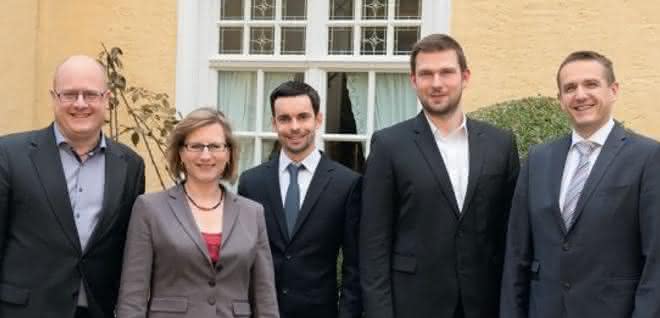
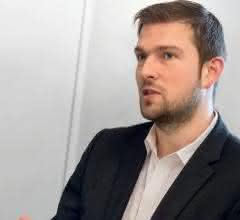
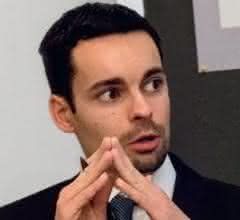
In the ambience of the legendary Stanglwirt, in Neufahrn just outside Munich, editor-in-chief Martin Schrüfer moderated an exciting panel discussion. The discussion partners Dr. Jakob Beer, Director Business Development Food Retail at SSI Schaefer, Markus Schmermund, Vice President Wamas Enterprise Solution at SSI Schaefer and Dipl.-Ing. Markus Spindler, research assistant at the Chair of Materials Handling, Material Flow and Logistics at the Technical University of Munich, had answers on the state of the art and the limits of what is currently feasible. In his introduction, Martin Schrüfer immediately steered the discussion towards e-commerce and wanted to know from the panel what significance the topic has for the requirements of intralogistics in the individual market segments. All eyes turn to Dr. Jakob Beer. He is familiar with logistics in the food retail sector from day-to-day practice. "E-commerce in food retail today is roughly where most other sectors were 10 to 15 years ago," says the food retail expert from SSI Schaefer, describing the industry. "Most established retailers with store networks often still see e-commerce as a threat. That's why they are reluctant to get involved in this area so as not to miss the boat." On the other hand, there are a lot of start-ups that see e-commerce as an opportunity. "The entire start-up sector must exploit the potential of e-commerce to avoid dying out. There will be consolidation and the difference between those that survive in the market and those that don't is largely the efficiency of intralogistics processes," believes Beer.
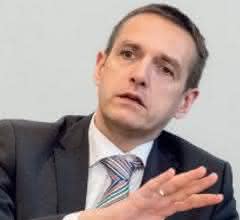
Clear words. Markus Schmermund sees it the same way: "What is influencing intralogistics there is first and foremost the shift from the producer to the consumer market. This is shaping logistics per se and, of course, intralogistics in terms of item variety, stock levels and batch size 1. The buzzword is customized automation. Solutions need to be designed in line with the customer's business model. Other buzzwords such as flexibility, scalability and modularity are becoming increasingly important. This brings enormous changes for traditional intralogistics companies, both in racking technology and in conveyor technology or software. To be attractive in terms of price, you have to think modularly. You can't assess every project from scratch."
Just ordered, already too small again
An important aspect for providers of logistics solutions is the overall project lead time, adds Beer. This must be significantly shorter with e-com than with conventional business models: "Otherwise, the new warehouse may already be too small by the time it goes live - if you look at the growth rates in the industry. On the other hand, it is not expedient to plan for a double-digit growth rate over several years in the warehouse dimensioning, as the project would otherwise exceed its financial limits. It is therefore important to design the solution modules in such a way that they can grow with the business without having to overturn established processes."
Susanne Frank asks. How can you convince a start-up company that initially wants to work manually that automation is important?
"We don't have to," says Beer, "because we don't necessarily have to automate at SSI Schaefer. We have the full range from shelving to high-tech solutions. When we talk to start-up companies, especially from the food sector, about automation, it's almost always about consolidating outgoing goods. The aim here is to find a solution that takes some of the pressure off the loading area. These are the elements where start-ups also realize that it would no longer be efficient to do this manually at a certain throughput volume."
Research is looking at AGVs
In view of the dynamics and ever shorter implementation times, is there any time left for research at all, the editor-in-chief wants to know from Markus Spindler. For the scientist, the separation between distribution logistics and production logistics is pretty clear due to e-commerce. "In terms of research, we are of course also looking at what can be done with more flexible systems, such as automated guided vehicles (AGVs). The requirements have changed due to batch size 1. All of a sudden, a lot of shipments have to be channeled through the stationary system because the customer wants their goods quickly."
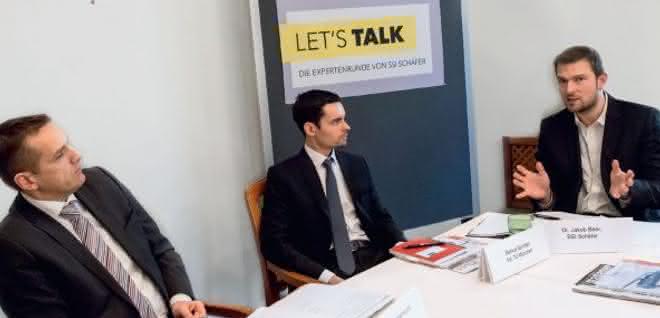
The challenge for intralogistics is that the solution offered grows with the customer's business model, i.e. the sustainable intralogistics solution offers interchangeable components for different levels of automation and warehouse complexity. According to Schmermund, SSI Schaefer has a broad portfolio of different technology modules, which can be put together in a modular way and then separated again, depending on the customer's business development. The solutions offered must focus on the key drivers of unit costs, throughput times and stock levels.
"Amazon is a typical example of how the interface between manual work and automation works," notes Beer. "Many processes are manual, but there is an efficient interface to full automation in the direction of outgoing goods, and that's exactly where you have to start for fast-growing companies." Markus Spindler agrees. "There are many approaches for more automation. A lot is technically possible today, for example in picking. However, cost-effectiveness is still a long way off, so people are still taking on tasks, especially picking individual parts."
Markus Schmermund is convinced that the use of robots in intralogistics with the need to increase productivity makes sense when human labor costs become unattractive or the dependency becomes too great.
Beer sees a fundamental problem with automatic handling in packaging design. "We need to make packaging automatically manageable," the food retail expert demands. If you had reasonably uniform packaging, you could already pick quickly and highly efficiently today. Sensor technology, image recognition and mechanics are continuing to develop, but this is often not yet fast enough. And even if it were fast enough, there wouldn't be a business case for it because the technology is simply still too expensive. You have to approach things from both sides.
Markus Spindler does not believe that anything will change in the packaging sector in the short term. We shouldn't expect too much, warns the graduate engineer.
What does process knowledge actually mean?
The editorial team steers the conversation towards best practices and questions the term process knowledge. Schmermund says: "As a globally active company, SSI Schaefer offers the opportunity to observe and analyze different markets and characteristics of company developments and to implement the requirements in solutions. In doing so, it is crucial to implement added value even closer to the customer. To do this, I need to know and understand the customer's business model, break it down to the logistics process and map the IT processes in direct connection. Process expertise, which we are continuously expanding with our industry-specific focus, is the lever for value creation. In the fashion sector, the focus is particularly on returns processing, as the high returns rate in this industry is painful for the customer. The success of an advanced intralogistics solution is determined by the quality and variability of our systems in terms of the degree of automation - the keyword here is custom automation - and the intelligent linking with our software solutions."
For Beer, it is important to understand how to link the various components and to design the processes in such a way that maximum throughput is achieved. When it comes to things like same day or same hour, the wheat is separated from the chaff.
Same Day / Same Hour - a challenge for logistics specialists or the limit of what is feasible? "Same Day / Same Hour is certainly a challenge that we as intralogistics providers are prepared to solve, but it is not the limit of what is feasible. This is just one of many customer expectations that e-commerce brings with it. E-commerce in all its forms, including omni-channel, is changing the conditions for our customers. 'Customer centricity' means small order quantities and higher order frequencies in order to satisfy the individual requirements of consumers. Due to the digital networking of the entire value chain, intralogistics IT must go far beyond the warehouse and integrate the procurement and distribution side right through to the consumer. Companies with an end-to-end supply chain react more quickly to consumer needs. Intralogistics' answer to the shift from established to customer- and technology-driven business models is a higher-level control instance for optimizing, controlling and monitoring all data and goods flows within the supply chain. This guarantees the customer process leadership."
... and the pace of delivery is getting faster and faster
Spindler is impressed by the pace of development. "Supermarkets have been around since the early 1900s. The internet and e-commerce have been around since 1990. That has developed slowly. The leap to same-day was relatively quick. Amazon promotes 2-hour delivery, free of charge. The question is, do customers use this in everyday life? In my experience, it is still very little used. It's usually not necessarily due to the cost." Spindler does not want to venture a prediction as to whether it will be widely used at some point.
"When we talk about same day and same hour, it requires an omni-channel concept," Jakob Beer points out. "You have to think across locations, because it's impossible to serve the customer within two hours from a warehouse 500 km away. After this step, it is no longer an intralogistics problem. It is then an interlogistics or supply chain problem, which we also have to think through in our planning," concludes Beer.


You might also be interested in
Standardized in design, flexible in use
Automated guided vehicles are increasingly in demand in production and logistics as they automate processes efficiently - but in addition to the vehicle, the right peripherals are also crucial for safe operation. A new solution consisting of a...
 read more...
Outdoor AGV networks production and logistics
An international company in the plastics industry is automating its intralogistics at its German site with a solution from ek robotics. A specially developed vehicle model from the Out Move series, an outdoor AGV, is being used.
read more...Transport systems for automated material flow
The Leo transporters from Bito make it easier for users to get started with the automation of material processes, which is possible from 20,000 euros. The system is a flexible all-in-one complete solution that is ready for immediate use and can be...
read more...Automated logistics for the university hospital
As part of the new construction of the University Hospital of Reims (CHU), France, the hospital has taken a number of steps to improve the needs of its patients and the working environment of its employees.
read more...K.Hartwall: Topping-out ceremony for the German site
The topping-out wreath was raised at the new building in the TIP Innovationspark Nordheide in Buchholz near Hamburg on February 27: The new K.Hartwall plant will comprise approx. 3,500 m² of hall space and around 2,000 m² of office and social areas.
read more...Noerpel Group tests driverless high lift trucks
The Noerpel Group has tested driverless pallet trucks in one of its two logistics facilities in Giengen. During a four-week trial, two autonomous systems were used to transport goods within the warehouse.
read more...Supply and disposal of printing machines by AGV
Numerous companies rely on AGVs in intralogistics to increase efficiency and meet challenges such as the shortage of skilled workers. One such company is GGP Media GmbH in Pößneck, Thuringia.
read more...Sophisticated automation: AGV and cobot combined
On behalf of Krefeld-based Saurer Technologies, the engineering team from Project Automation & Consulting developed a solution for production logistics that combines AGVs and cobots.
read more..."Herbie" robot in the Körber portfolio
Carrybots, a specialist in mobile robotics, is a new partner in the Körber supply chain ecosystem. The aim of this collaboration is to strengthen the position of both companies in intralogistics. Herbie" enables robot-based goods-to-person processes.
read more...