
Round Table - E-Grocery
A calculation with many variables
What does the future of online retail look like? Will e-grocery displace the branches of supermarket chains and what role will automation play in the future? These questions were the focus of a materialfluss round table at LogiMAT 2018 in Stuttgart.
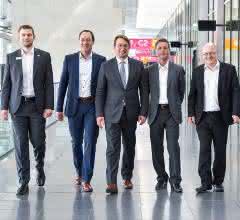
In the course of the discussion, it became clear that automation is also playing an increasingly important role in the processing of e-grocery orders. At the same time, virtual services will coexist with the individual shopping experience in local supermarkets. According to the experts, there will be no radical displacement process.
At the beginning, Martin Schrüfer wanted to know how online retail is developing in comparison to the traditional store business. For Issing, one thing is certain: "The store will not die." The requirements of e-grocery play an important role, which means a change from case picking to piece picking from an automation perspective. Issing differentiates: "Customers have been using the service of having heavy and large products delivered to their homes for a long time. However, offering the same service with groceries poses greater challenges for logistics - the small-scale e-grocery process can be seen as the supreme discipline of intralogistics." The challenge is to provide product groups of different classes and temperature ranges in precise sequences and in line with tours/orders. He sees the establishment of pick-up points or mini stores as an interesting variant in this respect. The customer orders by cell phone. "Order picking is semi-automated and the customer can pick up the goods at any time," he outlined. Provided there is a sufficiently dense network available.
"There will be a hybrid model"
Dr. Jakob Beer also believes that both offers will coexist. "There will be a hybrid model," he said. He sees stores as self-service warehouses, with customers moving around in a three-dimensional space and picking the goods themselves. According to Beer, one of the main cost drivers is the last mile. The supplier manages three to five stops per hour. However, each stop costs a double-digit euro amount. "With the notoriously low margins in food retail, the contribution margin of the individual customer order has already been eaten up in the worst case," he says. Whereas in the past, distribution was often seen as separate from intralogistics, the two are closely interlinked in e-grocery. With good processes and the right technology in the warehouse, the costs of the last mile can be significantly influenced, he explains. Volatility also plays a role.
Johannes Fottner also does not believe that online retailing will lead to the imminent demise of the store. "The two variants will not replace each other. They are converging and will probably go hand in hand," he said. After all, shopping is an experience and therefore an added value. Customers are looking for variety, which cannot be provided efficiently online. In the past, online retailers have provided additional services at no extra cost in order to differentiate themselves from the competition. He cited the free returns service as an example. However, it was questionable whether this could be maintained in the long term for cost reasons. "However, we would have to fight hard to get away from this service."
Replacing strenuous work with robots
Editor-in-chief Martin Schrüfer then wanted to know where technology can be used to generate efficiency benefits. From Elmar Issing's point of view, the highly stressful and unergonomic case picking for store delivery can now be almost completely automated. In contrast, there are now manual, highly developed and cost-efficient picking solutions for piece picking. However, the performance capabilities of humans, their cognitive abilities and skills are still unrivaled by the use of robotic solutions. Vision systems, gripper technologies and sensor technology paired with artificial intelligence are developing rapidly and are gradually enabling economical and increasingly flexible system solutions.
Jakob Beer explains that packaging plays an important role in automated piece picking - as it does in other warehouse and distribution processes. "These are designed according to marketing aspects and not logistical aspects, and they often change," he described. Anyone who wants to operate successful automatic piece picking has to deal with this topic intensively.
Where does automation make sense?
"Where can people be optimally supported in their work, where does automation make sense?" are key questions in Johannes Fottner's opinion. Automation for its own sake makes no sense. "There always has to be a specific goal." Highly automated production facilities are already a reality. However, this cannot simply be transferred to warehouse technology. "We have to take a very close look at the infrastructure and optimization variables such as sequences or package properties," demanded Fottner. He also sees the design of the products as a particular problem for logistics. "Manufacturers often change the packaging. This presents us with the challenge of an already taught robot encountering a changed reality." In order to clarify this issue, a calculation with many variables must be solved.
The participants largely agreed that automation can improve ergonomics in the workplace, but cannot replace it. Johannes Fottner also made the same point. Working with your hands is a complex matter. "We need five to ten years to artificially create this complexity. What people do with their hands is simply unbelievable."
Software must be consistent
In order to implement efficient automation in the warehouse with its constantly changing conditions, flexible software is a prerequisite. When asked about the WAMAS system from SSI Schaefer, Jakob Beer said: "With our modular solution, we have already moved beyond the warehouse. Now, for example, we are also entering the transportation processes at the customer's premises." This will make SSI Schaefer a larger part of the supply network. However, this is not the end of the story. Elmar Issing also recognizes the need to be deeply integrated into the customer's route management. "It has to be an end-to-end system in order to achieve the greatest possible efficiency." Johannes Fottner sees people as an integral part of an increasingly digital world. It's all about using fully automated robots sensibly. However, dialog is also important. Industry 4.0 means the elimination of hierarchies. "We are moving to a coordinative level and need to create a communication principle that is understandable," he argued. In order to enable meaningful cooperation, it must be clear who has which responsibilities in a system. However, there are still problems to be solved. His example: "A PLC works in the warehouse just like industrial trucks - but the two are not networked." More and more heterogeneous systems will be used within the company in the future. "However, these must be able to communicate with each other."
Klaus Hiemer


You might also be interested in
Dematic and Hai Robotics launch partnership for flexible AMR solutions
Dematic and Hai Robotics have recently agreed a Europe-wide partnership to work together as integration partners in the field of warehouse automation. Through this cooperation, the provider of automation solutions for supply chains and the...
 read more...
The market for service robots
A recent report from IDTechEx analyzes the global market for service robots and examines key applications for delivery and logistics robots, cleaning and disinfection robots, social robots and more.
read more...Application phase for Innovation Award 2026 begins
How can robotics help to make packaging more sustainable? Kuka is looking for creative and innovative ideas in the new round of the Innovation Award.
read more...Exoskeleton with AI power
Robotics company German Bionic presents its most advanced exoskeleton model to date, called 'Exia', which is fully controlled by augmented AI.
read more...Strategic partnership for the promotion of AI
Jungheinrich and Merantix have announced a strategic partnership. The aim of the cooperation is to promote applications based on artificial intelligence (AI) in the industry.
read more...New robotics organization founded
Omron has announced the establishment of a global robotics organization effective April 1, 2025. It will operate in parallel with Omron's automation business so that both areas can complement and support each other.
read more...No-code tool for programming robot user interfaces
ABB provides 'AppStudio', a software tool that allows users of all skill levels to quickly and easily create customized, graphical user interfaces for robots.
read more...SLAM navigation in real time
'Freestyle Localize', 'Trailer Find' and 'Scanner Switch' are three new features of Sigmatek's real-time location software forcontour-based navigation 'SlamLoc'.
read more...Robotic solution: Aiming high under your own steam
The Skypod system is now used in more than 100 order picking warehouses worldwide by companies in all kinds of industries. The autonomous Skypod robots are able to overcome height differences of up to 12 meters.
read more...